The Trees Bear Witness: Wildfire and Restoration in California
As wildfires threaten her community, Louise Ko Huang considers how faith calls her to care for creation and seek renewal in the face of devastation.
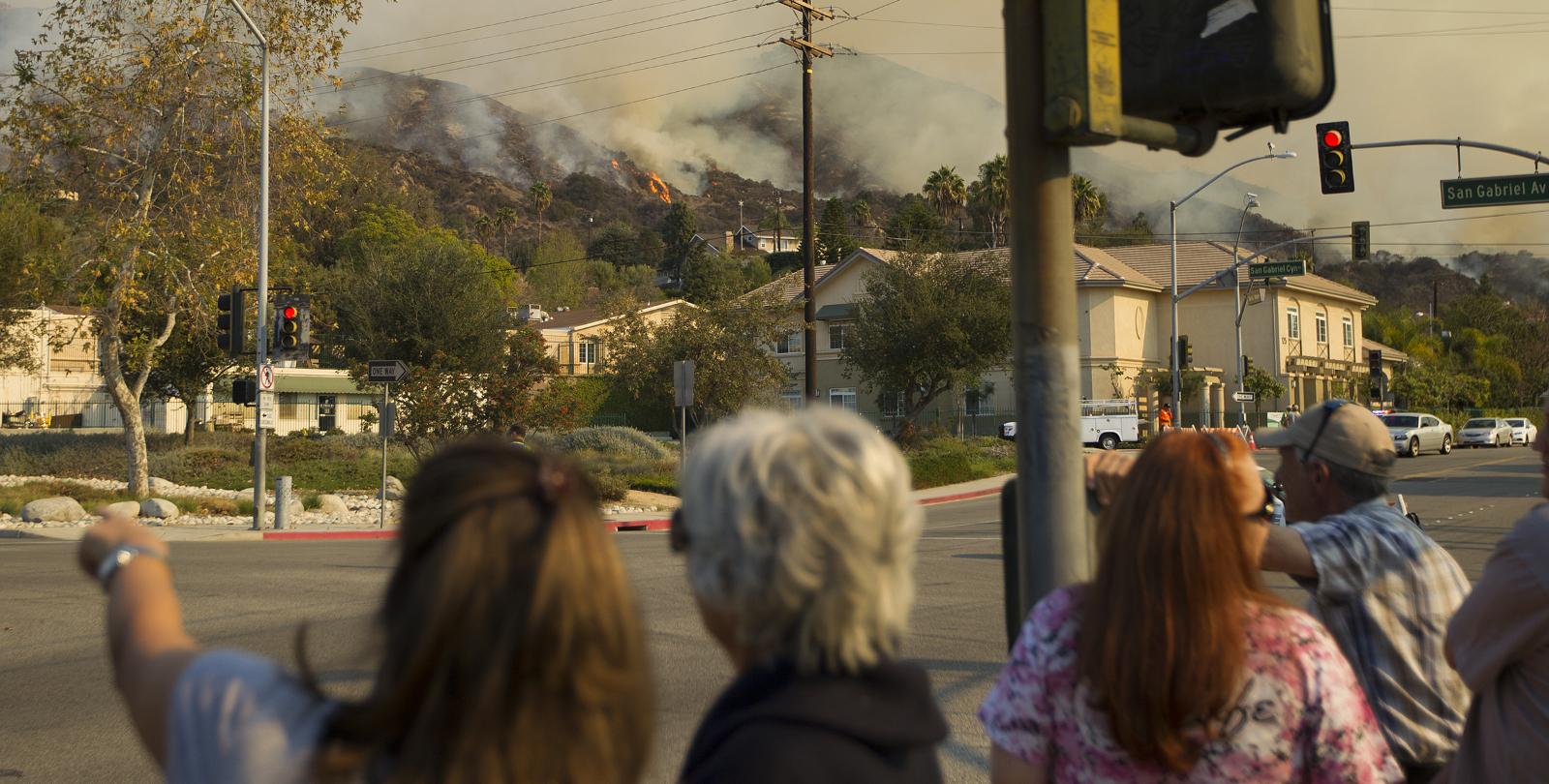
Residents watch the Colby Fire burn above Azusa, California, January 2014. Image: Scott L from Los Angeles, United States of America, CC BY-SA 2.0, via Wikimedia Commons.
It was a few minutes past 6 p.m., and I stood alone in a chemistry lab.
Class had just finished. With the last of my students having trickled out, I started the usual process of cleaning up. I busied myself with the work of putting away chemicals, washing beakers, and wiping down the lab benches.
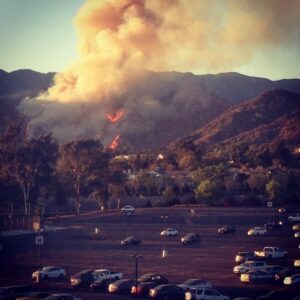
The Madre Fire burns near Azusa Pacific University. Photo by Louise Ko Huang.
But then I looked up. Through the window opposite me, I saw fire and smoke blazing in the distance. In stunned silence, I took out my phone and snapped a photo.
It was the evening of September 23, 2013. My photograph captured the Madre Fire, which ultimately burned 268 acres in the foothills of Azusa, California.
This particular wildfire, though relatively small, sparked a significant reaction in the Azusa Pacific University community. It was the first time one had spread so close to our science center.
Unfortunately, it wouldn’t be the last.
Wounded Creation in My Community
The Colby Fire Hits Home
We cover a chapter on air quality in my Citizenship Chemistry course. One day, my class received a real-life lesson on this topic.
It happened during a session in January 2014, just four months after the Madre Fire. I stood at the front of the lab, with all my students facing me. At some point, I glanced out the windows behind them and saw a small but growing patch of amber.
Over the course of our three-hour lab, I watched as that tiny pop of orange spread from the far-right corner of the window to the far-left. I was witnessing the Colby Fire, which burned over 1,900 acres in the foothills around Glendora.
This blaze reminded me of the myriad ways that wildfires impact our communities. During that same lab, I received a phone call from my kids’ elementary school. They had been forced to evacuate due to the fast-growing fire.
It scorched the greenery, leaving the mountains strikingly bare. Among the areas damaged were some of our community’s favorite hiking trails, including the Colby Trail, the Garcia Trail, and Glendora Mountain Road.
Friends of mine who are runners and cyclists felt this loss deeply. The trees consumed by the Colby Fire had not been mere adornment. They were an integral part of the biome, as well as an important—and beloved—feature of our neighborhood.
California Wildfires in a Changing Climate
Officials investigated the cause of the Colby Fire in the days that followed.
While the factors were complex—as they often are for wildfires—an extended drought in Southern California had created extremely dry conditions. Combined with strong Santa Ana winds, something as simple as a campfire flame started a blaze that relentlessly consumed trees and vegetation.
It’s been more than a decade since the Colby Fire. In that time, climate change has intensified drought in California. The result has been larger and more devastating wildfires throughout the state that have burned towns, harmed wildlife, and taken human lives.
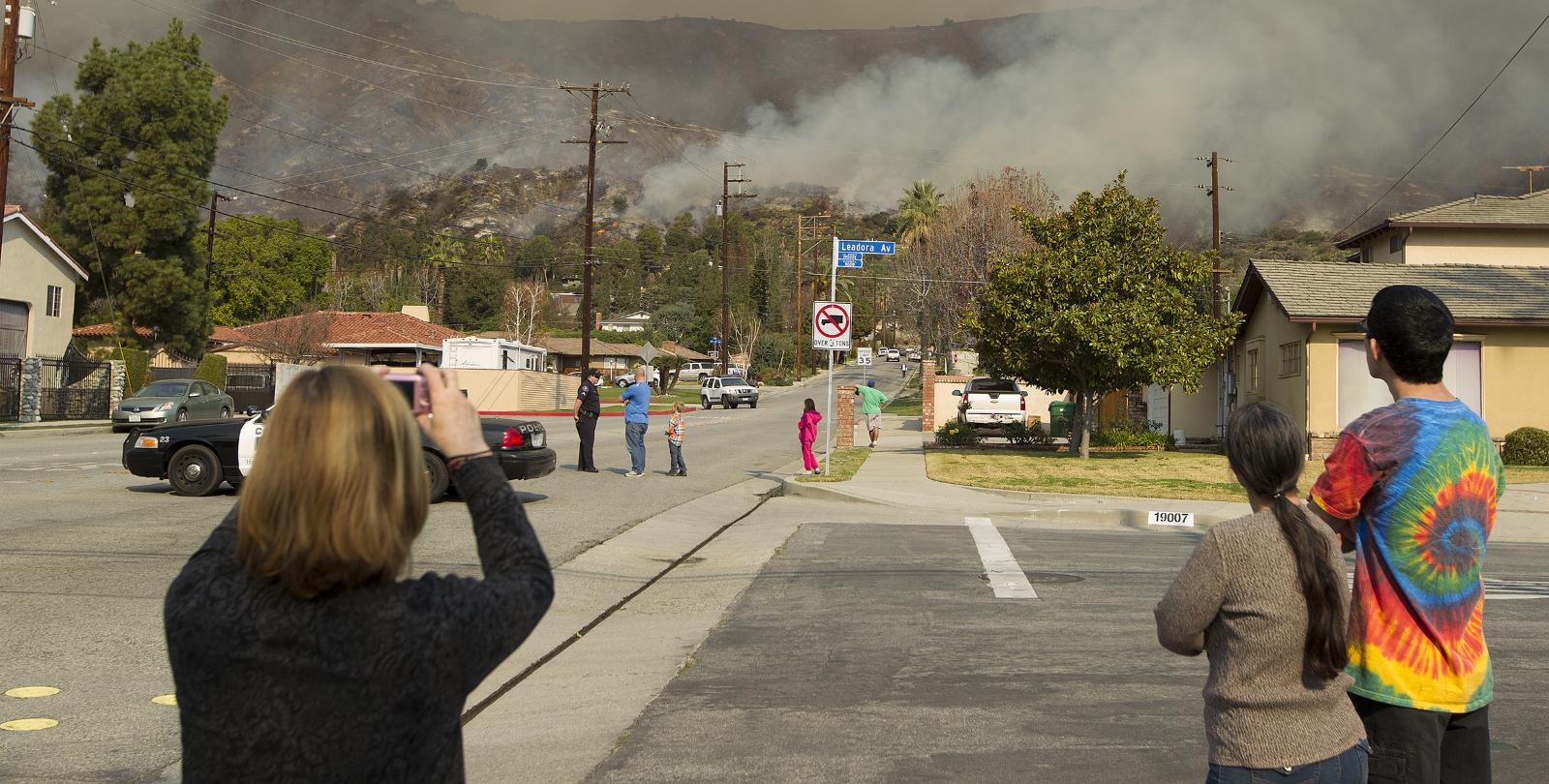
Residents watch as the Colby Fire blazes in the San Gabriel Mountains. Scott L from Los Angeles, United States of America, CC BY-SA 2.0, via Wikimedia Commons
Creation, Calling, and Our Broken Harmony
The severity of such destruction calls for a deeper reflection on our relationship with God’s creation—specifically, our role in its stewardship.
As Christians, we’re called to love God, our neighbors, and the vulnerable. The harm caused by wildfires impacts our ability to fulfill all three of these callings.
Fortunately, Scripture can help us understand both the lack of harmony we see and our calling within creation.
Our Calling: To Safekeep Creation
The creation narrative of Genesis 1 tells us that dry land and vegetation were created on the third day, birds and sea creatures on the fifth day, and land animals (including humans) on the sixth day.
We were created on the same day as other land animals, but we were made in the image of God and with the responsibility to rule over—or to safekeep—the garden and all the other creatures.
We were made with eternal significance: an intimate relationship with the Creator and an indisputable relationship with creation. To a certain extent, humans and the garden are created for each other.1
Creation is Good
Throughout the first chapter of Genesis, God repeatedly saw what he created was “good” (Genesis 1:10, 1:12, 1:18, 1:21, 1:25, 1:31).
Here, “good” can be understood as referring to life-enhancing, life-sustaining processes. Therefore, when we depart from or harm what God has declared as good, we take actions that are neither life-sustaining nor life-enhancing.
A Breach in God’s Harmony
In Genesis 2, God gave further instructions to the man in Eden, whom he “formed of dust from the ground” (Genesis 2:7). The man was to refrain from eating from the tree of knowledge of good and evil (Genesis 2:17).
There is divine peace, or shalom, as the fullness of God is manifested through the harmony between man, woman, creation, and God.
But this harmony was disrupted in Genesis 3. The man and his wife encountered temptation by the serpent in Eden and were enticed to eat the prohibited fruit.
This introduction of sin and the fall of mankind led to their banishment from Eden. It created a breach in God’s harmony,2 disrupting the peaceful relationship between humans and God, as well as between humans and nature.

Conversations for Creation
Christians across the country are pledging to talk about caring for God’s creation with someone in their lives. Together, we’re starting 5,000 Conversations for Creation.
Broken Harmony in California
The world we occupy today is far from the shalom, the divine peace and harmony, that symbolizes the fullness of life and points to the glory of God. Here in California, we see this loss of harmony in nature, animals, and ourselves.
Droughts are a natural part of California’s climate. However, climate change is making these conditions more volatile. One study shows the drought that hit California between 2012 and 2014 was the worst in at least 1,200 years.
Increased drought—and the wildfires that come with it—are transforming California’s landscape. A recent analysis estimates that between 1991 and 2023, California lost between 6% and 11% of its conifer forests.
These changes further upset the relationship between humans and the rest of creation. One study conducted by UCLA found that during drought years, reports of property damage and “nuisance” encounters with wild animals increase. As water sources dry up and wildfires destroy their habitats, these animals—bobcats, black bears, and coyotes, among others—may increasingly venture into areas occupied by humans.
At the same time, humans are feeling the impacts of climate change directly. Consider the 2025 Southern California wildfires. These fires, of which climate change was a factor, put close to 200,000 people under orders to evacuate their homes.
These trends are not limited to California. Around the world, temperatures are rising, forests are shrinking, and people are being displaced.
Finding Hope and Restoration
Christians have reason for hope amid this broken harmony. Our faith leads us to look for signs of restoration, even as we acknowledge our own brokenness.
These signs can (and often do) appear close to home. Sometimes, they show up in the same places where we have previously seen loss.
The Return of the Trees
2026 marked a dozen years since the Colby Fire. Now, when I look up to the foothills, I’m overjoyed to see trees and shrubs begin to cover the mountains once again.
It took nearly a decade for this area to regrow. So much has transpired in that time: a worldwide pandemic, global conflicts, and the rise of artificial intelligence. The return of the trees quietly bears witness to these changing times.
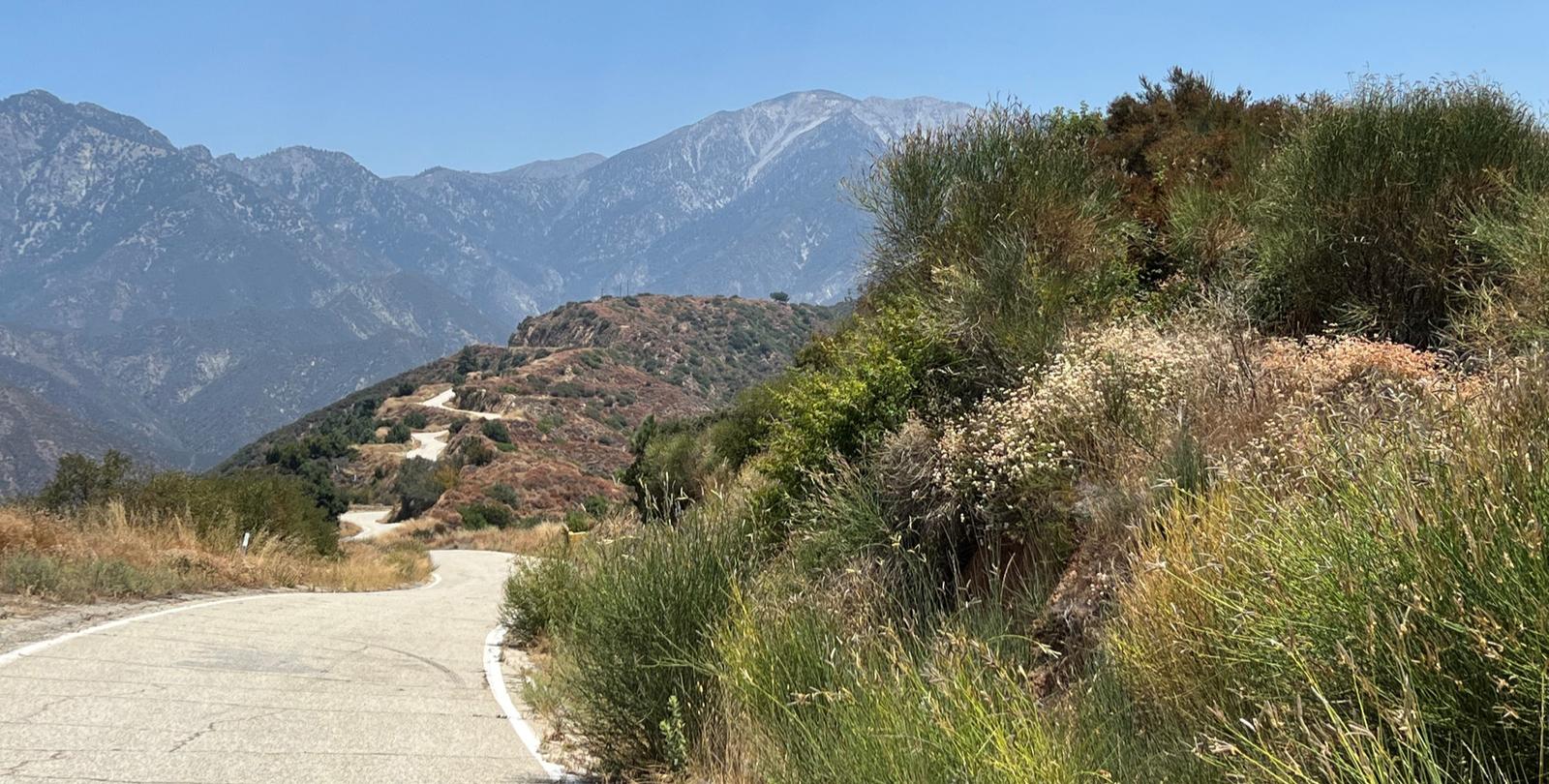
Glendora Ridge Road, as photographed in 2024 by the US Forest Service. Photo: Region 5 Photography, Public domain, via Wikimedia Commons.
In their full growth, the trees are stately, unpolluted, and reassuring, fostering a refreshing sense of wholesomeness and peace. They bring to mind Treebeard, a mythical character in J.R.R. Tolkien’s literary classic, The Lord of the Rings.
Treebeard is the oldest of the Ents, the shepherds of the forest. He is not merely a tree-like being, but a personification of the primordial natural world. He stands for deep, unhurried time and the preservation of history.
In a novel where cultures are rapidly changing, Treebeard is a bridge back to the First Age. When he talks, he speaks in an ancient language that cannot be rushed. Treebeard symbolizes an antidote to the rapidity of modern life.
Moreover, Treebeard initially views conflicts of the age through the longer history of the forest. When asked by one of the hobbits whose side he was on, he replied: “I am not altogether on anybody’s side, because nobody is altogether on my side.”3
Here, Treebeard personifies earthkeeping, shepherding the forest amid the rise and fall of empires.
Today, as we face the rise and fall of political powers, devastating calamities, and the inevitable cycles of life and death, I find great comfort in seeing trees return to the foothills. Though increasingly harmful wildfires have occurred since the Colby Fire, rebirth finds its way amid destruction, bringing forth restoration out of devastation.
The Trees Bear Witness
In Oppression and Liberty, Simone Weil writes about how flowers and other plants defy gravity as they grow toward the Sun’s nurturing rays.4 Perhaps when circumstances pull us down, simply looking up to receive God’s love can help us defy challenges and lead to growth.
When we glance to the foothills and spot trees and shrubs growing where wildfire once spread, we can see a bit of God’s creation defying destruction.
Trees are a good reminder of hope and peace in times of chaos. Their slow, defiant growth points to God’s prevailing goodness and shalom. No wonder the psalmist wrote: “I lift up my eyes to the mountains—where does my help come from? My help comes from the Lord, the Maker of heaven and earth. He will not let your foot slip—he who watches over you will not slumber; indeed, he who watches over Israel will neither slumber nor sleep” (Psalm 121:1-4).
We have a responsibility to care for creation, and to do so with the hope of the Gospel in mind. But when climate change-fueled disasters strike—whether it be a wildfire, a flood, or a drought—it can be hard to keep from despairing.
When these feelings crop up, I am grateful that I can simply look to the mountains and see the trees bear witness to how God cares for and loves his creation. Perhaps this is God’s way of reconciling us with what ought to be.
About the author

Louise Ko Huang
Related resources
If you enjoyed this article, we recommend you check out the following resources: