Restoration Runs Deep Along Grand Rapids’ Plaster Creek
Dave Warners and his watershed neighbors have worked to restore Plaster Creek for two decades. Along the way, they’ve rebuilt relationships with creation and each other.

PCS staff member Haley Kornoelje gives a tour of Grace Episcopal Church’s new bioswale, which processes runoff from the parking lot using native plants. Photo provided by the author.
My family moved to Grand Rapids in 1997. Not long after, I noticed a stream that passed under Eastern Avenue, only about a half mile from our house. The next time I was out with my kids, we went down to the path beside it and stopped at several spots to look at the water.
What we saw was heartbreaking.
Flotillas of garbage, a shopping cart, and several old tires littered the stream. The water looked like chocolate milk and the banks were severely eroded. The ugly name of the stream, Plaster Creek, seemed to fit it well. I told the kids that this would not be a good creek to play in.
I soon discovered that like my home, Calvin University—the school at which I teach—is located within the Plaster Creek Watershed. That means the water running off our rooftops, lawns, and parking lots eventually makes its way into Plaster Creek.

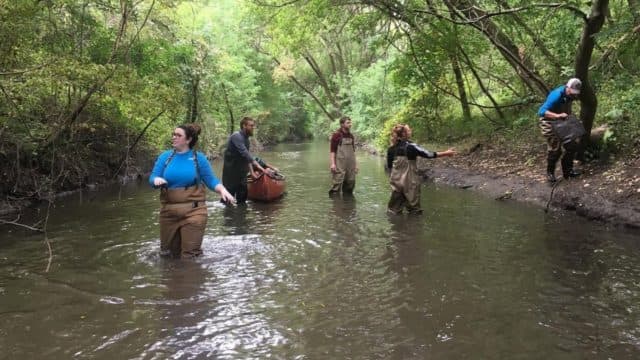
A degraded section of Plaster Creek where students are collecting water samples. Photo provided by the author.
What Drew Me Into This Restoration Story
As a biologist at Calvin, I talk a lot about the importance of Christian environmental stewardship. The realization that my home and campus were contributing to the degradation of this local creek therefore made me very uncomfortable.
Philosophers refer to these moments as “cognitive dissonance”—when we come face to face with the fact that what we believe does not align with how we are living.
This discomfort led to the formation of Plaster Creek Stewards (PCS), a faith-based initiative focused on restoring the Plaster Creek Watershed.

PCS staff members Mary Helen Prince and Haley Kornoelje lead a green team cohort on a field trip along Plaster Creek. Photo provided by the author.
What Plaster Creek Taught Us About Restoration
Starting with the Past
To know how best to proceed, we needed to learn how Plaster Creek had become so contaminated in the first place.
During those early years, we found out that Plaster Creek was considered the most contaminated waterway in West Michigan. It not only carried large volumes of sediment and garbage, but also dangerously high levels of E. coli that spiked after every rainfall.
Simply by touching the water, children had an increased risk of contracting infections. I had been right to warn my kids not to play there.
We also discovered that the creek’s original Ottawa name was Ken-O-Sha, which means “water of the walleye.” This fish would swim from Lake Michigan into the Grand River and then up this creek to spawn.
But according to historical records, no walleye have been seen in the creek since the 1840s, after the first gypsum mine was set up along the banks of Ken-O-Sha. The gypsum was ground into powder and mixed with water to make plaster, an operation that rendered the stream unlivable for walleye. This marked the start of a long legacy of contamination and neglect.
Bridging Community Differences
PCS was officially founded in 2009 after a representative from Michigan’s Department of Natural Resources asked Calvin faculty to help her connect with local farmers who were allowing their cows to wade through the creeks and along their banks—a likely source of the E. coli contamination.
Her efforts to connect with the farmers stalled. But before they did, she realized something. When she visited their homes, she noticed that their walls were adorned with Bible verses and crosses.
Since Calvin is a Christian university, she thought we might have a better chance of convincing the farmers to be more careful with the creek than she did.
Focusing on Our Relationship with Creation
Our original goal was to restore Plaster Creek so children could once again play in it. However, we soon realized that to truly heal the creek, we needed to take a more holistic approach.
The polluted creek was a symptom, not the actual problem. The true issue was that people in the watershed were not living in proper relationship with the creation. Unless everyone in the watershed changed the way they had been living, PCS’s efforts to restore the creek to health would be in vain.
With that in mind, we shifted our focus from restoring the creek to restoring the relationship between people and the creek. We moved from restoration ecology to reconciliation ecology.
Becoming Communities of Creation
Becoming Communities of Creation is a one-stop guide for ministry and lay leaders looking to bring their community together in the act of caring for creation.
What Reconciliation Ecology Looks Like
Pursuing Reconciliation Through Ecology
Reconciliation ecology calls for re-envisioning the human presence to better fit into God’s broader landscape of biodiversity.
Dr. Michael Rosenzweig introduced the concept in his 2003 book, Win-Win Ecology. In it, he advocates for us to change the way we live so other species can return to human-dominated spaces.
In the Plaster Creek Watershed, reconciliation ecology means creating rain gardens and bioswales to help absorb and filter stormwater so the creek’s flow is steadier and less erosive. It means planting trees that support stream banks and absorb carbon. It means re-creating floodplains that act as sponges.
By doing all these things, we can draw back bees and butterflies and the creek’s original namesake, the walleye—all of which used to be important members of this watershed community.
Another important aspect of restoring Plaster Creek is reconciling relationships among its human residents. The workdays we host connect upstream and downstream schools, churches, residents, and businesses to the hopeful act of doing restoration together. These events are powerful, tangible expressions that despite our differences, we are all members of this one watershed and therefore we all share the responsibility to care for it.

Plaster Creek Stewards Summer Research Crew standing in a newly installed urban curb-cut rain garden. Photo provided by the author.
Becoming Agents of Restoration
The story of Plaster Creek serves as a metaphor for broader, global challenges like climate change.
Climate change itself is not the problem; the way we have been living on the planet is. We certainly need to restore Earth’s atmosphere to healthier levels of carbon dioxide. But even if we could do so right now, global climate change would happen all over again if people’s relationship with the Earth doesn’t change.
We need new, more Earth-affirming ways of doing agriculture, economics, transportation, urban planning, and architecture. We need to learn to love our global neighbors and find ways to better fit into God’s good creation of diversity, beauty, and sustainability.
Reconciliation is hard yet hopeful work. Creation has an incredible tendency to recuperate from the harms we have inflicted, and we can help facilitate this recovery process.
The Call to Active Faith
To date, Plaster Creek Stewards has installed over 250 native plantings, including rain gardens, bioswales, and floodplains, and we now have 14 native gardens on Calvin’s campus.
These projects have diminished the stormwater that reaches the creek and have become oases for native species to return to the Plaster Creek Watershed community.
We’re seeing measurable progress. In the fall of 2024, students analyzed the creek’s health by sampling stream macroinvertebrates. They were surprised to find that Plaster Creek’s scores were not significantly different from a healthy stream they used for comparison.
When they compared their data to sampling that had been done from the same location in the fall of 2011, their scores were significantly healthier. This was the first quantifiable indication that Plaster Creek’s water quality is improving.
Furthermore, freshwater mussel and sucker surveys conducted in the past two years show that threatened species have been found in Plaster Creek. Otters have been seen in a downstream urban park. And this past spring, a family of beavers moved into the upper region of the watershed.

Dutton Shadyside Park, a spot along Plaster Creek, after the Plaster Creek Stewards completed a floodplain restoration project. Photo provided by the author.
Plaster Creek still receives too much contaminated stormwater when it rains. But after nearly 20 years of work, we are seeing tangible signs that good things are happening.
Not only is the relationship between humans and the land improving, but people of all ages, faith backgrounds, and cultures are working together to heal relationships. Diversity and beauty are returning to this place.
Human beings aren’t just destroyers. We can be reconcilers too.
Editor’s Note: The troubling and hopeful story of Plaster Creek is explored further in a book, Reconciliation in a Michigan Watershed. You can learn more about the Plaster Creek Stewards here.
About the author

David Paul Warners
Related resources
If you enjoyed this article, we recommend you check out the following resources:

Downloads

Common Question