At 100, Malcolm Jeeves Reflects on Faith and Science
As the noted psychologist and author today celebrates his 100th birthday, he shares insights from a lifetime at the intersection of faith and science.
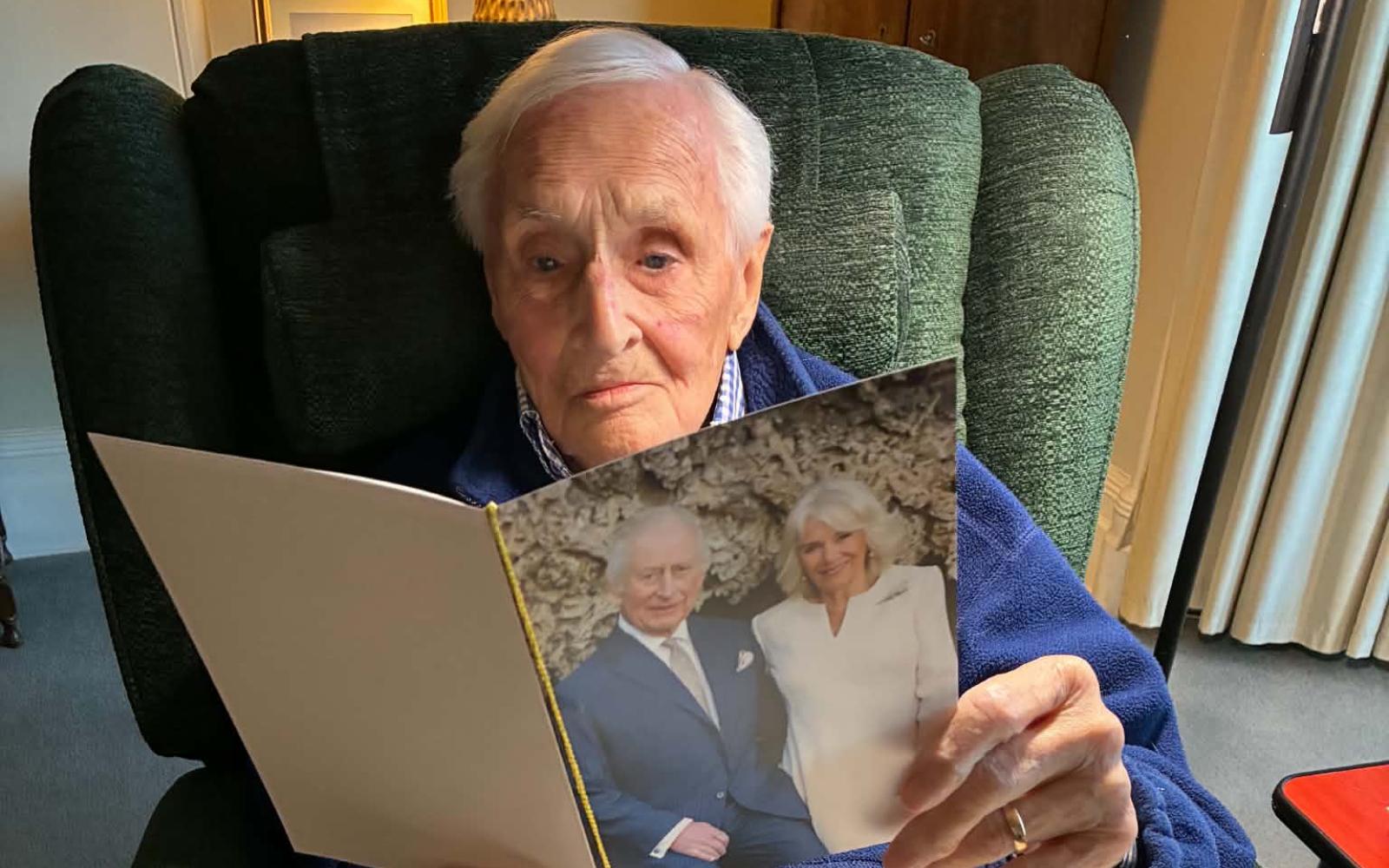
Malcolm Jeeves reads his 100th birthday greeting from King Charles III. Photo by Sarah Quine.
To appreciate how much Malcolm Jeeves has seen, consider the world of faith and science at the time of his birth.
The Scopes trial had concluded one year earlier with a Tennessee high school teacher convicted of teaching human evolution. In April 1927, theoretical physicist and Catholic priest Georges Lemaître proposed an expanding universe. (Four years later, Lemaître would expand his work into an early version of the Big Bang theory.)
Between these two events, on November 16, 1926, Malcolm was born. Today, he celebrates his 100th birthday.
As a Christian and a psychologist, Malcolm has spent a lifetime at the intersection of faith and science. Rarely do we have the chance to learn from someone who has experienced so much. We’ve asked him to share his perspective; what follows is a reflection on changes seen and lessons learned through the course of a remarkable life.
A Life in Faith and Science
Growing Up: Faith and Science in Harmony
Malcolm grew up in the medieval town of Stamford, one hundred miles north of London.
His family attended a local Anglican church there. Malcolm recalls no hint of a conflict between faith and science from the pulpit, perhaps because the main preacher held degrees in both theology and science.
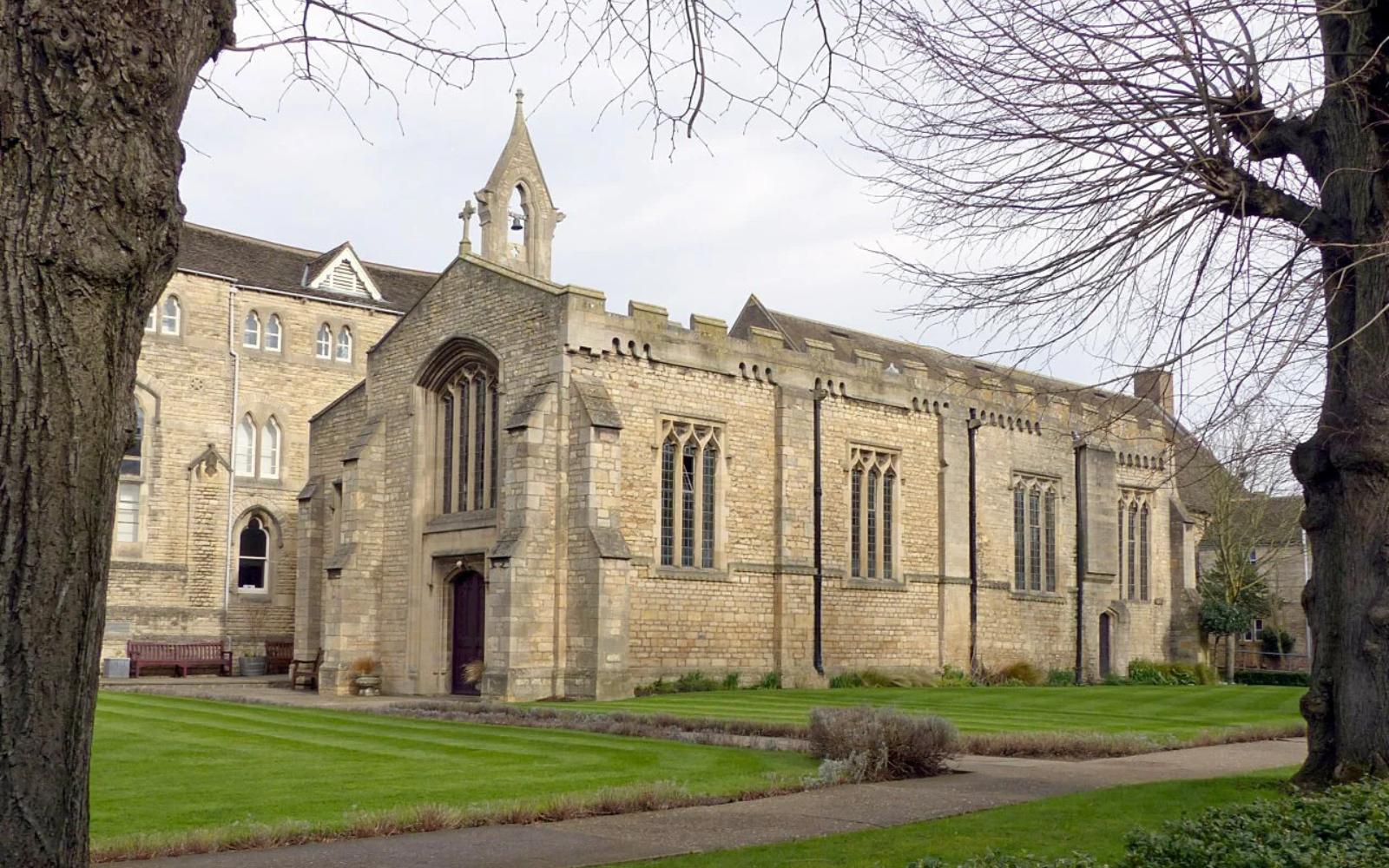
The chapel at Stamford School. Malcolm was educated at this school as a boy. Photo: Alan Murray-Rust, CC BY-SA 2.0, via Wikimedia Commons
Malcolm entered Cambridge University following service in the 1st Battalion of the Sherwood Foresters. Once there, he met a group of British academics within the InterVarsity Fellowship who had formed the Research Scientists’ Christian Fellowship (RSCF).
Led by Oliver Barclay, the RSCF worked with biblical scholars to formulate a coherent message that brought together the Gospel and growing scientific knowledge about God’s creation. Malcolm soon joined this organization, as did physicist Donald MacKay and historian of science Reijer Hooykaas.
A Different Climate: Harvard, 1953-1954
Malcolm had yet to experience real tension between faith and science. That changed in 1953, when he moved to the United States for his fellowship year at Harvard University.

Postcard of Harvard Square as it appeared during Malcolm’s time at the university. Image: Public domain, via Wikimedia Commons
During his time at Cambridge, 350 people had belonged to the Christian Union. When he arrived at Harvard, he was stunned to learn that the equivalent organization boasted just 10 members. He found the situation to be similar at other Ivy League universities.
Confronting Conflict: The 1965 Oxford Conference
A decade later, Malcolm became involved in organizing the 1965 Oxford Conference on Science and Faith. This summit revealed to him just how differently Christians on each side of the Atlantic thought about the relationship between faith and science.
He was shocked to learn that American institutions had forced scholars to sign statements disavowing evolution. For British participants, these accounts laid bare the dangers of getting bogged down in controversies about evolution.
A Career of Dialogue and Discovery
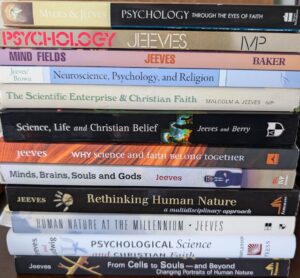
A stack of books written by Malcolm Jeeves. Courtesy of authors.
In 1969, Malcolm returned to Britain as founding chair of the Department of Psychology at Scotland’s University of St Andrews, where he later served as Vice-Principal. His 17 books and more than 150 journal articles testify to his role as one of the world’s experts on how the brain’s two hemispheres process information.
He became a leader in British science, serving as editor in chief of the journal Neuropsychologia, president of the Royal Society of Edinburgh, and member of the UK’s Science and Engineering Research Council. For his service to British science and psychology, he was made Commander of the Order of the British Empire in 1992.
Malcolm continued to influence the dialogue between faith and science. Throughout his career, he mentored a number of young Christian scholars in his neuropsychology laboratory. Even after his retirement, he maintained an influential role in the RSCF, which had now changed its name to Christians in Science (CiS).
He also maintained an active program of research and writing, including Why Science and Faith Belong Together (Cascade Books, 2021).
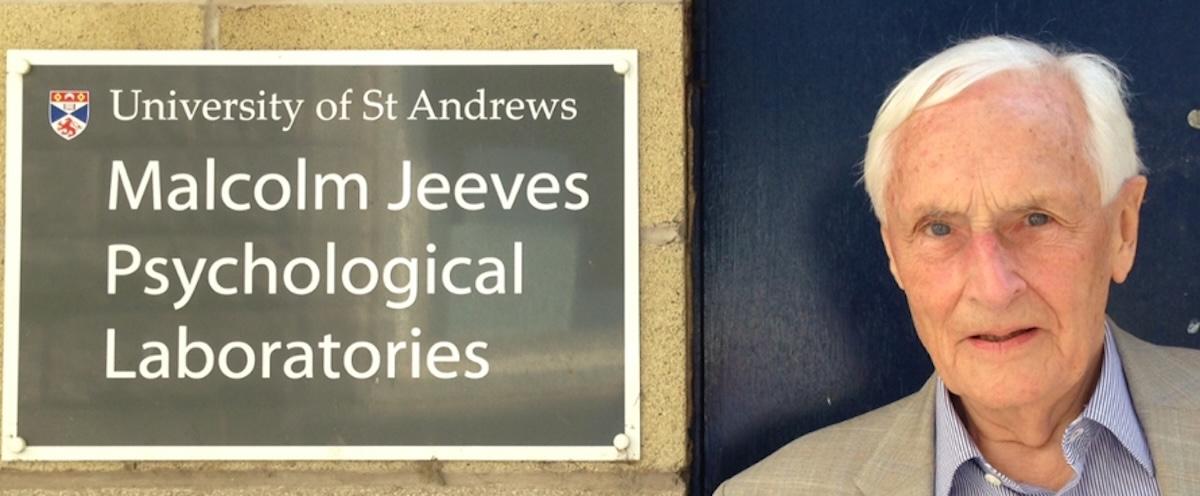
Malcolm Jeeves stands in front of the laboratory named after him. Photo courtesy of the authors.
A Century of Change and Lessons Learned
Faith and Science in a Secularized World
Some of the changes Malcolm has noticed in the dialogue between faith and science are the result of broader shifts in society.
In particular, increasing secularization in both the United States and the United Kingdom has decreased interest in religious issues among the public. This trend, of course, impacts the relationship between faith and science.
Compared to Malcolm’s early career, there seems to be a greater tendency among Christians in science to “compartmentalize” the different aspects of their lives—to say that “science belongs at work, while faith is relegated to one’s personal life.”
From Origins to Artificial Intelligence
Malcolm also notes that some previously volatile controversies seem less important today.
For example, many (though not all) Christians no longer view questions about the age of the Earth and human evolution as being a threat to their faith. “The focus of the discussions seems to have shifted somewhat from issues around evolution to the nature of the human person and the relationship of minds, brains, and souls,” Malcolm says.
Advances in artificial intelligence have accelerated this change. Malcolm observes that Christians today are becoming increasingly aware of both AI’s power and the challenges it poses, including to our understanding of human uniqueness and what it means to be “made in the image of God.”
That’s one reason why, as he turns 100, he has co-authored Brains, Minds, Selves, and Robots: Exploring Consciousness, AI, and the Human Future, a forthcoming book exploring perspectives from neuroscience and AI on the fundamental questions of human nature.
AI & Human Flourishing
What does the rise of artificial intelligence mean for human life? We explore how AI works, how it is changing us, and how we might learn to live with it.
Open Minds and Gracious Dialogue
When asked about lessons learned, Malcolm pointed to the enduring need for open and critical thinking on the part of Christians in science. In particular, we must avoid tying our defense of Christian faith too tightly to any specific scientific or philosophical perspective, “lest our theology become obsolete when the scientific model changes.”
Even at his advanced age, Malcolm is a model of openness to new ideas, urging us to “never foreclose on ideas when at present the evidence is insufficient.” He’s fond of quoting Donald MacKay: “When short of data, keep the mind open and the mouth closed.”
Most of all, he warns Christians not to abandon the dialogue between faith and science. He points to the success of organizations promoting continued engagement with non-Christian scientists and the public, including BioLogos.
Looking Ahead With Hope
As we concluded our conversation, we asked Malcolm about his future. With fewer days ahead than behind, we wondered whether his own understanding of the unity of mind, spirit, and body gives him comfort and hope.
Drawing on the Easter hope of a resurrection rather than a death-defying natural immortality, he maintains, “my remaining days, months, or even years are entirely in the hands of my Creator, Redeemer, and moment-by-moment Sustainer.”
Acknowledgments: This article includes material from an unpublished interview Warren Brown conducted with Malcolm Jeeves in 2023, and from M. A. Jeeves and R. J. Berry, “Christians in Science: Looking Back—and Forward,” Science and Christian Belief, 27: 125–52, 2015.
About the authors
David G. Myers
Thomas E. Ludwig
Related Resources

Language of God
AI & Human Flourishing | The Human



Language of God
AI & Human Flourishing | The Machine

Common Question

Language of God
AI & Human Flourishing | The Practice