How Old is the Earth According to the Bible?
The Bible does not tell us the age of the Earth, nor is it meant to do so. The wisdom it provides cannot be retasked to answer this scientific question.

Image of the Earth taken during the Artemis II mission. Image credit: NASA
Scientific consensus holds that Earth is 4.54 billion years old. Scientists have made this determination based on a number of independent observations, including radiometric dating.
But based on their interpretation of the Bible, some Christians believe that the Earth dates back only a few thousand years.
For many believers, this sparks an uncomfortable question: Does accepting the findings of modern science require rejecting Scripture?
However, before concluding that faith and science are at odds, we should first consider our reading of Scripture. We should ask: Do we understand Genesis’s context? And were the biblical authors trying to address the Earth’s age in the first place?
The Biblical Case Made for a Young Earth
Let’s first consider how some Christians arrive at a young-Earth interpretation of Scripture.
When we open to the first pages of the Bible, we find a narrative that lays out creation over a period of seven days.
This account is followed by the story of Adam, who, in Genesis 5:3, is placed at the head of a genealogy. That genealogy includes lifespans and connects to Noah. Noah, in turn, is part of a genealogy in Genesis 11:10-26 that leads to Abraham.
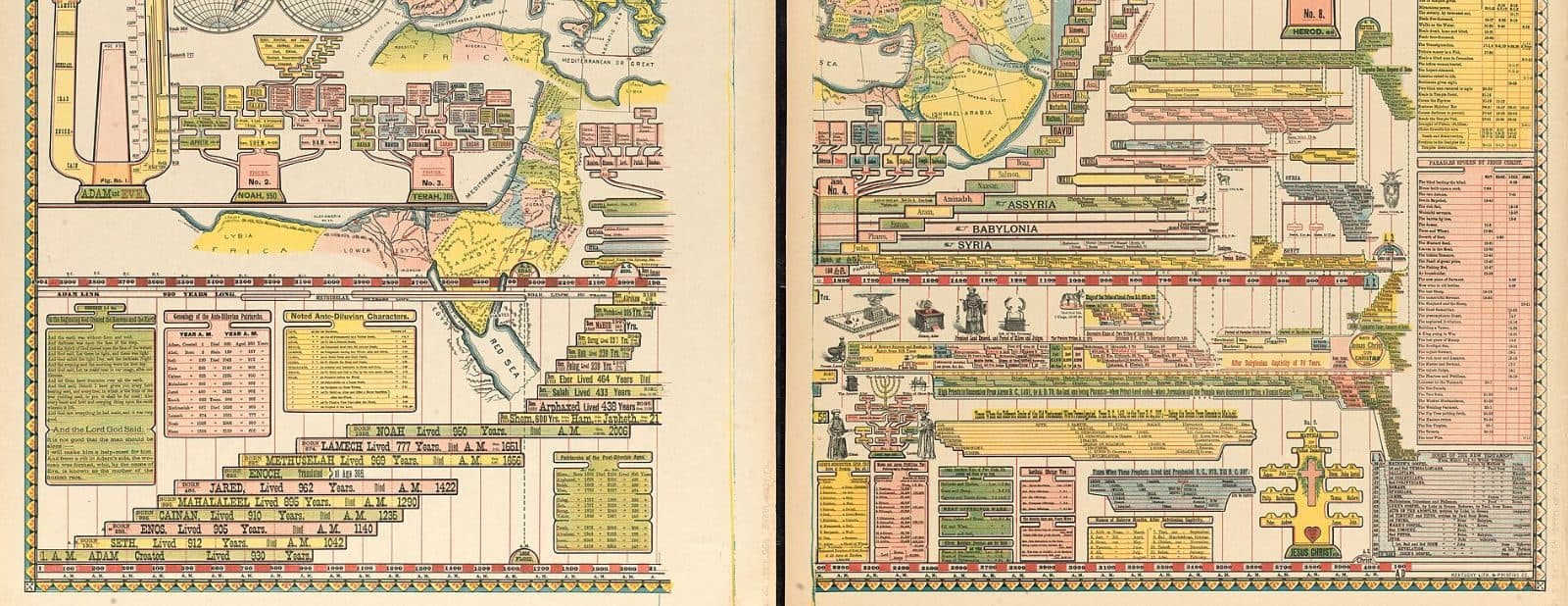
Portion of an 1887 poster by Jacob Skeen titled “Genealogical, Chronological, and Geographical Chart Embracing Biblical and Profane History of Ancient Times From Adam to Christ.” Credit: Jacob Skeen et al, Public domain, via Wikimedia Commons
Chronological information with Abraham and his family eventually connects to later Israelite history, which in turn intersects with the history of Assyria.
The history of Assyria can be situated in our chronological system because of its reference to a solar eclipse, identified as having taken place in what we call 763 BCE.
Working backward from the material anchored in known history, people assign dates to Abraham, then add up the genealogies from Genesis 5 and 11, and then add seven days. After doing this math, they arrive at what is finally determined to be the age of the Earth from a biblical standpoint.
The Jewish calendar is based on a date of creation of October 7, 3761 BCE1. In Christian circles, Bishop James Ussher determined the date of October 23, 4004 BCE in the 17th century.
Many today who would identify themselves as proponents of a young Earth have adopted similar dates. While they claim these dates have biblical support, they are also clearly in conflict with the current scientific consensus.
This tension raises three important questions:
Three Questions About Genesis and Earth’s Age
Do Biblical Genealogies Provide a Reliable Timeline?
Not necessarily.
Some Christians believe that we can just “do the math,” adding up biblical genealogies to help determine the age of the Earth.
But the nature of genealogies in the ancient world should caution us against using them this way.
Study of ancient genealogies shows that they are fluid in the numbers they give, the generations they include, and the order of the names2. This is in part because the purpose of genealogies in the ancient world, and the conventions that governed them, are very different from ours today.

How Should We Interpret Biblical Genealogies?
In this four-part series, biblical scholar J. Richard Middleton answers the often-asked question, "How should we interpret biblical genealogies?"
We use genealogies to document successive generations and keep an accurate record of dates. By contrast, the ancient world used them to establish a link between people in the present and important people in the past. They conveyed identity and continuity.
Examination of genealogies in the ancient world indicates that they could be characterized both by their fluidity and their rhetorical use of numbers. These variables make it unwise to use them in constructing a timeline.
If biblical genealogies cannot be confidently used to determine the age of the Earth, what about other parts of Genesis 1? For instance, does the creation account suggest that the Earth isn’t as old as the scientific community asserts?
To answer that, we need to ask two more questions.
What Kind of Text is Genesis One?
When considering what Genesis 1 tells us about the Earth’s age, we should first examine what kind of text it is. That means taking into account the way its ancient audience viewed the world.
We should not assume that the ancient Israelites had a scientific perspective that shaped their creation account, as they would not have brought the same questions to the text that we do today.
When modern people ask, “how did the world begin?,” we seek an answer by exploring the related question, “when did the world begin?” Our answers are scientific and focus on the material cosmos.
But Genesis was written in an ancient context. When its original audience asked the question, “how did the world begin?,” their interests or approach would likely not have been the same as ours.
This is why we cannot begin with the assumption that the account in Genesis 1 is intended to answer modern scientific or chronological questions.
What Kind of Creation Story Does the Bible Tell?
If Genesis 1 is not primarily answering questions about science or material origins, then what kind of story is it telling?
When we examine the text carefully, we can see that its main interest is not in providing an account of how material objects came into existence. In fact, many of the days have nothing to do with the creation of material objects.
Instead, the focus of the creation story has more to do with how God is ordering the cosmos to function with roles and purposes. Genesis 1 addresses how God’s created world works for people.

John Walton | More Than History
Discussing interpretation with biblical scholar John Walton and exploring the answers his work offers.
While there is no doubt that God created the material objects, the Israelites were more interested in affirming that God is the one in charge and the one who makes it work the way it does.
We can understand this as the difference between building a house (material focus) and making a home (bringing order and organization). Both are acts of creation, but they focus on different aspects. Both are important.
Genesis 1 may be more like a “home story” than a “house story.”
People in the ancient world thought about creation in terms of order and organization, so it is no surprise that Israel would have that same interest.
Furthermore, this focus reflects an important theological point about God. The text of Genesis presents the idea that God is the one who set up our world to work the way that it does. It is introducing our workplace, our relationship to it, and our job within it.
So, How Old is the Earth, According to the Bible?
The Bible does not tell us the age of the Earth, nor is it meant to do so.
As we have seen, Genesis 1 is intended by its author as a discussion of God’s creative activity in bringing order to the cosmos, not as an account of the material origins of the cosmos.
If that is the case, the seven-day account would have no information to offer us in determining the age of the material Earth. It is more about the identity of the cosmos relative to humanity than it is focused on describing the Earth’s age.
Even so, Genesis 1 does have a lot to say about God as the Creator, who has sovereignly ordered the world as its King. Further, it is written to show that humanity was created to work alongside him, bringing order to the world.
This message is far more vital to Genesis 1 than capturing our planet’s age.
We should not think that we can deduce the age of the Earth from a document that is not intended to address that question. The wisdom and truth it provides cannot be retasked to answer this modern scientific question.
About the author

John Walton
Related resources
If you enjoyed this article, we recommend you check out the following resources:

Common Question

Language of God

Common Question

Article

Article (Advanced)

Language of God
John Walton | More Than History