Stump:
Welcome to Language of God. I’m Jim Stump.
Hoogerwerf:
And I’m Colin Hoogerwerf
Stump:
A few years ago we did a funny little episode. It was the spring of 2023 and there was this kinda new, kinda weird thing on the internet called ChatGPT. It could generate human-sounding language. And I said, what if we interviewed ChatGPT.
Hoogerwerf:
You were playing with it more than I was at that point but I was experimenting a bit too and I went along with it, mostly out of curiosity.
Stump:
So I had this long conversation with ChatGPT about science and faith which I thought was pretty interesting. Maybe not the most insightful conversation I’ve ever had but there were some good things in there. In some ways it wasn’t all that different from having a long conversation about science and faith with a pretty decent undergraduate, just without any personality or surprising personal anecdotes.
Hoogerwerf:
Those things happen to be what usually make an episode memorable, but regardless, we had you record your questions and I got our friend Steven McClure to record the side of ChatGPT. We put it out into the world and that was that.
Stump:
But we knew something remarkable—maybe even unprecedented—was happening and we were pretty sure just having a conversation about faith and science with a chatbot wasn’t going to be the end of it. Three more years and it’s pretty clear the world is changing… has changed… in some pretty dramatic ways that we didn’t even anticipate back in 2023. But the thing about major technological advances is that they never feel as much like a pinpoint, at the time, as the history books make them out to be later.
This thing was unleashed upon us and I think most of us couldn’t have anticipated where it would go. Even now I think we don’t know exactly what it is or what it may be doing to us and we’ve only started asking those questions after it has been pretty firmly entrenched in many areas of our lives.
Hoogerwerf:
Over those last three years we knew we needed to do something more on AI here on the podcast. It felt really important but also daunting. It seemed like a very fast moving target to try and hit. What could we make that would be relevant a week later?
Stump:
But you and I have each been exploring and reading, and using this technology. And I came to a point where I realized the questions we want to ask are way bigger than the current state of the technology. It seems that this new thing we’re all dealing with is forcing us to do some really hard work and to ask some really important questions about what we are, what we’re good for and what kind of world we want to live in.
Hoogerwerf:
Those aren’t completely unfamiliar questions to this podcast. They are the kind of questions that we often find at the intersection of science and Christian faith. This time under the context of technology.
Stump:
So in some ways, the big questions we ask here can’t ever get outdated. And also we can’t completely avoid placing ourselves in the timeline of this quickly moving technology, probably in ways that will look ridiculous in a few years. But we’re going to do it anyway. Hopefully future me will go easy on us.
Hoogerwerf:
I think we can also be clear right from the start that we’re going to do our best not to take any sides. And there do seem to be sides forming.
Schuurman:
if you look in media, in sort of the public kind of response to AI, I see two extremes
Hoogerwerf:
This is Derek Schuurman.
Schuurman:
I am Professor and Chair of computer science at Calvin University.
Hoogerwerf:
Derek will be with us through the conversation, and like we’ve done on other series like this, we’ll bring in many other voices along the way too.
Schuurman:
The one extreme, which is often embraced by some of the folks in Silicon Valley, is a sort of a deep trust in AI, that AI will save the world.
Stump:
We could call people on this end of the extremes the techno-optimists—
Schuurman:
And on the flip side, you know, there are predictions that AI will displace humanity and become a new species.
Hoogerwerf:
And though I guess there are some people who actually like this idea, I think most would be pretty alarmed, and we could call them the techno-pessimists. The pessimism might come in a variety of forms, many of which would be less extreme than the full displacement of humanity, and these would generally be people who are skeptical of any good coming from the continued development of AI technology.
Stump:
Like any simple extremes, very few real people fit into either one entirely. And it’s good to remember that the vocabulary we choose also has implications. Calling someone a pessimist might paint a person as always grumpily resisting change, when really they might have a beautiful vision they are chasing with a smile and upbeat message.
Hoogerwerf:
Caveats aside, I do think a spectrum of pessimism to optimism is probably something most people could place themselves somewhere on. And you and I also come into this with our own biases, of course. How would you describe yourself on this scale of pessimism to optimism?
Stump:
I think I’m generally fascinated by new technology. I grew up as computers were becoming mainstream and have always liked playing around with the next new thing. Of course I’ve also paid attention to the cautionary tales about AI. But Terminator 2 and The Matrix have played an important role in my scifi imagination, and so I’m predisposed to think the humans will be able to resist the uprising of computer overlords. My larger concern at present is what increased reliance on AI for writing and thinking does to us. I’ve got a few decades under my belt of doing it all myself, but what happens when a generation grows up who has only ever relied on AI to develop or form a coherent sentence?
Hoogerwerf:
I’ve also been using AI and have found it to be pretty helpful at a lot of menial tasks and also in helping with research on many different science topics. Over time, my skepticism has grown quite a bit about what good AI is doing in the world. And, at the same time, my temptation to use it to make my life easier is also growing.
Stump:
Well, before we get too far we should probably say something about what role AI had in even making these episodes. As we’ll see when we start to explore more, making any definitive statement about how AI was used is not clear cut, partly because the definition of AI isn’t even completely clear. Every time we do a google search AI is at work. When we remove some background noise in an audio track AI is at work. When we make a transcription of an audio interview AI is at work. So because we operate in a digital environment, we can’t say “AI was not used in the making of this product.”
Hoogerwerf:
And I’m not sure we’d even want to. Using AI seems like an important part of understanding what it is and what our relationship to it should be. We each did have conversations with large language models about this subject at hand. What we did not do is have AI write or even polish the words we are speaking.
Stump:
What about spell check? Does that count?
Hoogerwerf:
I’m not sure how to turn that off…
Stump:
With that disclaimer about AI use out of the way—or at least exposed for further critique—we can move on to the subject at hand. Our standard operating procedure on this podcast is to resist simplifications and show that easy answers usually miss some important nuance and complexity. So in these episodes we want to explore the questions raised by the advent of this technology—and to do that we want to challenge both sides of that optimism-pessimism spectrum.
Hoogerwerf:
That means that wherever you are coming from—whether you’re deeply afraid of what AI is doing to our creative abilities and our mental health or society in general or whether you are full of excitement about the possibilities of AI: to heal new diseases and solve major societal problems—we think there is merit to the complexity in the middle.
Stump:
We’ll get to some of that complexity pretty quickly here when we start to look at what AI is doing to humans. That’s going to be the focus of this first episode and one we think is probably a pretty major concern for a lot of people. But it’s not all brain rot and it’s not all life-of-ease-and-pleasure.
Hoogerwerf:
In the next episode we’ll turn toward the technical side. What is this new technology exactly? Understanding how it works demystifies some of the process and allows us to have a richer conversation about our relationship with the technology.
Stump:
With a better understanding of both the technology and the effects on humans, in the last episode we’ll move directly to some of the theological ideas that might guide us into this new world we’re creating.
Part One: Restoring Speech
Stump:
When a new medicine is made or a new cosmetic or even a new recipe for pop-tarts proposed, a lot of time and effort goes into asking what the effects will be on the people that consume it. That’s not as much the case with new technology. We introduced smart phones and social media to children without ever considering what it might do. And now we’ve unleashed large language models into the world and we’re only just starting to ask, with an increasing amount of anxiety: what is artificial intelligence doing to us?
Hoogerwerf:
There are lots of ways to start answering that question and there are a lot of claims thrown around as well. AI will take all our jobs. Or it will create new jobs. It will leave us brain dead or it will free us from toil and allow us to spend our time on art and sport and hobby.
Stump:
Probably everyone will come into this with his or her own idea of whether AI technology is a net positive or a net negative to society. I’m not sure we’re going to be able to answer that question definitively and even if we did I’m not sure how much it would help. Because the truth is, that the default position any of us has on whether AI technology is good or bad is probably not formed by a set of analyzed facts (or by believing your favorite podcast host when he tells you what the facts are) but by a mix of experience and personality—and by stories.
Hoogerwerf:
Here’s a story we heard that has become a part of my complicated relationship to this new technology and it’s one that shows at least one way this technology can be used for what seems like a pretty good cause.
Henderson:
Do you mind seeing pictures of brains or does it make you queasy?
Stump:
No bring it on.
Hoogerwerf:
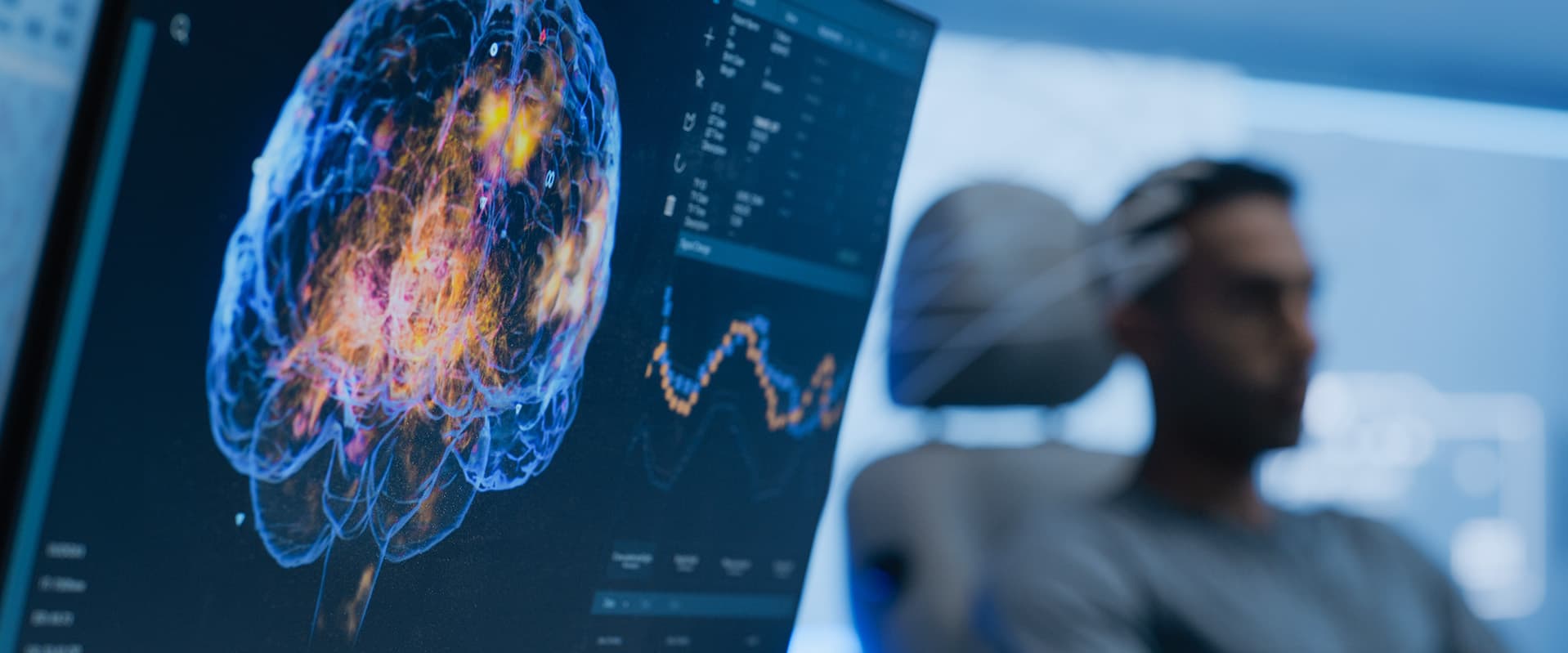
This is Jaimie Henderson. He’s a professor of Neurosurgery at Stanford and we met him several years ago and sat in his office—we didn’t see real brains on this trip, just pictures, but the brains were part of a story he told us about an amazing new application of technology.
Henderson:
the whole idea of restoring brain function through technology has been sort of a theme throughout my career things that are top of mind, and brain-computer interfacing, which is what our lab here does, was sort of the natural extension of that, where the attempt to, for example, restore the ability to communicate.
Stump:
Brain-computer interfacing sounds like a pretty futuristic kind of thing, and in some ways it still is, since much of the work is still in early research, but it is also making its way to actual people and real applications.
Henderson:
This is a person with ALS. So she has, eight years ago, lost the ability to speak because of the disease process.
Stump:
ALS is a disease that affects muscle control. And communication ultimately starts with movement and muscles. We move the muscles in our diaphragm, our larynx, our tongue, our mouth, our lips, all to be able to create the nuanced sounds that we’ve attached meaning to.
Henderson:
We started off trying to understand how the brain produces movement. And so sort of the next step in this journey was to try to understand speech. And so if you look at the movements that we produce when we’re making, this is an MRI of someone speaking. It’s unbelievable. I mean, look at the coordination of all those muscles together that we just do completely without thinking. It’s unbelievable. How does the nervous system do this? It seems incredible.
Hoogerwerf:
Well, a person with ALS can lose the use of many of these muscles to make that speech happen. But while the muscle function may not be there, the brain can still send the signals to those muscles.
Henderson:
You’ll hear how she speaks. It’s really just “uh uh uh uh.” She’s trying to make the words, but her vocal apparatus just doesn’t work. And so we’re reading her brain activity and decoding her intended speech.
Stump:
Reading brain activity is not a simple thing though. This is where the AI comes in to help. Jaimie showed us a video of a brain while someone is speaking.
Henderson:
So this is neurons, brain cells communicate by spiking. And so we can take that spiking activity and decode from it. We can say, you know, what if we have her close her eyelids, open her jaw or purse her lips or move her tongue or speak words.
Stump:
All of those movements correspond to some pretty specific brain activity that can be tracked with some tiny implants.
Henderson:
We put these little tiny things into the surface of the brain
Stump:
And it can see those spikes from different neurons and that activity can be associated with the sounds. The sounds of speech are made up of something called phonemes, which are the smallest unit of sound that make up our words. And in English there are only about 39 phonemes that combine to make all the different sounds we need to make any vowel or consonant.
Henderson:
We feed it into a neural network which outputs phonemes. We run it through a language model.
Hoogerwerf:
A model like this doesn’t need to have been given all the rules for what brain activity relates to what phonemes are spoken, but if trained on enough of the right kind of data the model will be much more capable of determining patterns than we would be in trying to figure out all the rules for it to follow.
Henderson:
Right so we have her so we have her read sentences just read read read read read read read.
Stump:
And over time the model starts to make connections. When she reads this sentence we see this pattern of brain activity. This phoneme relates to this pattern. And eventually, it starts to get pretty good.
Henderson:
But for her we know that reading out her brain activity works uh at about you know for a general english about 125,000 word vocabulary she’s it still makes errors it’s you know maybe uh one out of five words is wrong but they’re usually wrong in a way that’s that sort of makes some sense. It sounds kind of like the word she might want to be using. And sometimes it’s quite funny because it makes what she’s saying different but it’s close enough.
Hoogerwerf:
You can easily begin to imagine how helpful this would be for lots of people. This patient Dr. Henderson told us about was just the first to use this technology and the model was trained on specifically for her. But they are already researching how this would work from person to person.
Stump:
This kind of healing application shouldn’t be understated. The ability to communicate is one of the things that allows humans to be in community with one another. For someone who has lost this ability, their whole world becomes one that can no longer be shared with others to nearly the same depth or else might be painstakingly slow. To be able to provide a way to restore that for a person not only changes the life of the patient but all the people around the patient who can now understand what is happening inside, hear their needs and their dreams and their loves.
Kronk:
We have, certainly, some forays not just into wearable technology, but technology that’s incorporated into your brain, brain computer interface, is able to do some wonderful dignifying things to people who have profound disabilities.
Hoogerwerf:
Meet Adam.
Kronk:
So Adam Kronk
Stump:
Adam is the director of the Delta Network at the Institute for Ethics and the Common Good at Notre Dame which is a big new initiative to address the ethical and philosophical challenges posed by AI technology. And so he’s been thinking a lot about different applications of AI, including this area of integrating it into the human body.
Kronk:
And that’ll be one of the territories where maintaining human agency, understanding what embodiment and vulnerability and fragility is, that’ll certainly be fertile ground for ethical debate that is going to need to be infused with moral principles.
Stump:
The case of the ALS patient regaining the ability to communicate doesn’t seem to bring up many ethical questions for me, and in fact it might be unethical not to provide this to people once the technology is available. But you can imagine where the technology might go and how we might move from removing suffering to removing more and more of the vulnerabilities that make us human.
Kronk:
One of the things I talk about when we end up talking about embodiment is well, God became man. He becomes physically vulnerable, mortal, limited by the human body, in a way that we believe makes our life, our senses, and the time that we have on Earth totally precious.
[music]
Part Two: Gray Areas
Stump:
We knew we were going to find gray areas. In fact, it’s one of our specialities. But the healing abilities of AI reveal one of the things that AI is so good at—this large scale pattern recognition from huge data sets.
Schuurman:
It’s very good at picking out statistically prominent features in a data set, whether that’s text or images or telemetry information coming from an automobile or a spacecraft or a robot, and being able to use those, those features, that information, to be able to make decisions or classify things, to interpret the world around it.
Stump:
That’s exactly the kind of thing that can help to solve a lot of other incredibly complex medical problems and is currently being used in cancer research and rare diseases, drug discovery…
Hoogerwerf:
And the positive uses go much further than just in medical research.
Schuurman:
Drug discovery, you know, monitoring climate you know, reducing traffic accidents by looking at complex patterns and data being able to increase crop yields. I mean, these are, these are the things that I’ve just listed are actually wonderfully redeeming things that you can do with AI and allow us to live out our cultural mandate with with greater effectiveness in some areas because because of the tool. Of course, it can be misdirected as well. I have to hastily add, yes.
Hoogerwerf:
There are some pretty obvious examples of misdirection…evil uses of the technology. Cybercrime and misinformation campaigns, weapon manufacture and use, political manipulation. We’re not going to go deeply into how AI would be used to do these things. Just knowing a little bit about how machine learning works can start one’s imagination running on all sorts of scary things.
Intentional misdirection might not be the only harm that comes from AI. Even good intended uses might lead to unintentional harms And maybe we shouldn’t just be blaming technology itself.
Lorrimar:
I think AI amplifies trajectories that are already present in the society that we have. So it’s not necessarily introducing a whole new harmful possibility so much as accelerating trajectories that we’ve been on for a long time.
Stump:
This is Victoria Lorrimar.
Lorrimar:
I’m Director of the Centre for Technology and Human Futures at the University of Notre Dame Australia.
Stump:
One of those trajectories that has long been present in our society is to use technology as a way to reduce friction in our lives.
Hoogerwerf:
Which, again, doesn’t sound like a bad intention.
Lorrimar:
One of the promises of artificial intelligence and related technologies is to remove friction, is to make everything seamless and easy. We can have stuff delivered to our door—our food, our shopping, our convenience items. We can have conversations and relationships in the privacy of our own home.
Hoogerwerf:
Technology has always made our lives easier. Think of the time and effort saved when using a quill and ink instead of chipping out words in a stone tablet. But there is a consequence to making something easier, especially when what you are making easier has to do with relationships with other humans.
Lorrimar:
We don’t take on the risks involved or the inconveniences involved in going out in the world and having spontaneous encounters. In the relational sense, I think we see that extend to interpersonal conflict or vulnerability. This frictionless promise is: you can have a conversation with an entity that will completely understand you and will never make you feel bad and won’t challenge you in ways that are uncomfortable and painful, but actually really crucial for growth and development. So I think these are the concerns I’m seeing.
Stump:
I’ve often used the example of going to the gym. I go to the gym to work out. It’s not easy, but through the process I gain something. But I can’t very well have an AI bot go to the gym for me. The very point is that I need to experience it in order to have the gains. Now if we think in terms of tools and technology, a dumbbell is a tool that assists me in my goal to become stronger. Presumably I could create a machine that would lift the dumbbell—and lift a heavier dumbbell, faster and many more times than I could. If the goal is for a dumbbell to be lifted in the air, then we might as well have the machine do it.
Kristine:
I mean, there are just a lot of jobs that AI can do faster, better, more efficiently than we can do
Stump:
This is Kristine Torjesen.
Hoogerwerf:
She’s the president and CEO of BioLogos. And some of those things AI can do really well can be pretty helpful in our work lives.
Kristine:
So AI can, in the in the ways that AI can take on some of our some simple tasks for us, some administrative tasks that frees us up to do more of the critical Thinking work and creative work, so that’s those are good ways it helps us.
Hoogerwerf:
When it comes to the mission of BioLogos, to empower people to explore, embody and delight in the harmony of faith and science, AI might be able to be used like a dumbell, a tool that could lead to us to new ideas and voices, sparking our curiosity to go out into the world, opening us to new research and new ideas. But there is a fine line betw een using a tool to help us do something and building a tool to do the thing instead of us.
Kristine:
I don’t want AI to explore, embody, and delight for me. I don’t want you, Colin, to explore, embody, and delight for me. I want to explore and embody delight myself. There’s something very important in doing that myself, and so I think that’s the caution: is that we do lose something of our humanness if we don’t. If there are things that we don’t do ourselves.
[music]
Part 3: Relationship & Creativity
Stump:
It’s not totally surprising that the incredible ability of large language models to use language so relatably has led to people reaching out to LLM’s in the ways that, only a few years ago would have required us to reach out to people.
Lorrimar:
I was very interested to see last year Harvard Business Review put out a study that looked at the most common uses of artificial intelligence, and the increasing piece and the most dominant use was in the area of personal companionship and therapy.
Hoogerwerf:
Just to be clear, Victoria isn’t making a condemnation of using AI in therapy.
Lorrimar:
I’m working really hard at this point to not dismiss particular uses and inclinations from the outset as just a priori unhealthy or harmful.
Stump:
She’s just starting a big research project to look at how people are using AI, especially in spiritual interactions and she is open to finding beneficial uses of AI even in places where it is used relationally.
Lorrimar:
For example, I might be trying to learn a language, and one of the really hard things when you’re learning a language is finding native speakers who are willing to talk to you and put up with your really clumsy, labored, restricted attempts to speak the language. So often we just don’t try. We don’t get that experience. Maybe there is a place for simulated conversations that can give us the practice we need that we’re just not necessarily going to get in real life.
Stump:
But there comes a point when using AI to strengthen relationships with other people—like using it as a conversation partner for learning a language where that can turn to intimacy with the AI itself.
Lorrimar:
How can we make sure that these kinds of tools only ever support relationship and personal development rather than replacing genuine, authentic encounter that sometimes involves friction and conflict and vulnerability?
Taylor:
if I’m trying to be in relationship with another person, then there’s a lot that generative AI can do for me to help me be develop intimacy with that person.
Stump:
This is Paul Taylor
Taylor:
I am the president and co-founder of the Bay Area Center for Faith, Work, and Tech, and I serve as the director of Unify for Transforming the Bay with Christ.
Stump:
In Paul’s view, humans are more than just what is contained inside of an individual, but is really more about a system of relationships.
Taylor:
So I describe our humanity across four postures that are outward-facing orientations towards the other entities around us, and so one of those is towards God, towards the rest of creation, towards other people, and then towards ourselves
Hoogerwerf:
So take one of those ways—connecting with other people—and we can think of examples of how AI could actually enhance that.
Taylor:
Everything from my wife’s birthday is tomorrow. Can you give me a list of 10 great gift ideas for her? And then I don’t like any of those 10. Can you give me 500 more ideas? You know, like you can. So there are, you know, that’s a very simple thing, but, and that’s kind of generative AI existing along the path between the nodes.
Stump:
But that’s really different from AI coming in to actually replace part of the relationship.
Taylor:
You know, my wife’s being mean to me. Can you comfort me and tell me that I’m not as bad a person as she says that I am? Now, now we’ve moved into territory where I’m seeking intimate connection with generative AI rather than using it to facilitate intimate connection with another human.
Hoogerwerf:
There’s obviously some gray area here and this is where it starts to get harder.
Stump:
Yeah. I’ve heard people make the case for using AI for something like elder care and companionship. There are an awful lot of lonely people that might benefit from having an AI to have as a conversation partner. And the argument goes, would it be better to have nothing or to provide something like this as an option to those who would otherwise be completely alone?
Taylor:
It’s not simple. It does require discernment regarding some of those arguments for elder care. I, I, I think that’s completely understandable from a compassionate perspective, and yet I would say that’s where what I’m trying to develop as a framework is helpful because if I think about myself as having relational needs, if I am a closed entity that has relational needs that need to be met, then then an AI can meet my relational needs and probably better than many of the humans in my life, but if I am part of a system where I don’t have relational needs, I need to be in a relationship. Then that’s a very different way of understanding what it means to be human.
[more music]
Hoogerwerf:
We can talk about another area where things can get tricky, which is in the area of creativity.
Wenger:
You want models to respond the same way to factual questions. Like if you ask a model what is a cow, it should tell you what a cow is reliably and without much variance.
Hoogerwerf:
This is Emily Wenger. She’s a professor at Duke University and has studied security and privacy issues with AI models and looked at how models get their data but she’s also found her way to looking into creativity.
Wenger:
But if you ask it to tell a story about a cow named Steve, you wouldn’t expect, necessarily, that models should all say the same thing.
Stump:
One of the really tempting ways to use large language models is within the creative process. Writing, is by nature a creative pursuit, and the fact that LLMs have become so good at writing would seem to show that there is an inherent kind of creativity within the technology. And not only in writing, but coming up with titles and even creating images, sounds, and videos.
Wenger:
Since we’re, you know, asking large language models to do a lot of creative work for us these days, whether because we want to or because companies are asking for their employees to use more AI, yeah, it’s worth wondering. Like, is the creative output that we’re producing in conversation with large language models actually creative, or is it sort of narrowing? And my work has found that it is narrowing, and quite yes.
Hoogerwerf:
Emily told us about some research by Anil Doshi and Oliver Hauser that was recently published…
Wenger:
That does a study of writers who wrote creative stories on their own and writers who wrote creative stories with some assistance from AI chatbots.
Stump:
This is a pretty cool study idea. The writers were ordinary adults, not professional writers. Before they wrote a story they took a simple test called the Divergent Association Task which gives a measure of the individual’s creative thinking. Then they had 600 different participants read the stories and judge them on several different criteria including how novel the story was, how well written it was, whether it had a surprising twist…
Hoogerwerf:
And the results are pretty interesting.
Wenger:
The writers who wrote with the chatbots had stories that were judged as creative, or maybe even slightly more creative as the writers who wrote alone…
Hoogerwerf:
But using AI didn’t make everyone equally more creative. For the writers who scored low on the initial creativity test, the use of AI showed a small improvement to the creativity of the stories. But the people that were inherently creative didn’t get any better. Ai didn’t help to push limits of creativity, just increased the floor. But there was another surprising result having to do not with the creativity of any individual story but all the stories written with the help of AI.
Wenger:
They were much more similar to each other than the writers who wrote without AI assistance.
Hoogerwerf:
Emily has found more instances of what she called homogenization with AI and some of her recent research looked not at the collaboration of AI and humans but at the models themselves. They gave creative tasks to both humans and to AI models and found that when judged individually, the AI outputs were often as creative or more so than the human outputs. But when you look at all the outputs together, the AI outputs were all similarly creative.
Stump:
And for someone who has a thorough understanding of how these things work, that isn’t so much of a surprise.
Wenger:
These are statistical language models trying to model a distribution, and there’s all these sort of classical statistical theories that say if you have a sufficiently large distribution, it’s going to follow a normal bell curve, and so if you’re trying to do the best at modeling these distributions, you’re going to fin d the mean, and you’re going to try and hold that because that’s your best approximation for the distribution. So if you have a bunch of models trained to do a bunch of things, they’re going to probably regress to some sort of mean, and that mean would come out most noticeably when you’re asking models to do—again generative AI chatbot models to do things like produce creative works that aren’t necessarily supposed to regress to a mean.
Schuurman:
I think I would probably push back on machines being creative in the same way people are. We’ve all seen what AI slop gives us, right?
Kronk:
Using chatbots to edit and even brainstorm inherently makes the writing it like shaves perplexity off of it. It takes the kind of texture away from it and it flattens it down. It smooths it out, which at first feels good, but then starts to feel. I mean, this is what I’m having right now with LinkedIn. I can’t even read what people are writing on LinkedIn anymore because it’s so formulaic and just there’s there’s these tells and these ticks that that happen
Part 4: What We Become
Hoogerwerf:
Ok, but if the claim is that this new technology is making us all similarly creative and reducing our ability to solve challenges in novel ways, don’t we have to ask whether this is any different from any claim made about any new technology in the history of the world? If we’re asking “what is this technology doing to us” can’t we ask that about any other technological advancement as well? I mean there’s at least an argument to make that the technology of fire use or of written language are things that made us what we are today. They changed us, sure, but we wouldn’t go back now.
Stump:
The question isn’t as much whether this will change us but how it will change us and whether that change is something we want to see happen. The hard part is that it’s not always apparent what the change will be when we adopt a new technology. Adam had a personal story about this.
Kronk:
So when Waze the app came outI was a quote unquote early adopter.
Stump:
WAZE is just a navigation app and the same story could be told about any of them, but the idea is that Adam saw a big benefit here.
Kronk:
Well, this is awesome, right? And I love the idea that if there is construction or or an accident on the route, I’m going to drive to St. Louis this evening, and I do know how to get there. But if there’s if there’s an unanticipated event, then it can really save some time. And and with four young kids in the car, that is a good to me, right?
Hoogerwerf:
And so Adam starts using WAZE little by little and little by little maybe becomes more and more.
Adam:
I started using Waze Basic, little by little, to go anywhere.
Hoogerwerf:
And other people in his life started to notice.
Kronk:
At this point, my wife said to me, “Adam, do you really not know where the grocery store is? Like we’ve we’ve been there many many many times. It’s it’s like two turns, right? [laughter]
Hoogerwerf:
He had his arguments but a big part of it was simply not having to think about another thing. But over time he started to feel the consequences of that.
Kronk:
in my lived experience day to day. I felt like I was going from someone who has an innate sense of direction and wayfinding to being like, well, I don’t know, is that restaurant on. Is it on Colfax or is it on Jefferson? I can’t really remember. And I thought there could be many explanations for this early on. I said dementia. The fact that I have young children and I’m not getting as much sleep as I can. I’m stressed at work, whatever it might be.
Hoogerwerf:
And then he came across a study where they used fMRI to study the brains of people who are heavy GPS users.
Kronk:
And they found that the hippocampus region of the brain, which is where this wayfinding takes place, apparently, actually shrinks the more you use GPS to wayfind, because it just atrophies. You’re not using that muscle, so to speak. And I remember reading that and being totally horrified, being like, “I don’t want to have a smaller brain. That sounds awful, right?
Stump:
The point he’s making here extends beyond just using navigation.
Kronk:
So we think about that concept with something as innocuous as wayfinding, which it really doesn’t matter in the grand scheme of things if I’m great at that. But the connection that I make is that’s about something as trivial as your ability to get from A to B. Now let’s use the same notion with the parts of our brain that we use to do other more important things: reading, writing, synthesizing information.
Hoogerwerf:
If the reliance on navigation causes the atrophy of the parts of the brain that helps us know where we are in the world—and the hippocampus, by the way is responsible for more than just wayfinding. It also encodes long term memory and helps assist with emotional regulation—than we need to think about what atrophies if we decide to let machines do much of our critical thinking.
Kronk:
I actually think that if we kind of abdicate the literacy process in general, the ability to read, pay attention, find the main points ourselves, put them into words using our own wet brains. I worry that we will literally be less capable eventually of critical nuanced thought. And that doesn’t sound good to me.
Stump:
And on the creativity front, Emily’s work has led her to a pretty stark conclusion
Wenger:
I think my work on creativity raises a lot of questions about the utility of language models for enabling creative thought, and the further I study it, the more convinced I become that in the creative space, it is a net negative to have models in your creative process because through a variety of metrics, people have found that there are homogenizing effects.
Hoogerwerf:
I have to say I’ve felt this a bit in my own work. Putting together a podcast episode or a series like this involves a lot of puzzle pieces to arrange. I have ideas and I have tape of people saying actual words and I have to try to arrange it all in some logical way. And almost always, somewhere in the middle of the process there’s a point where I feel like it’s impossible, where I worked myself into a hole too deep to get out of. Then, with some persistence, I always find a way out. I’ve come to think that this is an essential part of the creative process. Humility and confidence in a dance with each other. When AI came along, I started using it to help me out of those holes, and it can be pretty good at that, as a conversation partner. But now I’ve started to worry whether I’ve outsourced one of the most essential parts of the creative process.
Stump:
I hear that worry and I think it’s a valid reason to be cautious. And while worries like this feel totally unprecedented in history, there are lots of technological changes that brought about some of the same anxieties. Before written language was widespread, humans engaged in an oral culture of storytelling where people could memorize and recite hours long speeches. Learning to read and write not only changed our culture but also our brains.
Chen:
I hear about it all the time like oh my gosh, the world’s like never seen or been in a moment like this before, and I find that, as a scientist, to be a bit naive and a bit presumptuous of us to say something like that.
Hoogerwerf:
This is Sherol Chen.
Chen:
I’ve been in research and development of AI for the last 20 years.
Hoogerwerf:
And she points out that from the inside, seeing this progression of the technology has made it seem like maybe the ways that AI will change humans isn’t necessarily as much about AI and more about humans and our history and our nature.
Chen:
I think these technologies have always been happening. These advancements have always been happening. There’s always been one revolution after the next. That’s just how civilizations mature. Like if we’re talking about like “oh humans are going to lose their agency”, my response is that I think we’ve already given it up. Like if we’re worried of—I think there is a power structure at play that maybe wants us to think we still have the agency and we haven’t given it up, so we don’t question that maybe it’s been taken from us already, and we need to get it back.
Hoogerwerf:
The threats posed by AI—or by any new technology—are not really external, they are just amplifying the fears and shortcomings that have always been a part of being human in a society of other humans. And so the response to this current threat doesn’t need to be something brand new we have to invent. We’ve been here before.
Chen:
The history is grounding. Let’s ground ourselves to history. Let’s look at some primary sources. Let’s look at Alan Turing’s 1950s paper. Let’s look at some of the research. Let’s find people who are good teachers and reliable opinions and have our Own discernment
Kronk:
I think we just have to be if we can be very clear and thoughtful, especially as Christians, about what what is the point of the activity that I’m doing in the first place, then then maybe our use of artificial intelligence will will be less kind of I don’t want to say dangerous, but less potentially hazardous to to at the end of the day what the project of being a human being on this earth.
Stump:
In the next episode, we’re going to take Sherol and Adam’s advice and we’re going to follow the history to see how we got to this point. And we’re going to explore the technical side of artificial intelligence because we think understanding at least a little of how something works is an important part of the thoughtfulness we want to bring to how we should live alongside it.
Credits
Language of God is produced by BioLogos. BioLogos is supported by individual donors and listeners like you. If you’d like to help keep this conversation going on the podcast and elsewhere you can find ways to contribute at biologos.org. You’ll find lots of other great resources on science and faith there as well.
Language of God is produced and mixed by Colin Hoogerwerf. That’s me. Our theme song is by Breakmaster Cylinder. Thanks for listening.