The Most Glorious Thing I’ve Ever Seen
For BioLogos President Deb Haarsma, understanding the science behind a solar eclipse does not make it any less glorious. She is drawn to deeper worship of God.
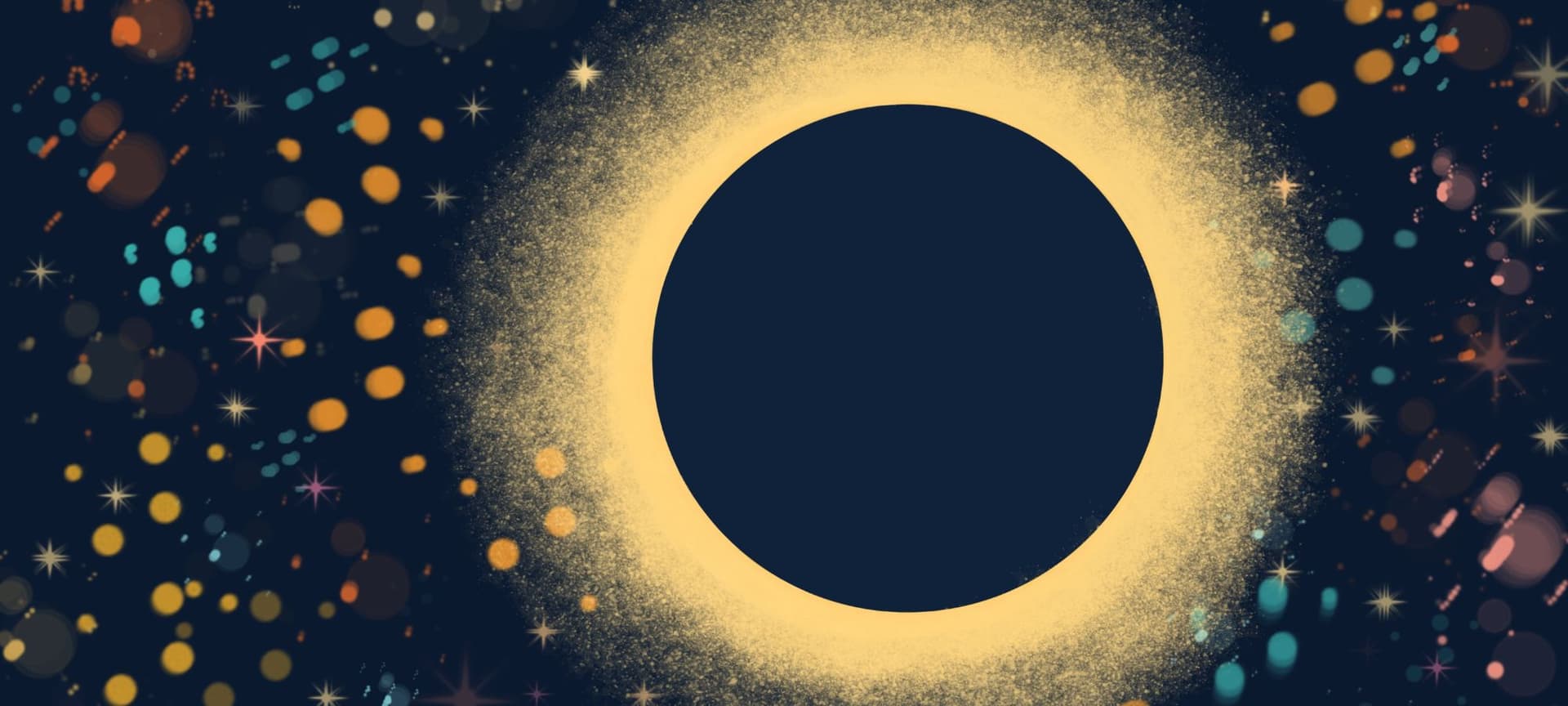
Image used under license from Shutterstock.com
The sky was blue, the sun was high, and the dry air was filled with the smell of the sagebrush and desert pine. I was standing on a little hill near a roadside in Oregon, not far from Mt. Hood, waiting for the total solar eclipse of August 2017. With the upcoming eclipse on April 8, 2024, the memories are flooding back.
We had planned our 2017 family vacation around the eclipse, choosing this part of the country because it was least likely to be cloudy. NASA picked it for the same reason, and the small nearby town of Madras was overrun with professional and amateur astronomers. My family stayed comfortably in a hotel outside the region of totality and drove in a few hours that morning. Even the highway rest stop we planned on was overrun, hence our roadside site. A few other cars stopped near us.
We had our solar eclipse glasses ready (these are essential for safety, you can permanently damage your eyes without them). We watched off and on through the glasses as the moon slowly began to cover the sun. This part lasted over an hour, so there was plenty of time to enjoy our surroundings and get settled in. I had seen partial eclipses multiple times, so this wasn’t anything new. Without the glasses, not much seemed to be happening; our eyes easily adapted to the reduced light, and we didn’t notice any changes in wildlife sounds.
But in the last minute before totality, it got dramatic. The sun seemed to be on a giant dimmer switch that was dialing back to zero. The air quickly cooled off. Through our eclipse glasses, we watched the last sliver of sun disappear, then whipped off the glasses.
With my bare eyes, I saw a total eclipse for the first time. I was stunned. I’m sure I screamed, and so did everyone around me. It’s not like I hadn’t seen pictures before—I had taught astronomy courses, which always included the sun and eclipses. But photos just can’t capture it.
The sun had been replaced by a deep dark circle—it looked like a dark hole in the sky, even though I knew it was the moon. The rest of the sky was the beautiful deep blue of twilight, with some reddish sunset light near the horizon. Encircling the dark hole, several times larger than the moon, was the blazing white corona. The corona was far larger and brighter than I expected based on pictures. I thought I’d have to squint or use binoculars, but it blazed forth!

Photo provided by author; Deb and her brother with their eclipse glasses on during the 2017 Solar eclipse.
Appreciating the Details
The astronomer in me appreciated the details. The corona is the superhot outer atmosphere of the sun. This region is a thin plasma, over a million degrees, and the source of solar flares and solar wind. Through binoculars, we could see another part of the sun, the chromosphere. It appeared as red beads around the black circle, peaking around the ridges on the moon’s surface. The chromosphere is the layer between the Sun’s surface and the corona, the place where jets and filaments rise up from the surface and fall back to it. I also took a moment to look around the sky for stars and planets, and spotted a few.
And then totality was over. We put the eclipse glasses back on for what was again a partial eclipse, and exclaimed over what we had seen. Eventually we packed up and began fighting the long traffic jam to get out of the region of totality (it was a good thing we had brought food and supplies for the day). When we got back to the hotel, a few people said “oh, I saw the eclipse at 95%, close enough.” I tried to explain that 100% was completely different!
A total solar eclipse was probably the most glorious thing I have ever seen in the natural world. I love the images we see through telescopes, but it is entirely different to see with my own eyes and all my senses. Psalm 19:1 says “The heavens declare the glory of God,” and in a total eclipse that glory is overwhelming.
…“The heavens declare the glory of God,” and in a total eclipse that glory is overwhelming.
The sun and the moon aren’t doing anything special, they are just continuing in their orbits following the laws of gravity, the way God created them to. Similarly, a beautiful sunset isn’t anything special that the sun and the atmosphere do. It’s our vantage point. During an eclipse, the alignment of the sun, moon, and earth gives us a special angle of view that is particularly stunning and reveals features we can’t see otherwise.
Something Glorious
Sometimes people use “miraculous” to describe amazing things in the natural world. Before astronomers figured out how to predict eclipses, the events must have seemed miraculous, in terms of having no ordinary explanation. Certainly miracles still happen, but for phenomena where we have a scientific explanation, I prefer the terms “glorious” or “wondrous.”
Does having a scientific explanation reduce the wonder of what we saw? Not a bit. Every person on that Oregon hillside was filled with the same wonder, and I’m sure every one of them knew that this was simply the moon moving in front of the sun.
Does having a scientific explanation reduce our worship for what we saw? Absolutely not! Whether we understand it scientifically or not, the wonders of creation declare the glory of their Creator. From our faith we know there is a Person behind the universe, the same Person who is our Savior and Lord, and we respond in worship.
Think of one of Rembrandt’s paintings. You can appreciate it on one level just by looking at it. When an art historian analyzes it and gives you important insights, that only enhances your understanding of both the painting and the artist. When I’ve viewed paintings in museums, I’ve sometimes wished I could meet the artist, to talk with them and thank them for their work. With the artwork of the Creator in the natural world, I can do exactly that.
Whether we understand it scientifically or not, the wonders of creation declare the glory of their Creator.
About the author