Where Did God Come From? A Philosopher Weighs In
God did not come from anywhere. Christians have long understood God not as created, but as the eternal source and ground of everything that is created.
Image: ESA/Webb, NASA & CSA, J. Lee and the PHANGS-JWST Team. Acknowledgment: J. Schmidt
“Where did God come from?” sounds like a perfectly natural question on its surface.
We ask ones like it all the time: Where did the moon come from? Where did that tree come from? Where did I come from?
These are normal questions because the things we encounter in the world have histories. They began. They developed. They came from somewhere.
So why not ask the same thing about God?
Why Asking “Where Did God Come From?” Does Not Work
A Loaded Question
The problem is that the question assumes something about God that Christians do not actually believe. In that sense, it is a loaded question.
A loaded question sneaks in an assumption. It’s like being asked, “Have you stopped cheating on your taxes?” If you say yes, you imply that you used to cheat. If you say no, you imply that you still do.
“Where did God come from?” works in a similar way. Any answer you give will imply that there was a time God didn’t exist, and that something else brought God into being.
But that is not what Christians mean by God.

What Created God?
If God created the world, what created God? Don’t we need an explanation for his origin as well?
A Category Mistake
It also involves what philosophers call a category mistake: It asks of one kind of reality a question that makes sense only of another kind. “How much does the color green weigh?” is grammatically fine, but it mixes up categories. Green is not the sort of thing that has weight.
A category mistake can be one kind of loaded question, as the wrong category quietly loads the question with a mistaken assumption. In this case, the question assumes that God belongs to the category of things that begin to exist.
To see why that matters takes us into the world of metaphysics, which is the fancy word philosophers use for thinking about what kinds of things exist.
Imagine making an inventory of everything that exists. We could start listing individual things: that car, my Aunt Pat, the Pacific Ocean, Jupiter, your left shoe, this copy of War and Peace. That list would get very long, very quickly.
So we sort individual things into categories. It’s like when we play the game Twenty Questions, which begins with a very general scheme: animal, vegetable, or mineral?
Fish, pomegranates, diamonds, and everything like them would be accounted for. It makes sense to ask where these things came from. But not everything we believe to be real fits into those categories — God certainly does not.
Consider money and universities. A twenty-dollar bill is a physical object, but its value depends on a community recognizing it as money. The University of Michigan has buildings, but it is not identical to them. Philosophers call such things “social realities.” They exist because communities establish and sustain certain practices and agreements.

Wondering About What There Is: A Brief Introduction to Metaphysics
What is metaphysics? Metaphysics investigates those questions for which science cannot give definitive answers. Here’s some thought provoking clips and resources from Tim O’Connor, one of our speakers at the upcoming BioLogos19 Conference.
Could God be a social reality? Of course our words for God and our religious institutions are shaped by human language and culture, but that is not what Christians are talking about when they say God is real.
We mean that God exists whether or not any human community agrees. If every church closed tomorrow, Christianity as a social institution might disappear. God would not.
But now, saying what Christians mean when they talk about God does not prove we are right. Perhaps God is imaginary, like a unicorn or the Fountain of Youth. People sometimes believe things are real when they are not.
This article will not settle the existence of God to everyone’s satisfaction. (That is setting the bar a little too high for 1,500 words on the internet!) But it can clear up some confusion.
God Is Not Just One More Thing in the Universe
Language can be subtle and tricky.
Even when we affirm that God is a person—or, to be more theologically precise, three persons of the Trinity—we don’t mean that God exists just like all other people exist. God is not an impressive creature. God is not a superhero with infinite powers. God is not just one of the things on the list of things that exist in the universe.
Instead, God is the source and ground of existence.
This is where we can see the question, “Where did God come from?”, start to wobble. Mountains, nations, trees, and humans can “come from” somewhere. But God, as Christians understand God, is not the sort of reality that comes to be.
But that does not mean God is irrelevant to mountains, nations, trees, and people. In fact, quite the opposite is true.
If God is not one item within the universe, that does not mean God is far away from the universe. Rather, it means God is related to everything in a deeper way.
How Is God Related to Everything That Exists?
Aquinas: God Isn’t Just the “First Domino”
Here is where the medieval theologian Thomas Aquinas can help.
Aquinas is famous for offering arguments for the existence of God, including what is often called a cosmological argument.
People often imagine this as a row of dominoes. One domino falls into another, which falls into another, which falls into another. Eventually, we ask what started the whole thing. There must have been a first push, a first cause, a first domino. And that, we say, is God.

Image used under license from Shutterstock.com.
That picture is easy to understand, but it is not really what Aquinas was after.
If God is just the first domino, then God is still one more thing in the line of things. God may be the biggest or earliest or most powerful thing, but God is still being imagined as part of the same chain.
That does not solve the problem, since we could still ask, “Fine, but where did that first domino come from?”
Aquinas was making a deeper point. He was not merely asking what happened first a long time ago. He was asking why anything exists at all, right now.
Think again about ordinary things. A tree exists, but not all by itself. It depends on soil, sunlight, water, air, and the biological processes that keep it alive.
But then we can ask the same about those things. Why is there soil? Why is there water? Why is there sunlight? Why are there stable patterns in nature that allow trees to grow in the first place?
We’re not moving back in time to explain things, but rather deeper into the hierarchy of dependencies. The tree does not explain its own existence. Neither do the soil, the atoms, or the laws of nature.
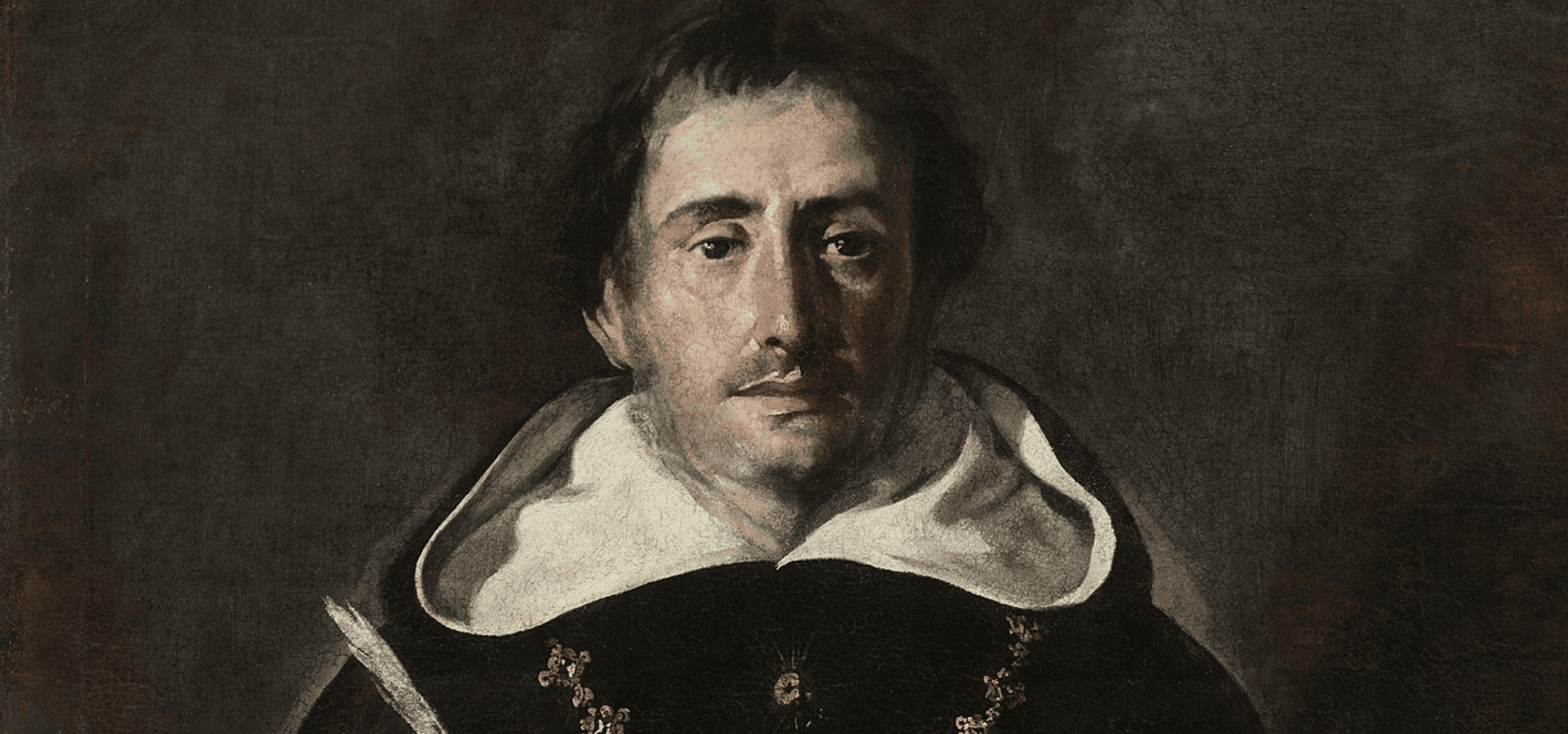
17th-century portrait of Thomas Aquinas. Antonio del Castillo y Saavedra, Public domain, via Wikimedia Commons
Why Is There Something Rather Than Nothing?
Eventually, we reach the question that lies underneath all the others: Why is there something rather than nothing?
That is the kind of question Aquinas was asking. God is not another dependent thing somewhere in the chain of causes, nor is God one more object in the universe. God is the ground of existence itself, the One on whom all dependent realities depend.
This makes God much closer to us than the first-domino picture suggests.
A first domino might fall and then lie flat, having nothing more to do with the chain that follows it. But Aquinas’s God is not merely the cause of the universe’s beginning. Rather, God is the One who gives existence to all things at every moment.
The apostle Paul says something similar in Acts 17 when he tells the Athenians that God is the One “in whom we live and move and have our being” (Acts 17:28).
This is the language of continual dependence, not that of a distant clockmaker who wound up the universe and stepped away. It reminds us that beyond needing God to explain something that happened billions of years ago, we depend on God for our next breath, for the ground beneath our feet, for friendship, and for every good gift.
To acknowledge the One in whom we live is to practice gratitude and humility, rather than self-sufficiency. If every creature receives its being, then the world around us is not raw material for our projects. It is a creation we did not make and do not own.
Science and God Are Not Competing Explanations
This also means that science and belief in God are not competing explanations of the same thing.
If we ask where the moon came from, scientists can tell us about the early solar system, planetary formation, and the likely collision that produced the material from which the moon formed.
Image used under license from Shutterstock.com.
Christians do not need to interrupt that explanation by saying, “No, God did it.” God is not an alternative to gravity, matter, time, or physical processes.
Rather, God is the reason there is a universe in which gravity, matter, time, and physical processes can exist at all.
So, Where Did God Come From?
God did not come from anywhere.
That answer may sound strange at first, but only because the question has led us to imagine God as one more object in the universe.
Mountains come from somewhere. Moons come from somewhere. Nations come from somewhere. Human beings come from somewhere. Created things have histories.
But God is not created. God is the eternal source and ground of everything that is created.
To be clear, this doesn’t explain all the questions we have about God. It doesn’t explain how we should understand the Trinity, and it doesn’t tell us why there is suffering.
But it should show us why not having an answer to “Where did God come from?” is not really a problem. And perhaps it opens up a different, more helpful kind of question: What would it mean to live as though every breath and every creature has its being in God?
About the author

Jim Stump
Related resources
If you enjoyed this article, we recommend you check out the following resources:

Common Question

Videos


Article
