What Is a Scientific Theory? Evolution Is More Than a Guess
Scientific theories are powerful tools for explaining what we observe in the natural world, making predictions about it, and sparking new discoveries.
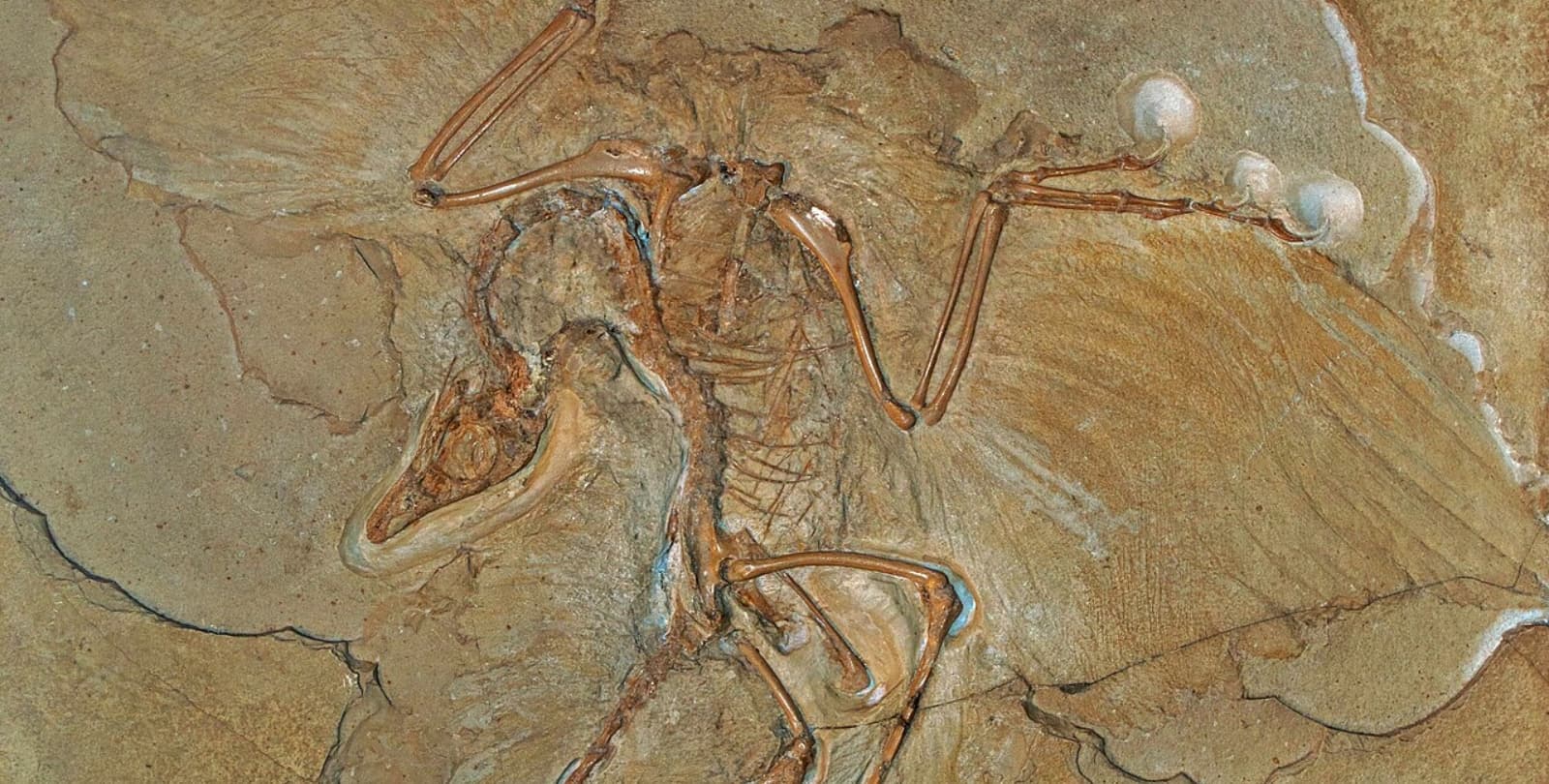
Archaeopteryx lithographica fossil displayed at the Museum für Naturkunde in Berlin. From Emily Willoughby (emily.a.willoughby@gmail.com), CC BY-SA 4.0 <https://creativecommons.org/licenses/by-sa/4.0>, via Wikimedia Commons
Have you ever heard someone dismiss evolution by saying “well, it’s just a theory?”
It’s an understandable thought. In everyday conversation, the word “theory” has taken on the meaning of a guess or personal opinion we hold.
The issue is that in the scientific world, the word “theory” means something much different.
When scientists refer to something as a theory, they don’t mean they’re making a guess. Scientific theories are the most powerful tools they have for explaining what they observe, making predictions about the natural world, and sparking new discoveries.
Let’s take a closer look at what it means for evolution to be a theory.
What is a Theory?
First, What Theories (and Science) Are Not
Many people see science as an encyclopedic listing of unchangeable facts. They believe that since scientific “facts” are equated with absolute truth, they cannot change once discovered.
This is an essentially static view of science, and one that is very much at odds with both the tentative nature of scientific conclusions and the dynamic process of scientific inquiry. It also elevates the discovery of observational “facts” as the fundamental objective of science.
People often regard theories, on the other hand, as mere guesses and speculation. This is commonly expressed in phrases like, “evolution is just a theory.”
The Foundation of the Scientific Enterprise
A scientific theory is a comprehensive cause-and-effect explanation for a set of observations that is supported by testing and can predict new observations not yet made.
The construction and testing of theories form the foundation of the scientific enterprise. Science is not the mastery of a body of unchanging scientific “facts,” but rather a means of inquiring about our physical environment. It provides a way of understanding, explaining, and integrating our diverse observations of the natural world.
Theories place these observations into an explanatory context, giving them coherence and meaning.
Although observations form the foundation of scientific description, serious theoretical inquiry is the essence of science. On their own, observational “facts” are lifeless. They do not yield understanding.
Nothing could be more deadly to science than to divorce it from the unifying theories that give observations meaning.
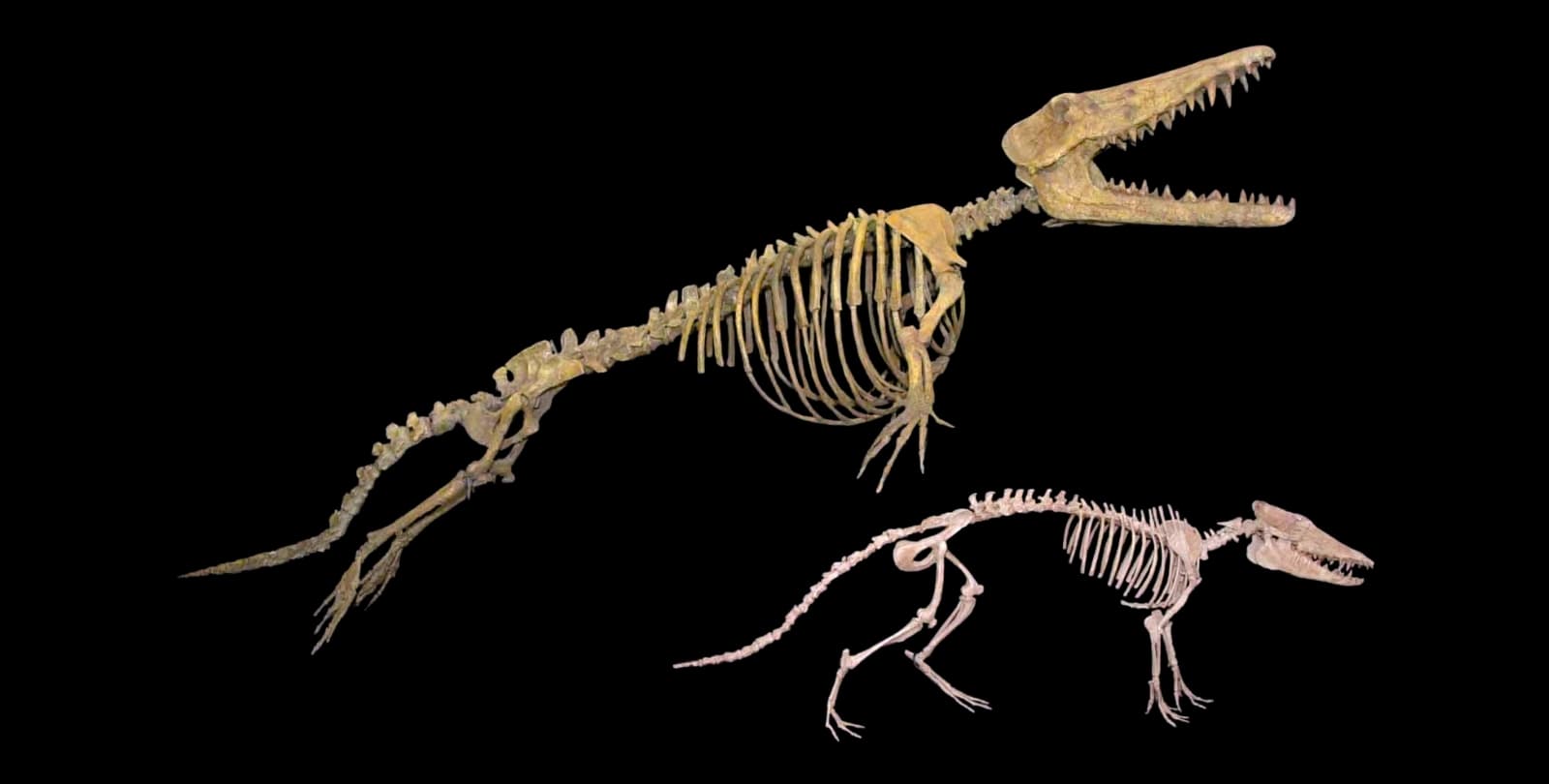
The skeletons of Pakicetus and Ambulocetus, two of the many “walking whales” whose discoveries revolutionized our understanding of the evolutionary origin of whales. Image: Thewissen, J. G. M. (2009). “From Land to Water: the Origin of Whales, Dolphins, and Porpoises”. Evolution: Education and Outreach 2: 280.
https://creativecommons.org/licenses/by/2.0/ via Wikimedia Commons.
The Drivers of New Discovery
Scientific theories provide the predictions that suggest new observations and drive new discoveries.1
Scientists are driven by unanswered questions—questions about what we don’t know. It is the pursuit of the unknown that results in correcting current understandings and opening up whole new areas of inquiry. That process is possible because scientific theories are never complete; they remain open to revision as new evidence emerges.
This open-endedness isn’t a flaw—it’s what makes science exciting. There is always the opportunity to discover something new.
For that reason, the gathering of scientific knowledge is never finished. Our current body of knowledge, theoretical conceptions, and technology represents just one point on a historical continuum, built upon the past and open to the future.
As stated by philosopher Nicholas Rescher, “Our theorizing about the nature of the real is a fallible estimation, the best that can be done at this time, in this particular state of the art. Our science is a historical phenomenon; it is one transitory state of things in an ongoing process.”2
Powerful Tools for Understanding the World
The more diverse observations a theory can explain, and the more testable predictions a theory makes, the more powerful and useful it is.
Good theories also raise new questions, and these questions drive new scientific research.
No scientific theory is ever absolutely “proven” because we can never know what future discoveries and observations will be made. However, theories that have extensive explanatory and predictive power are effective tools for understanding the world, and provide the foundation for future discoveries not yet made.
How Do Theories in Evolutionary Science Work?
Evolution is one of the most powerful and unifying theories in science.
As stated above, the more diverse observations a theory can explain, the more useful it is. The theory of evolution is well-supported by an extremely wide range of observations from many disciplines, including genetics, developmental biology, comparative anatomy, biogeography, paleontology, and paleogeography.
The theory of evolution has also proven effective in generating fruitful and testable hypotheses. Let’s take a look at one example of the explanatory and predictive power of evolutionary theory: the origin of feathers.
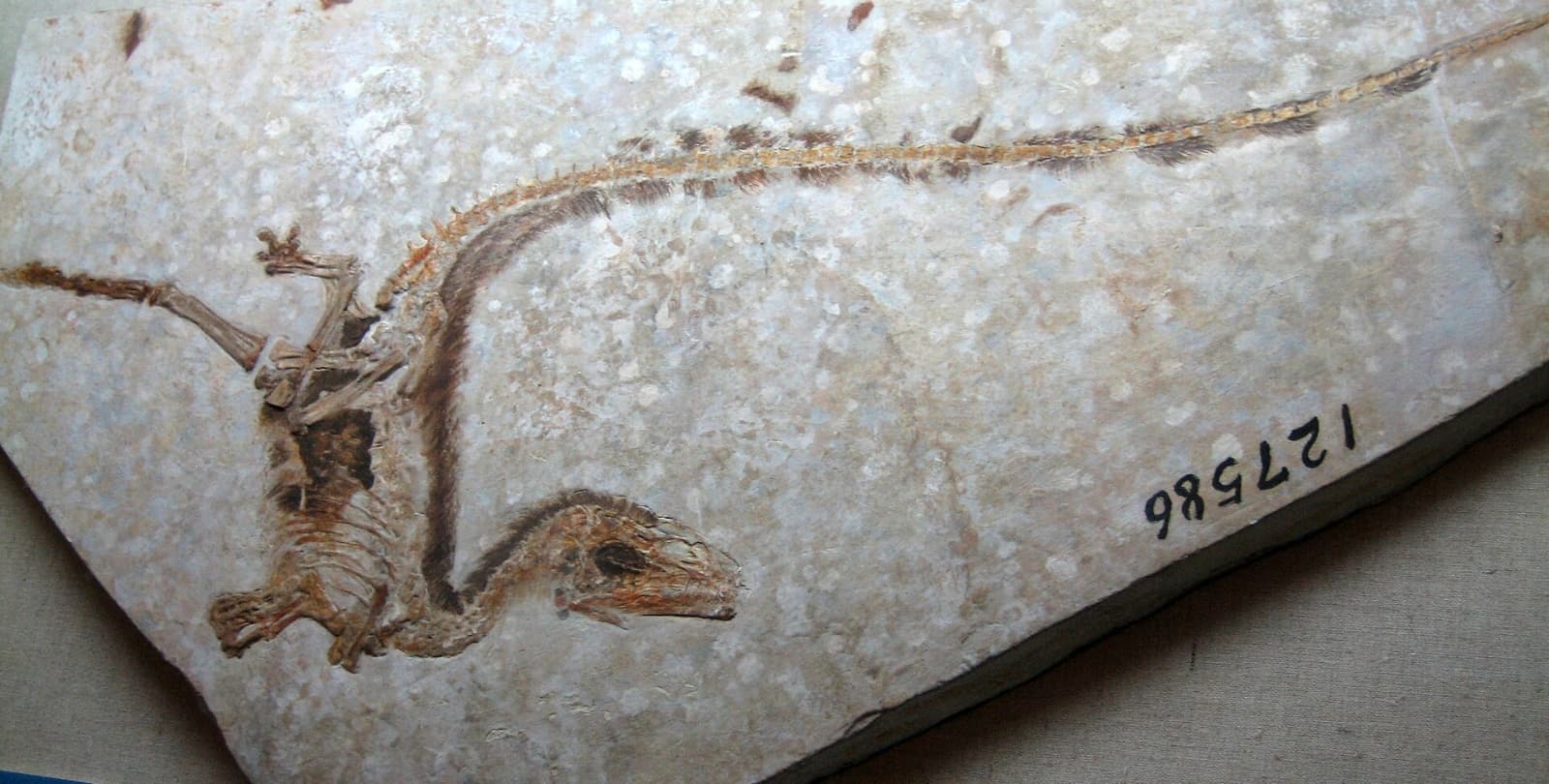
Sinosauropteryx fossil with preserved hollow filaments covering its body. Image: Sam / Olai Ose / Skjaervoy from Zhangjiagang, China, CC BY-SA 2.0 <https://creativecommons.org/licenses/by-sa/2.0>, via Wikimedia Commons
Example: The Origin of Feathers
In 1999, Richard Prum proposed an evolutionary sequence of feather evolution based on his study of feather development in modern birds.3 He described the following developmental sequence:
- First, a hollow filament
- Then, a tuft of filaments attached at the base
- Then, a planar feather with a central shaft or rachis and unbranched barbs
- Then, a feather with barbules that lock the barbs together
- Finally, an asymmetrical flight feather
In 1996, just a few years before Prum’s publication, the first fossil of a dinosaur named Sinosauropteryx was described in China. Sinosauropteryx, the first dinosaur fossil to be discovered with evidence of feathers outside the Avialae clade, was found to have had hollow filaments. This was the first step in Prum’s model.
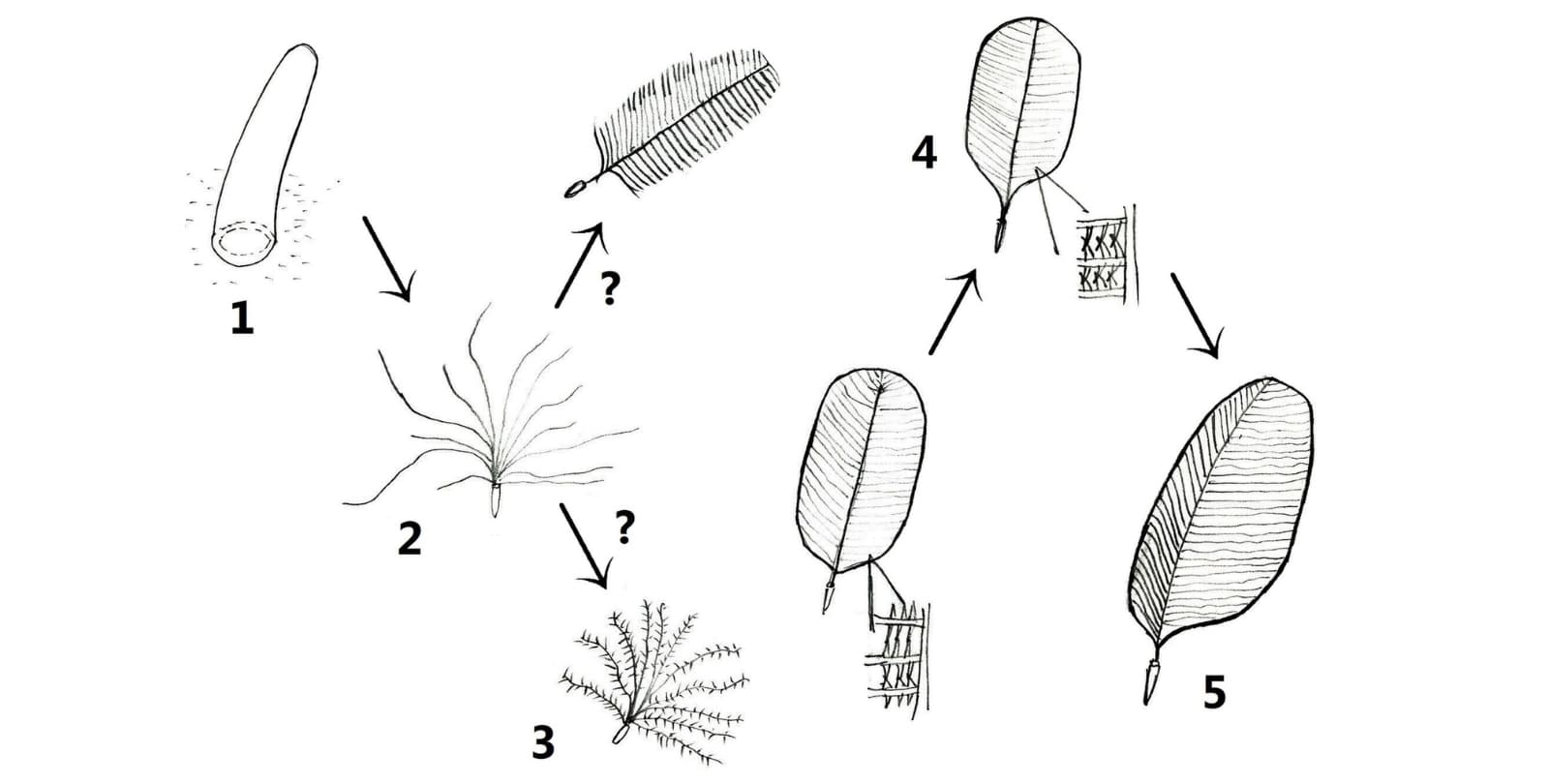
Simplified summary of the five stages of feather evolution outlined by Prum’s developmental model: 1) hollow filament, 2) tuft with unbranched barbs, 3) tuft with barbs and barbules, 4) planar feather with barbules that lock the barbs together, and 5) closed asymmetrical flight feather. Image: Dgg32, Public domain, via Wikimedia Commons.
Afterward, an entire collection of feathered dinosaurs was discovered that included all of the steps proposed by Prum. The stages of feather evolution appeared within different dinosaur groups in a pattern consistent with the evolutionary sequence of dinosaurs that had already been worked out based on other anatomical features.4
This example illustrates how the evolutionary expectation of descent with modification drives the predictions being made based on the data available. Documenting the developmental pattern of feathers in living birds, Prum proposed that the same pattern may be reflected in their evolution. The fossil record then supported the various stages in the evolution of feather morphology.
Furthermore, the evolutionary sequence is supported by the pattern of relationships of feather-bearing fossil species already determined by their other anatomical characteristics. In this way, independent information from the disciplines of developmental biology, comparative anatomy, and paleontology were brought together to support Prum’s prediction.
The Theory of Evolution and Christian Faith
The construction of theories is the objective of science. They aren’t guesses. Rather, they provide explanations for our observations of the natural world and generate predictions that move our understanding forward.
Strong theories have explanatory and predictive power. The theory of evolution fulfills both of these requirements, while also integrating a broad range of scientific disciplines.
As Christians, we believe that God is the ultimate Creator of everything we see, observe, and experience. Accepting evolution as a well-supported scientific theory does not conflict with this belief. Instead, it means taking seriously what scientific evidence tells us about the nature of God’s creation.
About the author

Keith Miller
Related resources
If you enjoyed this article, we recommend you check out the following resources:

Common Question

Common Question

Common Question

Article (Advanced)