What Are Vestigial Structures? Evidence for Evolution Explained
Vestigial structures are features in an organism that no longer do what they did in its ancestors. Explore examples and what they reveal about evolution.
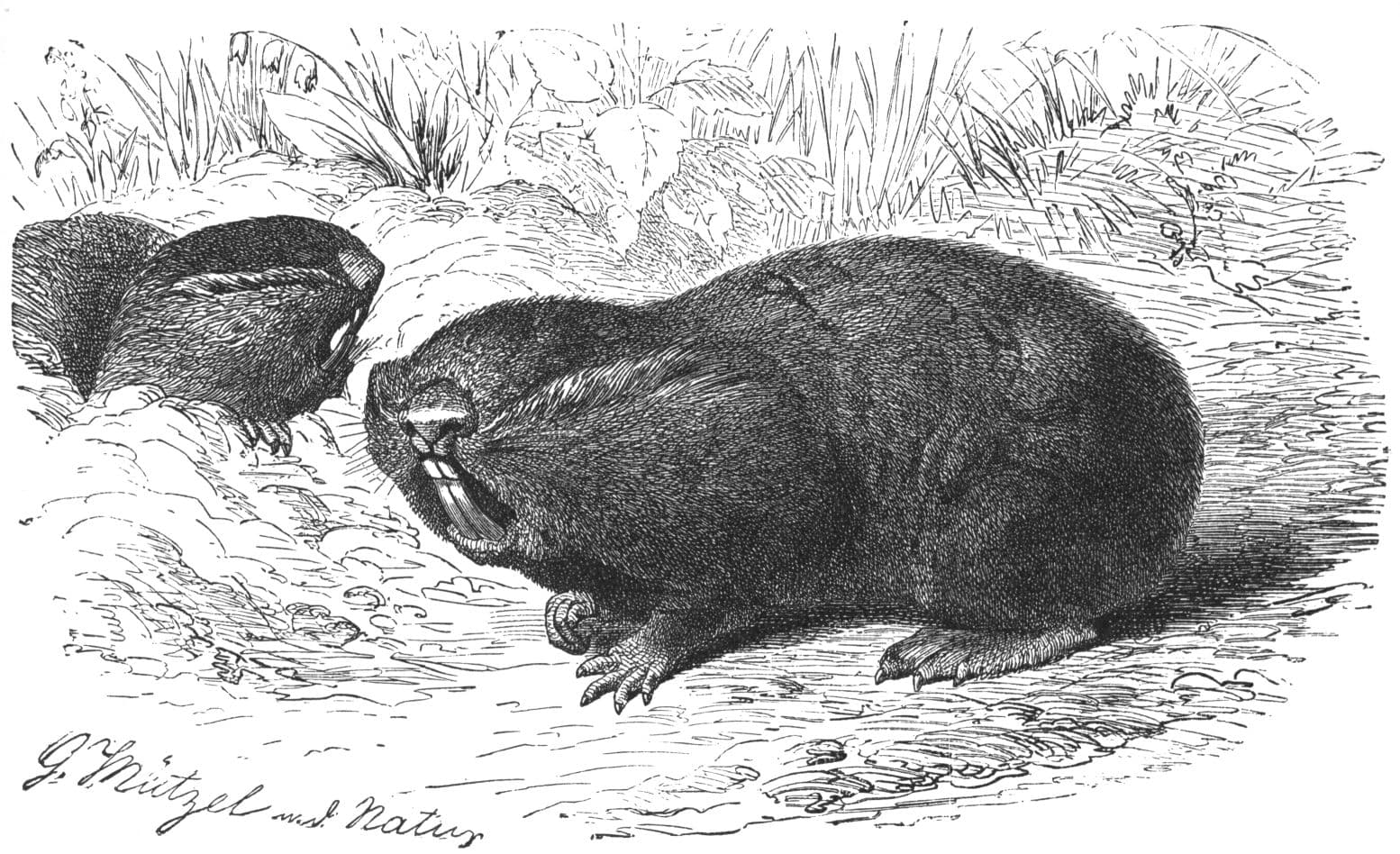
The eyes of blind mole-rats, which live their lives almost entirely underground, are small and completely covered by a layer of skin. Image: “Nehring’s blind mole rat, Spalax typhlus Pall. 1/2 natural size,” Gustav Mützel, Brehms Tierleben, Small Edition 1927, Public Domain via Wikimedia Commons.
Evolution wasn’t something we talked about very much in my home or church when I was growing up.
Yet somehow, I came to believe that evolution wasn’t compatible with Christian faith. At the time that seemed okay, because I had heard that the evidence for evolution wasn’t very strong anyway.
That all began to change when I started studying biology in college. In different classes, I encountered some of the compelling evidence for evolution and common descent.
Vestigial structures were one of the topics that came up often in biology textbooks about these topics.
Today, biologists point to vestigial structures as evidence for evolution, while some young-earth creationists dispute that interpretation—or even argue that these structures support their own view. So what are vestigial structures, and what do they have to do with evolution?
What Are Vestigial Structures?
Vestigial structures are features present in an organism that no longer do what they did in that organism’s ancestors.
These structures have become smaller and simpler in structure over time. In some cases, they have become so rudimentary that they can’t perform their original function at all.
Some people prefer to use the term vestigial organs, but not all vestigial structures are organs in the proper anatomical sense. Others may even refer to vestigial traits, which could include aspects of physiology or behavior as well.
Why Might a Structure Become Vestigial?
Vestigiality occurs when some factor that affects the survival or reproduction of a species changes.
This could include alterations in environmental or climatic factors, or it could involve changes in ecological relationships, such as the introduction of a new predator or the decline of a prey species. In new circumstances like these, a structure may no longer be beneficial like it once was.

Fossils | A Window to God's Creation
A journey into the world of fossils and what they can teach us about God.
When we see a vestigial structure, it may be in the midst of the long, slow process of being reduced or completely lost.
However, other constraints may make it so that it isn’t always possible to eliminate a feature. This is true in cases where critical developmental processes may be disrupted if a structure were to be totally lost.
In other cases, a vestigial structure may persist in some form simply because it is not energetically costly to maintain.
Are Vestigial Structures Completely Useless?
Some evolutionary biologists and critics of evolution characterize vestigial structures as completely useless, but this is not necessarily the case.
Loss of at least one key function is central to vestigiality. However, many vestigial structures have a secondary function that continues to be useful to the organism. It also might be possible for a structure to gain a new function during its evolutionary history.
In either case, arguing that a structure is not vestigial because it retains some function misunderstands what makes it vestigial.
Examples of Vestigial Structures
Vestigial Structures in Humans
There are many examples of vestigial structures in humans.
The appendix is commonly described as the remnant of a much larger cecum, which is part of the large intestine that helps digest plant material in some herbivorous animals.1
The coccyx (tailbone) is frequently cited as a vestige of the longer tail present in most other mammals.
While humans don’t have enough body hair to keep us warm or protect us from predators, we still have arrector pili muscles that cause body hairs to stand on end when we get goose bumps.
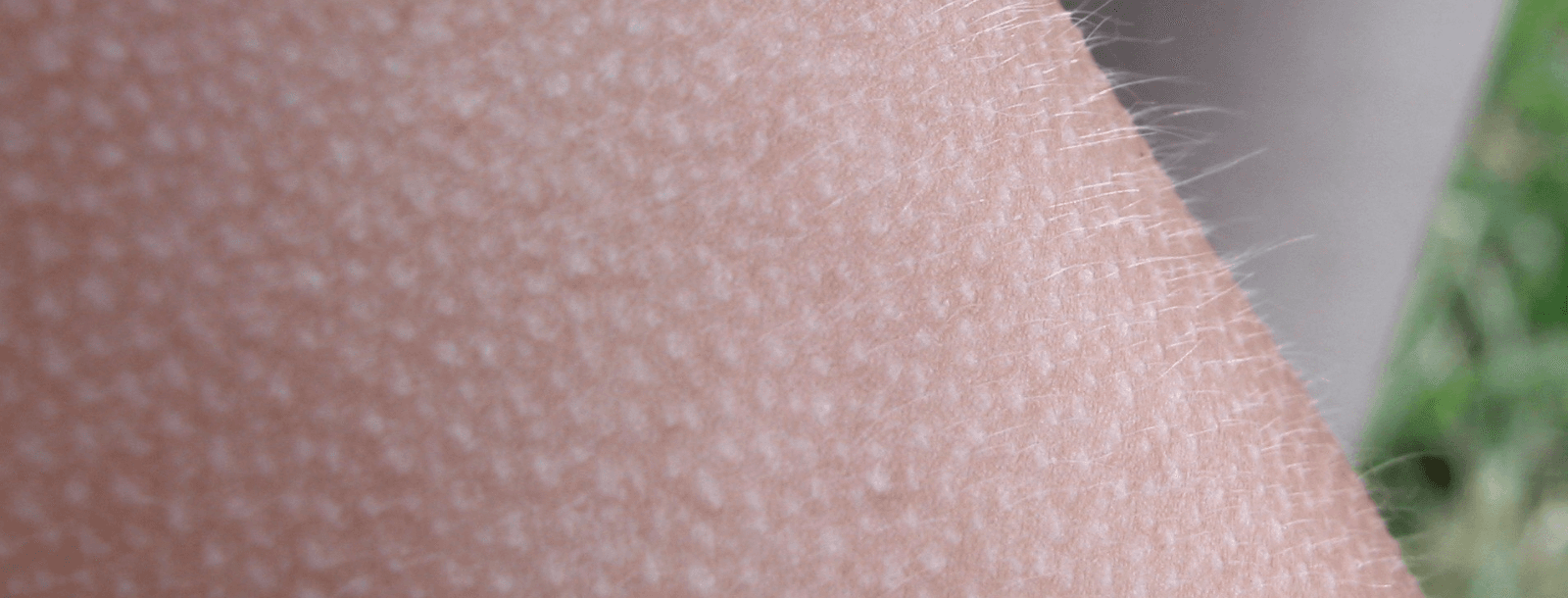
Goose bumps are caused by arrector pili muscles, an example of vestigial structures in humans. Ildar Sagdejev (Specious), CC BY-SA 3.0 <https://creativecommons.org/licenses/by-sa/3.0>, via Wikimedia Commons
We even still have small muscles on the sides of our heads called auricular muscles. Other mammals use these same muscles to rotate their ears in different directions to listen for a predator, but the best we can do with them is wiggle our ears a little bit.
Vestigial Structures in Animals
Examples of vestigial structures abound in the animal world as well.
There are many examples of flightless birds (including kiwis, emus, and the extinct dodos) with wings so small that they cannot fly. But this is actually beneficial given their lifestyles, since they don’t need to invest energy and nutrients into large wings.

Emus have wings so small that they cannot fly. JJ Harrison (https://www.jjharrison.com.au/), CC BY-SA 4.0 <https://creativecommons.org/licenses/by-sa/4.0>, via Wikimedia Commons
There are multiple examples of fish and salamanders that live in dark caves and have reduced, non-functional eyes. Some even have eyes that start to develop in larvae, but degenerate until they are completely lost in the adults.
Vestigial Structures in Whales
Aquatic mammals like manatees and cetaceans have many features that hint at their descent from ancestors that lived on land.
For example, their skeletons include small pelvic bones (and sometimes even other leg bones) despite them lacking hind legs. These bones do serve as attachment points for muscles associated with the pelvic floor and reproductive organs. However, they are far too small and underdeveloped to support weight-bearing limbs like they do in most tetrapods.2
Another fascinating example of a vestigial structure in whales has to do with the outer ear.
Most mammals have an ear structured like it is in humans: the pinna (auricle) on the side of the head collects sound waves and funnels them through a canal called the external acoustic meatus (auditory canal).
At the end of that canal, the sound waves cause the eardrum to vibrate. Those vibrations pass through a series of three tiny bones and result in fluid movement within the spiral-shaped cochlea. This activates tiny hair cells in the cochlea that send signals along a nerve to the auditory cortex of the brain.
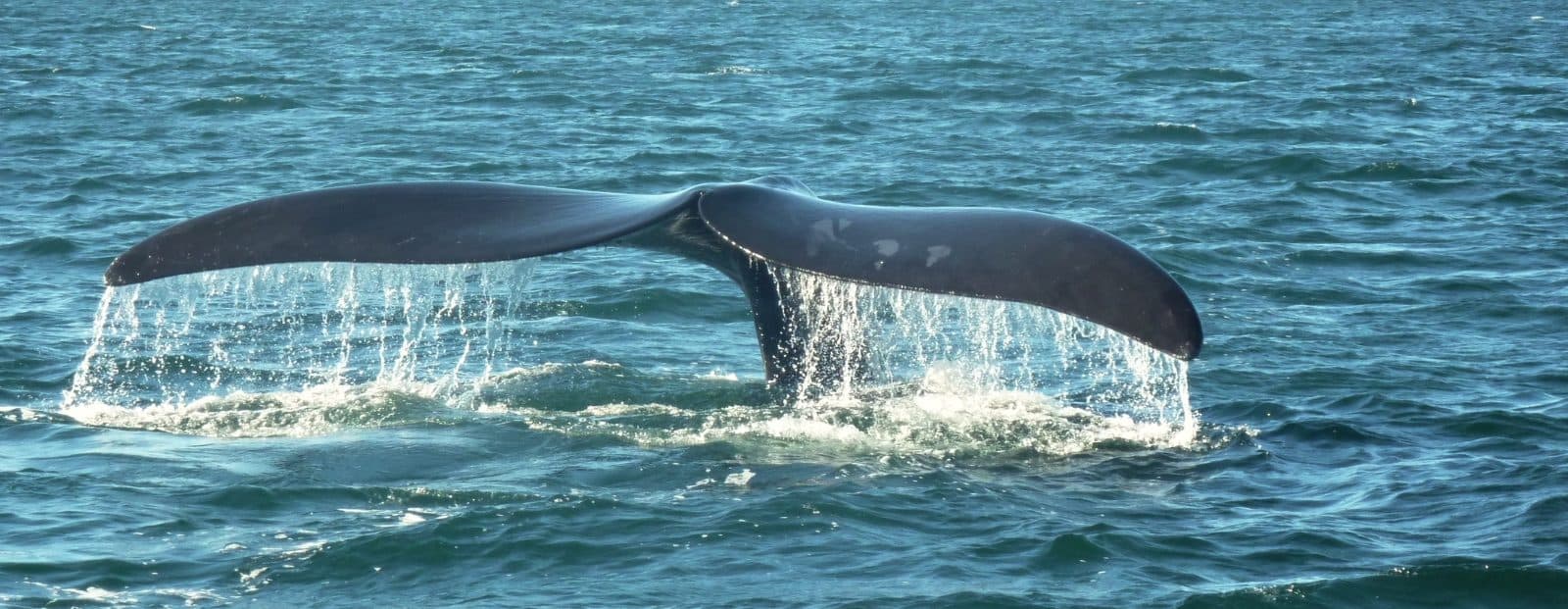
A whale’s tail hovers out of the water. Whales possess a number of vestigial structures. Photo: Dr.Hausderivative work: an-d, CC BY-SA 3.0 <https://creativecommons.org/licenses/by-sa/3.0>, via Wikimedia Commons
But for aquatic mammals like whales, this sort of ear doesn’t work very well in water. Cetaceans need a different pathway to get sound waves to the middle ear bones and cochlea. They do this by channeling sound waves from the water through their lower jaw.
At the back of the jaw, there is a pad of fat that transmits vibrations to the middle ear. This unique system allows cetaceans to hear directionally underwater.
However, they still have an external acoustic meatus and a remnant of the eardrum.
In toothed whales (including dolphins) the pinna has been completely lost, likely due to the benefits of having a streamlined body shape in the water. But there is still a small external acoustic meatus behind the eye.
Its structure has been significantly reduced. The canal is extremely narrow and at least partially (if not fully) blocked by earwax and cellular debris. The eardrum at the end of the canal has been reduced from a broad elastic membrane into more of a calcified ligament. This ligament can no longer help with sound transmission, though it may contribute to pressure regulation in the middle ear.
What Do Vestigial Structures Have to Do With Evolution?
Vestigial structures have been recognized for centuries, going back to at least Aristotle. But their presence did not have a compelling explanation until they were linked to ideas of adaptive change.
In On the Origin of Species, Charles Darwin discussed “rudimentary organs” as compelling evidence for descent with modification. Today, biology textbooks continue to discuss vestigial structures in their chapters on evolution.
The topic also comes up in young-earth creationist materials that seek to cast doubts on the strength of the evidence for evolution.
Many of these arguments focus on questioning the supposed uselessness of vestigial structures. In other words, they argue that if one or more functions can be assigned to a structure, then it must not be vestigial. But as noted above, a complete lack of function is not what defines vestigiality.

My Body Carries Evidence for Evolution?
Several features of the human body are best explained by common descent.
Vestigial structures are one type of evidence that supports evolutionary theory, and the distribution of these structures across the living world can serve as a test for the theory of common descent. If all living things share a deep history together, then we would only expect to see vestigial structures in organisms descended from ancestors that had the more functional versions of those structures.
To connect to the example above, we would expect to see a vestigial external acoustic meatus in whales and manatees, since they both descended from land mammals that shared a functional external ear. But we would not expect to see this canal in sharks or salmon, since they never had ancestors that were adapted to hear airborne sounds.
We see compelling patterns like this over and over again with different structures and organisms across the tree of life.
This is why vestigial structures continue to provide strong evidence for shared ancestry.
About the author

Ryan Bebej
Related resources
If you enjoyed this article, we recommend you check out the following resources:


Common Question


Common Question
