Evolution and Personal Faith: How Christian University Students Resolve the Conflict
Nearly all students receive some kind of science education and many experience tension between what they are taught at home and what they learn in school. How should that tension be addressed?
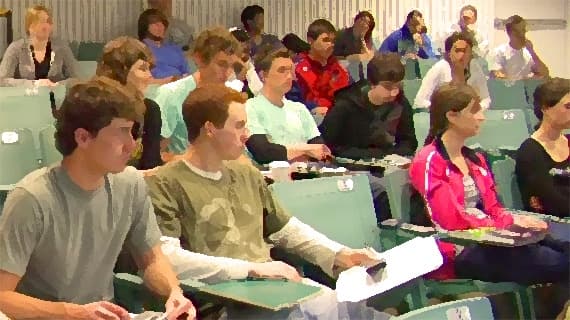
As students across the country begin another academic year, nearly all of them will receive some kind of science education, and many will experience tension between what they have been taught about God’s creation in church or at home, and what they are likely to find in science textbooks and hear from their instructors. How should that tension be addressed? How might it be resolved? What resources does the Church have (and still need) to equip our young people to honor the truth God has revealed in both his Word and his world, and to share in the work of his Kingdom?
Today we continue to look at those questions from several perspectives and approaches and in multiple educational settings with the first of a four-part series on how Christian biology-related majors at a mid-Western Christian liberal arts university reconciled evolution and their personal religious beliefs. Here Dr. Mark Winslow lays out the methodology of the study he and his colleagues conducted and describes the influence parents had on study participants’ beliefs about evolution and creationism. He continues by describing how students negotiated their perceived conflicts, as well as what factors led to their acceptance of evolution.
I have to ask God to give me patience to not hate the men who cause me and my dad to argue about origins. I think that if they could just realize that science is not out to destroy God then maybe they would give it a chance.
Rachel spoke these words as she reflected on her relationship with her father and the strain she felt about her own acceptance of evolution. Rachel had grown up as a pastor’s kid firmly entrenched in Young Earth Creationism. When she enrolled in a Zoology course at a Christian college as a Pre-Med major, it was the first time she had encountered the notion that a person could accept evolution and remain a vibrant Christian – her professor was a testament to that reality. Through her experiences at the university, Rachel eventually came to accept cosmological, geological, and biological evolution as valid in understanding the long history of the universe and life on Earth. However, her acceptance of evolution was an extended journey marked by conflict resolution and apprehension.
Rachel’s account of her struggle with evolution resonates with the stories told by many participants in a qualitative research case study designed to explore how Christian biology-related majors at a mid-Western Christian liberal arts university reconciled evolution and their personal religious beliefs. Their individual stories and the common themes that emerged from research data are the focus of this three-part series.
This first part of the series provides a backdrop for the reader to see this crucible of conflict from the participants’ perspectives – using their words to convey the struggle and anxiety of encountering evolution in juxtaposition to their faith. The second part of the article explores the participants’ negotiation of their perceived conflict between evolution and their personal faith. The third and final part of the series discusses the factors in the participants coming to an acceptance of evolution and addresses the question, “What, then, are the ramifications for college educators and those who seek to mentor young people in reconciling science and faith?”
The 15 participants in the case study were senior biology-related majors (biology, biology-chemistry, or biological science education) and recent graduates (within the last two years) who majored in a biology-related science, and had completed an upper-level biology course on evolution entitled Origins. While a diversity of approaches exists in addressing evolution issues at Christian universities, no aspect of the study site suggested that it was atypical of higher education institutions committed to the teaching of evolution in non-opposition to religious belief. Or to put it positively, the college is typical of other Christian institutions where evolution is taught as being compatible with faith.
Parental Influence
Data were collected for the study from December 2006 to August 2007, utilizing a dual interview design. The first interview investigated the participants’ worldview using Fowler’s (1981) structural-developmental theory of “stages of faith” which describe the cognitive rationale and affective response in shaping one’s world. The second interview was conducted approximately a week following the first interview and explored participants’ perceived conflicts between evolution and personal religious beliefs. Additional data came in the form of the Evolution Attitudes Survey (Ingram & Nelson, 2006); descriptive field notes of the Origins course in Spring 2007; a “scholarly paper” that participants wrote in the Origins class that integrated course content with their own worldview; and participant feedback on interview transcripts and researcher-written descriptive personal portraits that described their views of creationism and evolution. The data was coded, and through multiple readings and refinement of codes, patterns evident within the data suggested common themes in the experiences of the students.
This article series is not a formal presentation of the study (see Winslow, 2008 and Winslow, Staver, & Scharmann, 2011), but seeks to tell a story from the participants’ perspectives to help the reader better understand their experiences in reconciling science and faith.
Participants’ Views of Creationism and Evolution
Table 1 summarizes participants’ childhood beliefs, including the sources for those beliefs, and their views on creationism and evolution at the time of the study. As the data show, most of the participants were raised during childhood to believe in Young Earth Creationism.

Many participants reported that their strong creationist and anti-evolution beliefs were due to their parents’ influence during childhood. Eight participants voiced that one or both parents expressed a strong belief in creationism throughout the participants’ childhood and expected participants to hold similar beliefs. For example, Nicole stated, “My family was . . . very much of the Genesis is the golden rule. God created the earth in seven days. That’s how it happened, no questions asked. If you asked questions, . . . you were thinking too hard about it.”
Asked about where she acquired her negative view of evolution before enrolling at the study site university, Rachel recalled hearing her parents’ conversations, such as, “Darwin is a tool of the devil and . . . he’s led so many people astray from God and that’s just terrible and don’t get sucked into that because it’s the devil working through him.” Rachel added, “I’d be kinda listening in” and soon enough, she found herself saying to her high school friends, “Oh yeah, I can’t believe these evolutionist liberals.” She added, “Those two words always went together – liberal and evolutionist!”
Other participants remarked that they simply assimilated creationist beliefs from what they heard in church. Six participants perceived that their parents believed in creationism, but primarily because creationism was part of the participants’ upbringing in the church. In other words, parents’ expression of their belief in creationism was less pronounced than in the other eight cases. For example, Ashley noted,
“I’m pretty safe in saying from the time I was born until high school senior year, the first chapter of Genesis was literal. That’s just how I was raised. . . . Nothing was ever questioned.” Ashley clarified, “Not that they [my parents] said everything in the Bible is word for word true, . . . but no one ever said the opposite, that it wasn’t literal. So I just assumed that it was.”
Other factors, such as church, friends, siblings, and spouses were construed by participants as relatively moderate influences in their lives. For example, when participants expressed apprehension in their encounters with evolution, not a single participant expressed anxiety about the response of their church or pastor. Instead, most were worried about the reaction of their parents.
For many participants, the anti-evolution sentiments they heard in childhood continued while learning evolution at the study site university. Several participants asserted that their parents expressed displeasure that their daughter or son was learning evolution at a Christian university. For example, Jennifer stated that whenever her parents spoke of “evolution stuff,” they would pejoratively append, “and that’s not right.” In high school, Jennifer thought of evolution as “kind of a theory. . . . It was just something . . . good for the scientists, but that’s not what happened.” She recalled in her junior AP Biology class that the teacher announced, “Well, I teach evolution as a theory, not as a scientific explanation.” Jennifer laughed as she recounted, “My mom was real happy that I was having her for my teacher.” However, when Jennifer took the Origins course at the study site university, she began to share her new ideas about evolution with her parents. She recalled they became increasingly “apprehensive about things.” Jennifer could tell by their body language and, as she described,
[the] kind of looks they give me whenever I’m like, “Well, what about this [evidence for evolution]?” Because I get real kind of built up about things like this . . . and I’m like, “But this is what I learned in college” [shouting as she says this] and I bring my papers home and I’m like, “Look at this” [pounding the table] and they’re like a little skeptical. . . . You kind of see it in their eyes and they furrow their brow and stuff like that.
Jennifer enjoyed a strong relationship with her parents and despite the pressure she encountered from her parents regarding evolution, she said, “I’ve come to respect their opinions about certain things a lot more. At the same time, I’ve come to realize that maybe they’re not always right in every single thing. . . . It’s okay for me to think differently than them.” As reflected in the last column of Table 1, Jennifer was among the thirteen participants who—at the time of the study—affirmed that God created through evolution in contrast to their childhood beliefs.
Two noticeable exceptions are Ashley and David. David espoused a traditional, Young Earth Creationist view. Ashley’s views were a hybrid model of Old Earth Creationism and Evolutionary Creationism perspectives. Having come from a strong creationist background, Ashley adapted her views while in college to assert that God specially intervened to create an initial line of ten thousand species through which evolution took over to result in the diversity of life on earth. Item 1 in the Evolution Attitudes Survey stated, “Over billions of years all plants and animals on Earth descended from a common ancestor.” David strongly disagreed and Ashley disagreed with this statement. Nine participants agreed and four participants were undecided.
Most participants also accepted human evolution as evidenced from their interview statements, scholarly papers, and survey data. Five items in the Evolution Attitudes Survey dealt directly with human evolution. Marking “strongly disagree” or “disagree” on these statements would indicate an acceptance of human evolution. Fourteen participants demonstrated an acceptance of human evolution from their survey results. David was the lone exception. Eight participants either “strongly disagreed” or “disagreed” on all five items while the remaining participants marked disagree with only one or two “undecideds” on the five survey items.
The results from the survey show a clear trend in 14 participants’ acceptance of human evolution despite a relatively mixed response to Item 1, which said, “Over billions of years all plants and animals on Earth descended from a common ancestor.” For instance, Ashley disagreed with evolution from a common ancestor, but she disagreed with every statement that rejected human evolution. Similarly, all four participants who were undecided on evolution from a common ancestor indicated by their survey responses that they accepted human evolution.
Participants saw ample evidence for human evolution in the Origins course both in textbook and lecture materials. Accepting human evolution may require less scientific inference in the minds of the participants than the linking of all living things to a single ancestor billions of years ago. Many participants expressed that human evolution was part of the larger story of evolution. When asked if humans evolved, Gail said, “For evolution to make sense in my head, we have to have had a common ancestor. If I understand evolution correctly, there has to be some ultimate beginning, which would be a link for all of us.”
The transition from Young Earth Creationism to Evolutionary Creationism for most of the participants was not an easy one. As we’ll see next, that journey was marked by apprehension and a process of conflict resolution.
When they entered the study site university as freshmen, many of the participants had no concept of Evolutionary Creationism and instead held to anti-evolution perspectives. Two notable exceptions are Diana and Tiffany. Diana’s father was a geologist and taught her from a young age to see evolution as valid and without contradiction to her Catholic faith. Tiffany was also unique in that she accepted non-human evolution while in high school when she discovered that evolution “didn’t necessarily mean that God didn’t create everything.” Still, Tiffany faced uncertainty about human evolution. Both Diana and Tiffany were surprised at how many of their fellow classmates in the Origins course struggled with evolution. Tiffany said, “I didn’t even realize that until I actually took that Origins course and there were kids in there . . . [where] the light bulbs were just coming on and I was like [? – quizzical, bewildered expression].”
Diana and Tiffany’s relative ease with evolution contrasted with most other participants who struggled to overcome their distrust of evolutionary ideas. The data indicate two primary sources of anxiety: participants’ apprehension about how they would defend an emerging acceptance of evolution to their parents; and participants’ awareness that the beliefs they once thought to be sacrosanct were beginning to change.
What Will My Parents Think?
Participants who accepted evolution worried about how they would be viewed by their parents. Eight participants indicated that they had experienced conflict with their parents over evolution or were too worried to broach the issue with their parents. Megan still hadn’t discussed evolution with her parents in the year since she took Origins. She said, “I’m kinda . . . scared about talking to them [about evolution].”
In contrast to Megan, five participants broached the subject of evolution with their parents and recounted the heated arguments that ensued. The parents reportedly denied evolution as a valid theory and stated that it contradicted the Bible. For example, Rachel recalled tense exchanges with her father in which they would get into arguments and “become angry.” She cited his comments, “Why are you thinking this way? We sent you off to a Christian school [and] you are learning all this liberal garbage?” Furthermore, all five participants indicated their parents viewed a literal interpretation of Genesis as a necessary condition for salvation. Rachel remarked, “I have been taught my whole life you can’t be both [a Christian and an evolutionist], that’s just not how it works.”
The emotional stress that many of these participants experienced in forming increasingly independent views about evolution in direct opposition to their parents cannot be overstated. Gail felt so pressured on the matter that she formulated her scholarly paper as a letter to her father. The genuine emotion of her plea merits quoting at length below. The title of her paper in Origins was “Dear Dad…” and the following are excerpts:
Dear Dad,
I am writing to explain to you what I have learned in my origins class this spring. . . . You and mom have always had a strong belief that God created the earth in six twenty-four hour days as outlined in Genesis one; however, probably much to your horror, this class has challenged that belief. Please keep in mind that this class never once challenged the existence of God. . . . It set out to explain how God created the earth.
Later in the paper, Gail implored her father, “Please do not question my walk with God.” She explained how theologians “consider Genesis one to be a Hebrew poem,” and that the “Bible was not written as a scientific journal.” Gail concluded her paper with,
Dad, I know this letter is probably discouraging to you – maybe someday I will be convinced otherwise, but this seems very logical and practical to me. I pray that you will not condemn me in your disappointment, but understand that it is not a contingent factor in my salvation… I pray you have at least been open to this letter and accepting of my stance.
Your Loving Daughter, Gail
Asked why she wrote the paper to her father, Gail responded, “I was . . . just trying to convince him that . . . I hadn’t gone off the deep end, [that] I wasn’t crazy.” Gail considered the paper as “a little therapy session getting everything I wanted to say to my dad out on paper and it just almost felt like I was relieving a burden.” In the two years since she completed the paper and during the time of the study, Gail still hadn’t given it to her father.
Changing Beliefs
A second source of anxiety for participants was a developing awareness that some of their long-held beliefs were now beginning to change at the university. Many participants did not realize that a Christian could accept evolution until they arrived at the study site university.
For some participants, it was a complete shock to see a professor present evolution in the Zoology classroom. Stephanie described her evolution encounter in freshman Zoology as the “most upsetting time” in her college experience, and her “defining moment of . . . being challenged.” She recounted, “I was sitting there and she [the Zoology professor] started talking about it and I was just floored that she could believe in evolution. I was like, ‘You call yourself a Christian and you believe in evolution?!’ [her voice elevated and sounding incredulous]” Stephanie continued, “I remember walking out of that class so angry. I can still remember how angry I was.” Reflecting on her experience, Stephanie offered “disgusted” as a “good word” for how she felt.
Ashley said that learning about evolution “was a culmination of your thoughts for so many years being shattered and then you’re picking pieces here and there and adding your own.” She expressed a personal sense of shock in first learning that a Christian could accept evolution. A look of exasperation came over Ashley’s face when she reflected on that new realization her sophomore year when a guest lecturer spoke on campus about evolutionary creationism. With a laugh of incredulity, she said,
Now do you see what I mean about being blindsided or bombarded with things that for 18 or 19 years you’ve held true? I mean, to me, it’s almost like for 23 years believing that my mom and my dad are my parents and then one day, them saying, ‘No, you’re adopted.’ That’s kinda like what it was to me. Just this truth for so long and then you’re just like, ‘What?!’ That’s how out of the blue it was to me.
Stephanie’s and Ashley’s reactions of anger and shock were apparently provoked by a sudden, unacknowledged fear that a belief they had held so strongly for most of their life was suddenly overturned. As was true with many participants, Stephanie and Ashley realized for the first time that a Christian could accept evolution.
Many participants reported that the process of coming to an acceptance of evolution was journey-like and took several years. Some who learned about evolution in their freshman Zoology class didn’t resolve the issue in their minds until their junior or senior year. In many cases, the process was a slow accumulation of scientific evidence from various science courses. Many participants reported that Origins was a semester-long process of working through perceived conflicts. Ashley described her experience in the course: “There you were, a whole semester, just basically ripping your hair out about where you stand.”
Some participants mentioned they had “a-ha” moments along the journey. A few participants encountered a new perspective in a lecture or in a book, and their ideas about evolution and personal religious beliefs suddenly found greater clarity in the context of each other. However, these advances were steps along an extended journey. Many participants indicated that the process was a tug-of-war experience. They were pulled back and forth in deciding what scientific aspects to accept and how their religious beliefs would mesh with that new scientific acceptance. The comments of Ashley illustrate the struggle:
I wanted to please both sides of myself. I wanted to please the science part of me but I also wanted to be true to the faith part of me and I wanted to get right in the middle and make sure both were alright and sometimes it’s not possible.
Later in her interview, Ashley also remarked, “I felt like you’d get three steps ahead and you’d be ‘Alright’ and then five back! . . . And it was just a constant thought process . . . about where do I stand on this new issue.”
Jennifer joked about trying to find closure on human evolution saying, “When it [the Bible] says man was created instantaneously, one [evolution] says man was created over time, that was hard, but we eventually worked that one out.” Asked what she meant by “we,” Jennifer laughed and offered as an explanation, “Well me, myself, and I.” Her joke implies the internal, contentious, decision-making process to which many participants similarly alluded. Throughout many participants’ recollections was an undercurrent of anxiety in becoming aware that some of their religious beliefs were changing for the first time.
Part 1 of this three part series described the influence parents and others had on study participants’ beliefs about evolution and creationism; Part 2 addressed the process through which those participants tried to resolve both personal and interpersonal conflicts in coming to an acceptance of evolution. Today’s Part 3 focuses on the specific factors that eased participants’ acceptance of evolution. The interview protocol did not specifically ask them to identify factors they considered crucial to accepting evolution; however, as participants recounted their stories, patterns emerged from the data to suggest that four factors were important as part of the process of accepting evolution:
- relying on the evidence for evolution
- negotiating Genesis as non-literal
- recognizing evolution as a non-salvation issue
- observing professors as role models of Christians who accept evolution.
These four factors are not to be construed as a requisite for accepting evolution. Instead, these four factors helped the process of accepting evolution for the participants.
Relying on the Evidence
The data show that the evidence for evolution was an important consideration for most participants who accepted evolution. A common thread evident in many participants’ dialogue was their dependence on the scientific evidence. Ten participants specifically said the evidence for evolution was incontrovertible. Several participants articulated that though they took their parents’ or teachers’ word at face value in the past, they now demanded evidence from those authority figures to back up their statements.
Rachel noticed herself becoming more reliant on evidence to adjudicate her positions and reflected, “When I was younger, I took everything that everyone said at face value . . . and if an adult said it, it must have been true.” But as an adult herself, Rachel said her line of questioning is now: “Why do you think that? Can you provide more evidence as in ‘why?’ and not just tell me ‘because’?” Rachel’s comments clarify the way many participants had transitioned to a reliance on evidence to support what they held as true. In the context of science, that reliance was on scientific evidence, and many participants said the evidence for evolution was overwhelming.
David was the only participant to categorically deny evolution. He appeared to operate with a mental filter that collected only ideas and purported evidence that supported his existing creationist notions. Incontrovertible evidence for evolution apparently slipped through David’s filter without serious consideration. David was familiar with Intelligent Design arguments regarding the irreducible complexity of biological systems such as blood-clotting mechanisms and the bacterial flagellum (Behe, 1996), which he posited could not be explained by evolution. The researcher, in an effort to remain neutral and not broach the fact that science currently has valid explanations for these mechanisms (e.g. Pallen & Matzke, 2006), asked David how he would react if science found a naturalistic explanation to these systems. David referred to a historical example to state his response:
If they prove it right, I mean everyone from Galileo’s time, they didn’t want to believe the earth wasn’t the center of the universe and he proved that false. . . . If I go to not take those, then I cannot call myself a scientist. If they provide the facts and give them—show they are true, then—and I don’t take them, I can’t consider myself a scientist.
A careful inspection of David’s statements reveals that he never said he would accept the evidence, even if shown to be “true.” Ironically, David’s reference to Galileo is fitting. Several of Galileo’s most vocal critics in the early seventeenth century refused to look through Galileo’s telescope. However, several prominent Jesuit astronomers looked through the telescope and “did not deny the evidence of their senses” (Sobel, 2000, p. 40) and affirmed the Copernican Theory. It appeared as if David was unwilling to look through the telescope.
A Non-Literal Genesis
A second factor for most participants who accepted evolution was negotiating Genesis as non-literal. Most participants asserted they had been raised to believe in a literal interpretation of Genesis by their parents, and the notion that the Bible is literal was taken for granted by many participants from childhood on. All discussed the past and ongoing importance of the Bible in their lives, and indeed, many of these young men and women demonstrated an intimate knowledge of the Bible by referencing and quoting scripture to support their statements. However, participants recognized that a literal interpretation of Genesis was at odds with evolution. Megan wrote in her scholarly paper, “A strictly literal interpretation of the Bible does not mesh with the evidence discovered by science, especially the discoveries made within the past century.”
Furthermore, some participants recognized that an acceptance of evolution would not jeopardize their salvation. This thought process can be paraphrased, “My salvation is unaffected because I can concomitantly accept evolution and remain true to the Bible as it should be interpreted.” These paraphrased statements are echoed in the comments of Gail. When asked what had made the crucial difference in turning the corner in accepting evolution, Gail responded that it was when the Origins professor “brought up the fact that, ‘This isn’t crucial to your salvation and we’re not saying that God didn’t start it all, that God’s not behind it. We’re just saying here are all the natural laws . . . [that] God put in place.’” Gail recognized through her professor that evolution did not countermand a belief in God or in the Bible.
Not a Salvation Issue
Gail’s comments link her recognition of Genesis as non-literal with the third factor in many participants’ acceptance of evolution: the realization that an acceptance of evolution and salvation are not linked. Prior to attending the study site university, many participants never believed that a Christian could accept evolution. At some point, those who held that assumption had to evaluate its legitimacy. Furthermore, five participants in particular had to deal with parents who doubted that accepting evolution could be uncoupled from spiritual standing.
Jennifer, for example, reported that she would go home and tell her parents about her Christian professors who affirmed evolution. She would use that as “leverage,” telling her parents, “So it must be okay. God’s not gonna strike you down cause they’re still alive kind of thing.” Jennifer’s joking notwithstanding, many participants had to make an intentional or unconscious break with their previous assumption that an acceptance of evolution placed a Christian’s salvation in serious jeopardy.
Role Models
The fourth factor in many participants’ acceptance of evolution was observing a Christian professor model a commitment to evolution. The data show that participants viewed their professors as validation that Christians can unapologetically accept evolution.
Megan serves as a poignant example. She first learned about evolution while writing a report for a high school biology class. Megan reported that she “paid no attention” to what she wrote and simply completed the assignment for a grade. But at the university, she remarked, “Here are all these Christians around me and a Christian professor who is having this kind of idea and that actually made me open up to it.” Rather than ignoring evolution as she had done in high school, Megan could consider an acceptance of evolution because it was so powerfully affirmed by her Origins professor, bringing her to a point where she could say, “Maybe I can believe that too.”
Many participants indicated a respect for professors who were genuine and forthright in presenting evolution in a Christian context. Seven participants expressed this sentiment. For example, Ashley commented about the Origins professor:
She has such a humble, low-key sense of spirit that . . . I respect everything that she says and to me she really is true. It was helpful to know that the person standing up there teaching me wasn’t trying to number one impress their opinions on to me. They were just giving them to me and that they weren’t out to prove something. I really felt like she wasn’t trying to prove creationism and she wasn’t trying to prove evolution. She was just presenting things and in turn letting you decide where you stood, but she would give you her opinion.
Rachel noted that it wasn’t enough for the Origins professor to simply claim to be both a Christian and evolutionist – she needed to see it demonstrated by her professor. Rachel explained,
They can say they’re Christian and be an evolutionist, but it would really help for Dr. [Origins professor] because she actually showed you. She’d talk about God so passionately and . . . you knew she was speaking from her heart. You knew she believed it and God’s love, but then she also talked about evolution and so you kinda had to reconcile the two [Christianity and evolution]. . . . My whole life it was just two things that were separate and they must stay separate, but with her they kinda came together and you had to reconcile them.
David once again comes into sharp contrast with the other participants in this study. While he credited his religion professors for shaping his ideas about Christianity, he made no mention of any of his science professors as role models. David appeared so firmly entrenched in his anti-evolution stance that he remained unmoved by the example of his Origins professor and other science professors who affirmed evolution. The mental filter that kept out conclusive evidence for evolution while letting in only purported evidence for David’s existing notions of creationism appeared to extend to authority sources, as well.
Conclusion
To summarize, four factors facilitated many participants’ acceptance of evolution. Participants’ cited Christian professors who avowed evolution, a new reliance on evidence for evolution, the realization that Genesis could be non-literal, and recognition that an acceptance of evolution did not jeopardize salvation.
University professors and those who seek to mentor young people in reconciling science and faith may view this study’s findings as relevant in several ways: first, it may help them gain a better understanding of the mental crucible in which Christian young people attempting to reconcile evolution and personal religious belief find themselves; second, it may help professors recognize the importance of role models who demonstrate a robust faith and an unmitigated acceptance of evolution.
Popular literature often champions the teacher as a potential role model to shape and inspire student learning (e.g., Palmer, 1997), and the same is certainly true in this context; the findings of this study underscore the importance of Christians in higher education who demonstrate integrity to both science and religion. Given participants’ frustration at growing up without seeing Christians who modeled a coherent and positive commitment to science, it’s not surprising that many participants viewed their professors as important role models.
This study’s findings are also consonant with the imperatives given by scholars (e.g., Holmes, 1987; Poe, 2004) who are familiar with the Christian higher education goal of helping students find ways in which religious faith and learning interact in positive ways. Holmes writes,
Students need . . . to gain a realistic look at life and to discover for themselves the questions that confront us. They need to work their way painfully though the maze of alternative ideas and arguments while finding out how the Christian [religious] faith speaks to such matters. They need a teacher as a catalyst and guide (p. 46).
A well-respected science educator writes, “Science does not occur in a vacuum” (Lederman, n.d.). In this study, personal religious beliefs had a great bearing on how participants viewed evolution. In spite of the conflict and apprehension these students faced in seeking ways to reconcile evolution and personal religious beliefs, an unshakable conviction of the reality of God in their life carried them through times of doubt and discouragement.
Holding Fast to the Bible
So far, I described the factors that help Christian biology-related majors come to an acceptance of the truth of evolution while navigating the sometimes-incongruous messages they receive from two different sets of trusted older adults: their parents and believing university faculty. But just as important as how these students come to believe in evolution is how this new belief affects their continued lives of following Christ.
Our study’s findings have two messages for Evangelicals who are interested in better understanding how such students reconcile evolution and personal religious beliefs: first, the findings demonstrate that those who accept evolution can remain committed to their religious beliefs. In this study, an acceptance of evolution did not diminish participants’ view of God or the importance they placed on the Bible. Second, many believing biology-related majors seek wholeness and coherence in their lives by endeavoring to be true to both science and their religious beliefs. Each of these is discussed below.
Many proponents of Young Earth Creationism claim that societal acceptance of evolution leads to a moral breakdown of society (e.g., MacArthur, 2001; H. M. Morris, 1976). Ham (1999) claims that “evolutionary/long-age ideas totally undermine” the foundations of Christianity and lead students to seeing the Bible as “just an outdated religious book” (p. 27).
Theistic evolution or evolutionary creationism—the notion that God created through evolution—is also subject to these assertions of evolution’s inescapable dangers. Gitt (1995) warns, “The doctrines of creation and evolution are so strongly divergent that reconciliation is totally impossible. Theistic evolutionists attempt to integrate the two doctrines, however such syncretism reduces the message of the Bible to insignificance” (p. 51). Many participants in this study reported that their parents echoed similar declarations.
Contrary to these claims, however, the acceptance of evolution by participants in this study did not lead to a rejection of the Bible or a loss of personal religious beliefs. Instead, many participants said that their understanding and acceptance of evolution gave them a greater appreciation for God as Creator. For example, Megan wrote in her Origins scholarly paper as a junior, “At some point, I have to decide whether these ideas change my relationship with and/or my view of God. So far, God is still my Creator and my Savior, the One who is in charge of everything and that is all that really matters.”
When she was interviewed as part of this study a year later, Megan acknowledged that God could have created according to the Genesis account, but then rhetorically asked, “Why couldn’t He also do it this way [through evolution]?” She added, “There’s a lot more evidence to back up this claim [evolution]. . . . I just kinda realized maybe God could do it this way too and that just made Him even more powerful.”
Heather noted, “I see God through science, but it’s . . . understanding creation and understanding what He has done [that] makes God come alive.” Other students echoed these themes: Brittany said, “I didn’t think of God not being in it [evolution]. It made me think more of God in it. It made me think God is this amazing – how can He make such amazing creatures?!” In his Origins scholarly paper, entitled “Evolution: A Beautiful Way to Understand God,” Michael wrote,
Understanding these scientific theories give [sic] us a special way to see God. Learning scientifically about these areas only allows for a better understanding of God and His vast power in the amazing way He has created this universe.
No student expressed a disregard for the Bible. Instead, many noted that they had learned to approach the Bible with revised interpretive tools. John described his interpretive lens as “understanding how the Bible was written, and the purpose that it was written, and the audience that it was written to, and . . . their cultural understanding of science in their day.” Negotiating Genesis 1 and 2 as non-literal did not reduce participants’ respect for the Bible. Instead, many participants noted that the Bible was not meant to be a scientific textbook. Rather, the Genesis creation story, as Michael explained, “tells us why God created us, . . . why He wants us to live in relationship with Him and things like that. It tells us characteristics about God and things of that nature.”
Two Windows on Creation
Interestingly, our study’s findings contrast with others that explored university students’ attitudes on evolution in very different cultural contexts. Dagher and BouJaoude (1997) studied Lebanese Christian and Muslim biology majors, and Brem et al. (2003) conducted a survey of 135 university students at a major, public university in the Western United States. While these studies are discussed at more length elsewhere (Winslow 2008), it can be said that the attitudes about evolution in those settings was much more mixed—something that further underlines the importance of the Christian role-models discussed earlier in this series for helping students (even non-Christians) see the compatibility of evolution and Christian faith.
In our study, only one student rejected evolution. David vigorously defended Young Earth Creationism and used Intelligent Design arguments to dispute evolutionary theory. He also denounced evolution for what he perceived as its moral debasement and corrupting influence on societal values. In contrast, fourteen participants did not attach negative implications to evolutionary theory. Those who accepted evolution affirmed God’s role in the creation process while reiterating their own teleological purpose. They supported evolution as a practical mechanism for the creation of new species and rejected any association with a negative view of theodicy.
Clearly, then, Christian biology-related majors at a Christian university who accept evolution can persist in an abiding belief in God, a commitment to the Bible, a dedication to the Christian life, and a positive view of teleology and theodicy. Moreover, many of these students seek wholeness and coherence in their lives by endeavoring to be true to both science and their religious beliefs.
This sentiment is a rejection of two other possibilities: a creationist conflation of science and religion, and a complete isolation between science and religion. Indeed, most participants in this study recognized that creationism was an improper conflation of science and religion, and understood that altering science to fit a Biblical account of creation was a violation of scientific principles. Ignoring the overwhelming evidence for evolution was not an option for those students who were developing scientific habits of mind.
Still, while most recognized science and religion as separate and unique ways of knowing, they asserted that science and religion could and should interact in positive ways. In other words, science and religion were not completely isolated. Jennifer espoused such a position, claiming that science and religion are like two separate windows through which to view the world. What is observed through the science window is distinct from what is observed through the religion window because, as Jennifer noted, “religion is for the why and . . . what’s the purpose, . . . whereas science is the what and the how it works.” She also noted, “If you are looking at it [the world through these windows] to ask the correct questions, they might give you an answer that forms to create one big answer that complements with itself.”
In summary, these students asserted that science and religion are separate but positively interacting, and claimed that as long as a person maintained proper boundaries in their application of science and religion, conflicts between the two could be resolved.
On the other hand, many students expressed frustration that a proper view of the domains of science and religion was sorely lacking in the Evangelical community, as evidenced by what they heard from their parents and in their churches. Brittany was disappointed by those in the church who led her to believe in childhood that “Darwin’s bad, Darwin’s evil, evolution did not happen, there is no way, God did everything.” She added, “I guess that was . . . [my] biggest problem – thinking they were just telling me things that they didn’t know why they said it.” Michael voiced similar feelings:
I don’t know why the church is so scared of this stuff. . . . I think they’re getting better definitely, but there’s still people out there that just make up stuff because they’re scared that it’s going to change something – that the truth will change something. It . . . really frustrates me when growing up, . . . you pretty much get the idea of evolution is wrong and . . . the evidence they [scientists] make up is false.
Again, an Evangelical Christian may allege that this study’s participants are misguided in their understanding of the separate domains of science and religion and claim instead that religion always trumps science, that scientific findings are always subservient to Biblical explanations (e.g., Lubenow, 1978) and therefore, evolution is invalid. This type of thinking is what many participants lamented: antievolution dogma so rigid as to disallow the possibility that evolution may be God’s mechanism for creation.
Lives of Reconciliation
Finally, some critics of evolution might allege that the students who accepted it are not “real” Christians. However, the data show that they remained committed to their religious beliefs and to a Christian way of living, including Bible reading, praying, and attending church. Many sought to assure their parents that they hadn’t “gone off the deep end” in accepting evolution, as Gail described it. Gail said she wasn’t trying to convince her parents to accept evolution, but rather to have them understand her perspective. She expressed relief when she reported, “We [my father and I] have both come to an understanding and acceptance of each other’s opinions and . . . that doesn’t have to change our relationship, and that we can still respect each other even though we don’t agree on this . . . one topic.”
But the testimony of Rachel offers perhaps the most striking example of those who accepted evolution with a continued commitment to their Christian way of life, in stark contrast to the opinions of naysayers who would cast doubt on that possibility. In her interviews, Rachel shared about heated arguments with her father, a pastor in the same denomination as the study site university. Asked why her father was so concerned about her views on evolution, Rachel reflected,
I think he’s really concerned about my spiritual life and he wants me to stay on track with God and so I kinda tried to tell him you know, “I’m there and I’m walking and I’m praying and reading the Bible so it hasn’t affected me,” but it’s still, I think it’s hard for him to get out of that mindset. I think he’s afraid that it will kinda push me away from God instead of getting closer to Him.
While Rachel was home for the summer, her father placed some literature in their church foyer, which Rachel described as “little pamphlets on why evolution is stupid.” She finished the story,
I was like, “Dad, don’t put that in the church” and he was like, “Why not? I think it’s good that people know about it, know that evolution is wrong,” and I said, “No Dad, because people have different viewpoints and I don’t think just because a person is a[n] evolutionist doesn’t mean they aren’t a Christian.”
Rachel smiled as she recounted, “He took them down after a few Sundays. I was pleased.” She never asked him why. During her interview, Rachel indicated she was ready to stop arguing with her father about evolution and let him see how a Christian could accept evolution. She explained,
I’m just . . . taking a step back and letting him see how I’m walking through my Christian life and then maybe later on, he will be like, “Hey, are you still an evolutionist? Do you still believe that?” And I’m like, “Yeah, I still do both.”
Taking all the insights from this study together, it seems clear that if Evangelicalism is to remain relevant to—at the very least—Christian university students who understand science and religion as separate but positively interacting domains (e.g., those students described in the National Academy of Sciences study from 2008), then evangelical churches must more consistently provide role models for young people to see that science and religion, when properly understood, are not in conflict.
Perhaps more importantly for the life of the church, it is critical that Christian young people also see role models for seeking reconciliation between Christians who hold to different views. And while more study needs to be done in how such role models might also impact students at secular universities, it may be that messages of compatibility coming from evangelicals and other Christians will be a key in helping non-believing science students see Christian faith as a viable and attractive path for their lives, too.
Related resources
If you enjoyed this article, we recommend you check out the following resources:

Language of God
Alister McGrath | CS Lewis & Science

Language of God

Language of God
Ayaan Hirsi Ali | The Shape of Belief

Language of God
Seeking Wholeness in a Fractured World

Language of God
Spiritual Yearning in Science
