Sy Montgomery | A Manta’s Glance
Sy Montgomery explores the wonder of manta rays through the gaze of a fish that seems just as curious about her as she is about it.
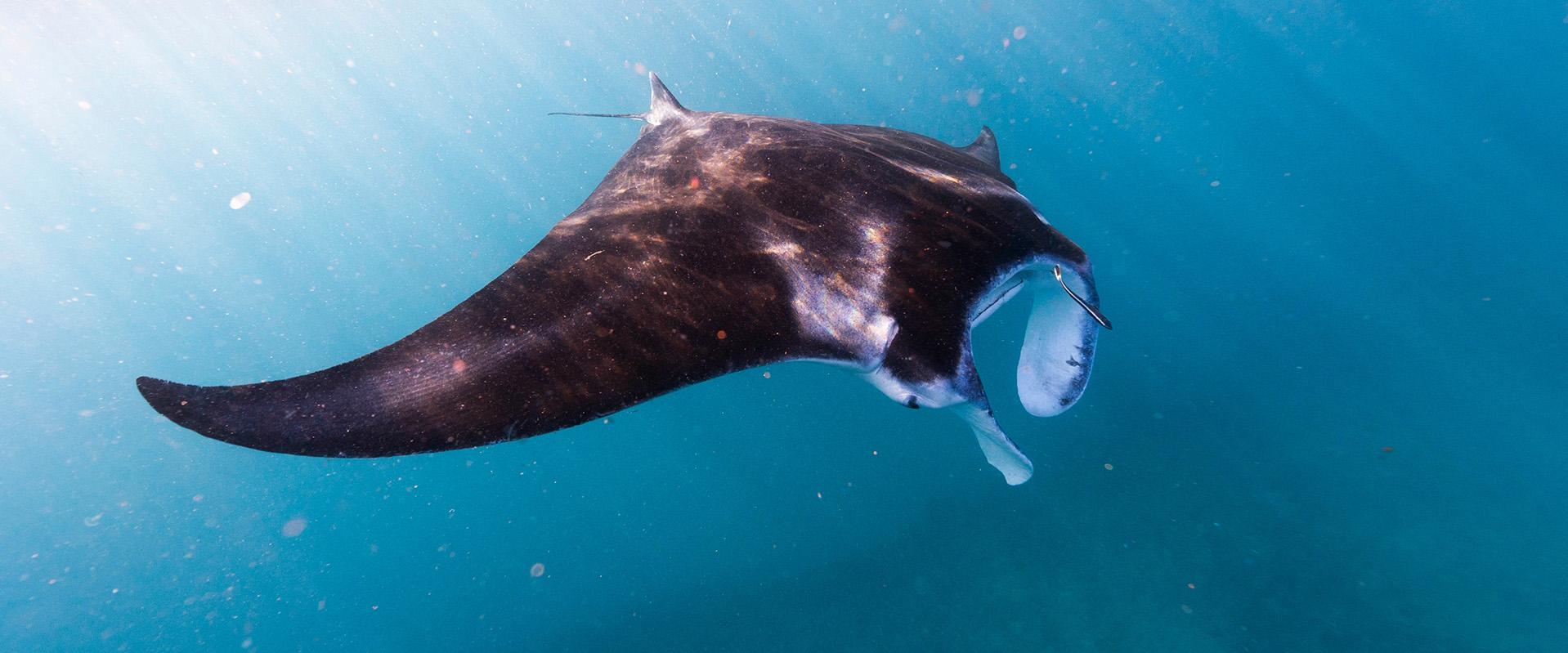
Image used under license from Shutterstock.com
Description
What happens when a fish looks you in the eye—and seems just as curious about you as you are about it? Author Sy Montgomery returns to Language of God to share stories from her journey off the coast of Ecuador to meet giant oceanic manta rays. She takes us into powerful currents, introduces the scientists working to understand and protect these gentle giants, and describes the wonder of being held in a manta’s gaze. Along the way, we explore animal intelligence, what it means for a creature to have a soul, and how paying attention to other animals can shape our faith and teach us to love the living world.
Theme song and credits music by Breakmaster Cylinder. Other music in this episode by Luciano Music Co, courtesy of Shutterstock, Inc.
- Originally aired on November 12, 2026
- WithColin Hoogerwerf
Transcript
Montgomery:
The current is tough to fight, but you find your way to these undersea rocks, and you’re clinging onto the rocks with your fingertips to avoid being swept away, so you cling there and you wait, and you might have to wait a long time. We didn’t know. And then overhead, we see this enormous dark shape, like an alien spacecraft coming in for landing, but the spacecraft is alive and has eyes that look into yours and favor you with its glance.
My name is Sy Montgomery and I’m an author of books for adults and children on nature.
Hoogerwerf:
Welcome to Language of God. I’m Colin Hoogerwerf, hosting our conversation today with Sy Montgomery.
Jim, my co-host here on Language God, and I first met Sy a couple of years ago when BioLogos had her in to speak at a creation care summit in Grand Rapids. We hit it off right away and as we were dropping her off at the airport she invited us out to New England Aquarium to meet a Giant Pacific Octopus.
Well Jim and I have a hard time turning down invitations like this, especially when they get right to the heart of interesting science questions and profound theological insights and so some time later we found ourselves sticking our hands down to the elbow into an octopus tank with Sy at the New England Aquarium. That turned into our first episode in the series we’ve called cool creatures which you can find on the feed. So when I heard Sy was coming through Grand Rapids and had a new book about Oceanic manta rays, I knew I wanted to talk again.
Being caught in the glance of a manta ray is no small task and it took lots of planning and many years for Sy make it happen, but when it finally did, it became another life changing experience in a long list of animal encounters that she has had and that continue to form her faith and her actions in the world.
Most of us won’t be able to swim with manta rays but we can through Sy’s stories we come to appreciate the magnificence of these creatures. And maybe also learn to pay a different kind of attention to the life that does surround us, to be caught in the glance of another creature and to behold life in our own glance and allow it to teach us and form us.
Let’s get to the conversation.
Interview Part One
Hoogerwerf:
Well, welcome, Sy, back to the podcast. It’s good to be with you here in Michigan.
Montgomery:
I’m so glad that we can be together again.
Hoogerwerf:
We ordered up this perfect day for you.
Montgomery:
Yes, thank you. Oh, I know you have a direct line to God.
Hoogerwerf:
[laughs] Let’s start, tell us about what you’ve been up to recently. How are the creatures and friends back home?
Montgomery:
Oh, boy. Well, Firechief, our 42-pound snapping turtle friend, is doing well. He’s moved inside from his outdoor pond, so he’s now in Matt Patterson’s basement. I have three baby Blanding’s turtles who I’m raising with a permit from the state for head starting to release. And my 11-year-old border collie Thurber keeps me busy in the woods every day for hours in the gorgeous New Hampshire fall woods.
Hoogerwerf:
Yeah, wow. Well, I want to spend most of our time today talking about oceanic giant manta rays. You just had this new book come out what?
Montgomery:
Tuesday.
Hoogerwerf:
Tuesday. Tells a story about spending some time with the scientists and these manta rays off the coast of Ecuador, studying these creatures. Before we meet the creatures, I wonder if you can just say how this came about. How did you get connected to this?
Montgomery:
Oh my gosh. Well, actually, this book took seven years to unfold. At first, we were trying to work with one researcher and year after year there was a problem with her schedule and eventually that just did not work out. But at the last minute, when our plans fell apart, we still had tickets, air tickets, which had been expensive. So we went not to Peru, but to Ecuador.
And then we discovered that in Ecuador was a newly discovered site, which harbors and attracts more of these giant oceanic manta rays than anywhere else in the world. There are 10 times the number of these beautiful, enormous, large-brained, long-lived fish here during this particular time of the year than anywhere else in the world. So it’s of global significance.
But the man who made the discovery was not there when we were there and neither were the mantas. So then we spent the next year, we were going to go down there and work with Michel Guerrero and meet the mantas, but the next year was 2020, so COVID. The following year, the photographer’s mother died, so that was no good. And the year after that, I knew I couldn’t do it because I had a book tour. So finally, seven years after we had… I mean, seven’s a magical number, isn’t it? Seven years after trying to meet these amazing creatures, we finally got to do it. And it was an epic journey.
Hoogerwerf:
Yeah. We’ll get there. How manta rays? I mean, you knew about these, but did you just kind of look through a book of animals and say, “That’s next”?
Montgomery:
Well, there’s 600 species of rays in the world and I had met rays in the Amazon and also there’s oceanic ones. These are called the oceanic manta ray, but it’s a specific species, the largest. They can get as long as a van. They can weigh two tons. They’re enormous. And I didn’t know they existed until I learned about them at New England Aquarium. And I didn’t know how critically endangered they were until I began to look into their lives.
So having learned scuba for my book, The Soul of an Octopus, I’m always looking for a reason to deploy my scuba skills. But because my husband and I don’t take vacations and he’s not a diver, I had to find a work reason. Oh, look at my job. Gosh, I’m working here. So that was how this all came about.
And this book is the final one in a very successful series that unfortunately is being retired. This is the last one, going out in a blaze of glory, the Scientists in the Field series that takes the reader on a scientific field expedition. So we take the reader underwater with us.
Hoogerwerf:
I want to talk about that before we meet the actual rays here. This series, it’s categorized as a children’s book. I’ll say I read it to my eight-year-old and he was riveted. And it’s got amazing pictures, but it’s not quite a picture book. Who do you hope reads it? Who do you hope finds it?
Montgomery:
Well, we invented this series in 1999 and my book with a photographer, Nic Bishop, a New Zealander, and another book by Ken Mallory about sharks debuted this series. And our idea was to welcome aboard reluctant readers with a book that was half photographs and half text. So the hope was that the reader would pick it up, see these cool photographs. And most books for young readers at that time in 1999 were illustrated with artwork, which is wonderful. But photographs, particularly when you’re talking about science, have a particular immediacy that invites the reader to open this up and then they want to read the print to find out what’s the story behind these things.
And our first one in that series was The Snake Scientist, and I got to work in a pit with 18,000 snakes, which was my idea of heaven. It was wonderful. Usually, you’re lucky to see one snake. We were walking around campus here hoping that we might see a snake or a salamander, but here there were more snakes at a glance than you could see in a lifetime.
My mother was horrified. She was like, “You’re writing for children at last.” This was my first children’s book I’d written for only adults. She’s like, “Okay, is it a bunnies or puppies?” And I’m like, “No, it’s 18,000 snakes.” “Oh my gosh, what are they doing?” “Copulating.” So everyone was thinking, “You’re insane. No one’s going to want to read this.” And yet the book was a huge hit, particularly with boys, who are often the more reluctant readers because of the way the human brain matures. So this has been a very successful series and I’m really proud to have contributed over a dozen titles to it and welcomed so many other terrific writers and photographers into the Scientists in the Field family.
Hoogerwerf:
Yeah, good. All right, let’s meet these manta rays. So set us up. So you’re in Ecuador, you’re on a boat in the Pacific Ocean heading to Isla de la Plata with a bunch of scuba gear bouncing around. And this is your first dive in a while?
Montgomery:
Oh, yeah, I basically… I hadn’t been diving, working for like 10 years. Yeah, and I wasn’t a very experienced diver before because again, I only dive for work.
Hoogerwerf:
So listeners will know that a few years ago you took us to the New England Aquarium to meet an octopus.
Montgomery:
Yeah, she was beautiful.
Hoogerwerf:
I remember, along with the excitement, feeling some anxiety and I didn’t have to jump into a freezing ocean with 60 pounds on my back.
Montgomery:
Oh my gosh.
Hoogerwerf:
Do you get used to this kind of thing? Were you nervous?
Montgomery:
Oh, my heart was beating out of my chest, but part of it is I hope I don’t mess this up for everybody else. I hope my mask doesn’t flood.
And the other thing was just leaving the boat. I had not done this particular maneuver. What you usually do is called the giant stride, and you just walk off a plank and jump into the ocean. But the boat wasn’t set up for that, so we had to do back flip and I had not done a back flip off a boat into the ocean. And PS, someone turned off my air by mistake. So once I got in the water, I realized, “Oh, I can’t breathe. I better do something about this.” But you know how to signal your dive partner that there’s a problem, and then they turned my air back on and things improved.
Hoogerwerf:
Okay, so walk us through that first dive that, I mean, after you’ve got—You can breathe now.Montgomery:
Montgomery:
Oh, well, first, I should tell you—for 90 minutes, the trip out there, I should show you the video, the waves are just whacking the heck out of your boat. You can’t hear anything. People are… Well, at least one of us threw up. 90 minutes of bam, bam, bam, bam, and clanging tanks. And meanwhile, you’re looking out the windows through which water is pouring and big whales are leaping out of the water. It’s like giant pickles the size of school buses are coming up. It’s surreal and you can’t stop and watch them because you’re on your way.
So you finally, after 90 minutes of jostling around, there you are. And the waves are pretty rough. The current is like a fire hose. The reason the animals are here is the Humboldt current, the swift, cold, plankton-rich current is coming up from Antarctica bringing all these treasures to Isla de la Plata. And once a year for this period of several weeks, the mantas come to this place off this tiny uninhabited island, and they appear to be coming so that they can have a manta spa, so that these cleaner fishes can remove their parasites. There’s five different species of fishes whose job it is to pick off their parasites and eat them because they’re delicious. Some of them will specialize just in the gills and some of them will specialize just… It’s like here’s the mani/pedi, and then we go to the next place and see some more and then we’ll have our facial over here.
So the objective was to go to one of these undersea spa stations, which are usually around a big rock. And these were deep dives too. The deepest we went was 110, which I’d never been to 110 before. I’ve been to 90. I mean, it doesn’t make any difference except you feel great that you’ve been to 110.
So the current is tough to fight, but you find your way to these undersea rocks and you’re clinging onto the rocks with your fingertips to avoid being swept away. And you can see the person immediately closest to you, your dive buddy, but a lot of times you can’t see any of the other divers because you’re enveloped in this living… It’s food. I mean, you’re swimming in the soup.
So you cling there and you wait and you might have to wait a long time. We didn’t know. And then overhead, we see this enormous dark shape, like an alien spacecraft coming in for a landing. But this spacecraft is alive and has eyes that look into yours and favor you with its glance. And they circle around and around it. Sometimes they just vanish back into the merc like some fading dream, but sometimes we found in subsequent dives, they’ll follow you. And even if you leave that one rock and pull yourself along the bottom to another rock, they’ll follow you.
They even follow you after they’ve been tagged. And you’d think someone wouldn’t like that when somebody gives you… It doesn’t hurt them, but sometimes they’ll flinch. But they’re curious and they’re interested in you and they know who divers are, to the point that sometimes if they’re entangled, they’ve got fishhooks in them sometimes, or they’ve got a rope stuck around them, they’ll approach a diver and ask for help. And Michel Guerrero, who was the scientist star of our book, has disentangled a number of these mantas. And after swimming away free, they’ll often come right back as if to say thank you.
Hoogerwerf:
What should we know about manta rays? Maybe just some of the basic facts. I want to hear about how big they are. Say something about how they jump. This was amazing to me.
Montgomery:
Yeah, they’ll shoot out of the water and fly through the sky. I mean, not for very far. But because they have these angel wings like all rays do, they’ll actually flap the wings and they’ll sail for yards before splashing back into the water. And this is one of the many mysteries about these animals. We don’t know why they do it. It looks to me like they do it for pure joy. And a lot of creation does do a lot of its behaviors for pure joy, we are now finding out, so that could well be it.
I think the most critical thing to understand about them is how severely endangered they are. And in some cases it is because of targeted fisheries, they’re trying to kill them, and they’re trying to kill them to take their gill rakers. In their gills are these structures that they use that have no working medicinal value, but there are myths that they will help you with your disease. So these beautiful, long-lived, intelligent, emotional animals are being murdered for something that will leave someone’s disease untreated, when there are medicines that will help that person, that will not kill an animal. So that’s one of the things we’re trying to get across.
The other thing that is killing them is incidental kill. They get entangled in things that aren’t meant to kill them, that we call this ghost fishing gear. If you lose your fisherman’s net, not only has that fisherman lost their valuable tool, but it continues to fish and kill for tens of years, maybe hundreds of years. And this is a horrible tragedy, so we need to find ways to make that stop.
But fishermen generally are scientists’ friends. They love the ocean, they depend on the ocean. And generally, we find that fishermen love to pair with the scientists and pair that knowledge so that we can conserve the ocean on which their livelihood depends.
Hoogerwerf:
You said there’s lots of rays. They’re also related to sharks. But they don’t bite and they don’t sting, right? So say something more about what—
Montgomery:
Yeah, yeah. Of the 600 species of rays, only a few are stingrays that have a poisonous spine. Only a few are the kind of ray that totally accidentally killed Steve Irwin, who was the crocodile hunter. That was a freakish accident. But these animals, the oceanic mantas, they’re gentle giants. They don’t need that spine. They don’t have that spine. They have a long tail, but there’s no venomous spine. And even though they’re related to sharks, these animals just eat plankton. They’re harmless. They’re lovely little sweeties, big sweeties.
Hoogerwerf:
I think in all your writing, you put animals in the spotlight. But also, there are always people there and people are creatures too, right? Say something about the people in this book, you tell us about who these people are and why they’re doing this work. Can you give them a little bit of spotlight here?
Montgomery:
Yeah, absolutely. I want to talk about Michel Guerrero. Growing up, he wanted to be a professional soccer player, he wanted to be a physician, he wanted to be a musician, and he wanted to be a marine biologist. So like a lot of young people, he was faced with this Chinese menu of choices and fate intervened and he became a professional scuba diver. And he heard about Isla de la Plata as a possible dive site. And it was investigating this dive site that he found this enormous globally significant aggregation of animals.
He remembers so vividly he had gone out on a fishing boat. It was no 90 minutes, it was three hours on the fishing boat to get to this remote place that hadn’t really been explored much. And they looked over the side of the boat and they saw this big black thing in the water and everyone was like, “Oh my gosh, it’s a shark.” And he’s like, “No, it’s not. This is a manta.” And he dove in when everyone else was afraid. And this manta came over to him and was overcome with curiosity and bathed him in its glance. And he said from that moment, his life changed, his heart opened, and he has made this his life work.
The other people on the team too, have come to mantas in various different ways and I tell their stories. We had two wonderful scientists from a manta organization in Costa Rica come. And the book is actually dedicated to one of Michel’s students. She was a young scuba diver who fell in love with manta rays under Michel’s guidance. And she loved them so much that she decided when she went to college, she was going to devote her life to environmental law, to protect the creatures of the sea. And she had won a prestigious position at a university in Australia to further her education, and there she was hit by a car and died.
We were there after seven years of trying to do this project, we just happened to be there while her family had come from several different countries to meet Michel, to meet the oceanic mantas and give her ashes to them. We didn’t know when we left that this was even going to happen. We went to the presentation that Michel was giving to the family before they would actually… Not all of the family was divers, before they would actually go meet the rays. We went to this presentation just to support Michel, but we didn’t know Antonella. We’d never met her, and we were kind of standing in the background. But Michel had told her family about our book and they were thrilled that we were going to tell the world about these mantas who she loved.
[musical interlude]
Interview Part Two
Hoogerwerf:
So this was first and foremost a scientific expedition and project led by Michel, right? Can you say what some of the things, what were they trying to learn or what questions were they trying to answer?
Montgomery:
The scientific expedition had several different objectives. One is to continue to photograph these animals and identify individuals, and this is how you estimate populations. How often do you see the same animal versus you’re encountering a new animal? There could be over 20,000 mantas that come to this area based on the current estimates. Each animal has an individual almost fingerprint. On their bellies, they have different patterns of spots, so that’s how you can tell who is there. They also are taking video of the animals.
You can tell if someone has just been mating. I mean, thank goodness you can’t tell that with people, but you can tell it with them. For some reason, the males always hold onto the females with their mouths on the left side. So sometimes the ladies will show evidence of having recently at a romantic encounter, and the males, who have claspers, these two cylindrical organs near the tail, you can also often tell if they’ve just had a date as well. So that, you can tell from video and photographs.
In addition, they’re taking small tissue samples and running DNA, looking for chemicals in their bodies to see what toxins they’ve been exposed to, what they’ve been eating. And there’s two kinds of transmitters that they’re putting on these animals, radio transmitters and satellite transmitters to try to find out where they go, because we don’t know. We don’t know where they go or what they do when they’re gone. How deep do they dive? We do know that they can dive as deep as the Grand Canyon is deep. Where are they going and what are they doing there? So that’s what they’re trying to find out.
And do they share a population with Peru? Do they share a population with the Galapagos? They do appear to share a population with Peru, and that is important to know because if your animals are protected in Ecuador, it doesn’t do them very much good if they’re going to leave and go to Peru where they may not have as strong protections or where the protections are not enforced. So it’s critical to know where they go.
Hoogerwerf:
One of the things I found interesting throughout this story is it kind of highlights a lot of the less glorious parts of doing science. I mean, this is not high-tech labs and a cushy yacht with lounge chairs, right? And then at one point you mentioned, I think it’s Jeffrey, one of the Costa Rican scientists is—
Montgomery:
Jeffrey Madrigal, yeah.
Hoogerwerf:
—preparing tissue samples in petri dishes at your hotel?
Montgomery:
At breakfast. Yes, everyone else is having their eggs and pancakes, and we’re cutting up smelly bits of old fish with a scalpel on a Petri dish, but that’s what you got to do.
Hoogerwerf:
And you ran into other issues that kind of highlight this everyday working of scientific research. I wonder if you felt like, were those frustrations, did they just feel like a normal part of the scientific process? Did it affect the morale of the team? How did they deal with this?
Montgomery:
Well, it’s always kind of a bummer when you get your equipment and you think it’s clean, and instead for an entire year, it’s been sitting with tissue samples rotting. That was a bummer, but you fix that problem.
One thing that was really a gut punch was on one of our early dives, they needed to retrieve the underwater receivers that were getting signals from the animals who had these radio tags. These receivers had been collecting data for a year. We were super excited to download this, and of course, we’re looking forward to seeing what it had discovered.
So there were two receivers, and the first one, “Don’t worry, we’re going to find it. The team will be back in five minutes with the receiver.” They go overboard, five minutes pass, 10 minutes pass, 15 minutes pass. They’re not coming up, so what is the matter? We had no idea.
And they finally surface and Michel throws his hands up like, “I don’t know what happened.” So did it get washed away? All that data just gone. But happily, there was another receiver to pull up in another location. So we went on to pick up that receiver, and this time the team surfaced quickly. And Michel made a cutting motion with his second and third fingers. It had been cut and stolen. And we later discovered it was being essentially held for ransom. And of course, he’s not going to pay that because that’s going to happen every time, and you don’t want to reward people for bad behavior, as every animal trainer knows. So that data was gone, and that was pretty devastating.
But you’re still going to be seeing these beautiful animals, and they’re still going to reveal themselves to you. So it’s impossible to feel down when you’re just being dazzled by glory every day.
Hoogerwerf:
And as you went on, they were able to successfully get a bunch of tissue samples and add new trackers, right? I mean, so they had to push through.
Montgomery:
And the speed with which the team worked was astonishing, and it made me really happy because you weren’t stressing the mantas at all. And it was so clear that the mantas weren’t hurt by having a tiny tissue sample taken. It didn’t hurt them. They’re super careful about where they place the tag, so it doesn’t create drag. It doesn’t increase the chance of getting entangled, doesn’t hurt in any way. They’re very careful about it can only be put here, can never be put here or here or here or here.
Hoogerwerf:
Let’s bring the mantas back here right in the spotlight. These are fish. We don’t typically think of fish as intelligent. But you talk about them in a way that gives them maybe more than we typically give a fish. What do they deserve as far as how we think about them as creatures with a soul, you say?
Montgomery:
Yeah.
Hoogerwerf:
What can we say it means for a creature to have a soul?
Montgomery:
I think they all have souls, but we don’t know how to see it. There’s so much unseen. We see through a mirror darkly. But with these fish, with their big brains, the biggest brains of any fish, and with their almost human-like eyes that focus on you and are curious about you and are interested in your face and are interested in learning about you, their souls are obvious to us. And they’re kind of a gateway fish that can help us understand that all fish have thoughts and feelings and memories.
We’re now learning that most fish make sounds. We may not be able to even hear them, but they make sounds to communicate. We used to think that fish were all silent. Nothing could be further from the truth.
And the idea that fish can’t feel pain, of course they feel pain. Your nervous system is there. It’s an adaptation. To not feel pain, someone’s eating your tail and you don’t even know. That would be stupid. So of course, evolution has given them a nervous system.
We are basically on the fish plan, as we know from books like Neil Shubin’s Your Inner Fish. And we still carry with us, our ears are fish jaws. The bones in our ears, the hammer, anvil, and stirrup, came from fish jaws. And because we are basically modified fish, this is why we get hiccups. This is why we’re prone to hernias, because evolution had to deal with the gifts that fish gave us, our fish ancestors. So I hope getting to know these oceanic mantas who look you in the face, whose cognizant gaze speaks to us in a recognizable way, I hope they introduce people to the personhood of fish.
Hoogerwerf:
At the beginning, I think it was Michel probably, promised you that this encounter would change your life, and you often talk about animals as your teachers. What did this encounter change for you? What did they teach you this time around?
Montgomery:
I had never seen a fish who looked at me in that way. I had no doubt that they had thoughts and feelings, but I could not read them. They don’t have muscles in their faces like we do, and we rely so much on our vision and what a face tells you. And their faces are very different from our faces. Their eyes are essentially in their armpits. They’re right by their funny cephalic or head fins. Most of us don’t have fins at all, but if we had them, they wouldn’t be on our heads. And yet a creature this different can look into your eyes and you get a feeling of someone is there.
The photographer, Patrick Joyce, told me, and he’s a very experienced diver, that he had never experienced a glance like this except from a whale, a fellow mammal. And we think of whales as very, and they are very wise mammals who live in the sea and with whom you can have a profound connection. But now I have had a profound life-changing experience thanks to a fish.
Hoogerwerf:
What’s next? Do you have another animal you’re working on ?
Montgomery:
Oh, boy. There’s always another animal. Yeah. Well, I’ve got a book on caterpillars coming out with Matt Patterson in the spring. I’ve got a book coming out on parrots and that little series of birds, and I’m working on an entirely new book on pigeons. Everyone knows pigeons, but people think of them as rats with wings or living bus exhaust, when in fact pigeons are doves. They’re the ones who brought the olive branch. They are the doves of peace, and here they are right at our feet among us. Again, living angels living among us. So I’m hoping to bring the wildness and wonder of these common animals to re-enchant our world.
Hoogerwerf:
Thank you so much, Sy. Thank you for introducing us to something other and helping us to know how to love it better.
Montgomery:
Oh, Colin, it’s such a pleasure to be here with you. I love that we’re all together again.
Credits
Language of God is produced by BioLogos. BioLogos is supported by individual donors and listeners like you. If you’d like to help keep this conversation going on the podcast and elsewhere you can find ways to contribute at biologos.org. You’ll find lots of other great resources on science and faith there as well.
Language of God is produced and mixed by Colin Hoogerwerf. That’s me. Our theme song is by Breakmaster Cylinder.
If you’d like to get in touch we are always happy to hear your feedback, questions, or ideas for future episodes and conversations. Email us at podcast@biologos.org.
Thanks for listening.
Featured guest
