A Journey into the Arctic National Wildlife Refuge
Jim Stump shares stories from Alaska’s Arctic National Wildlife Refuge, exploring wonder, faith, and the practice of paying attention.
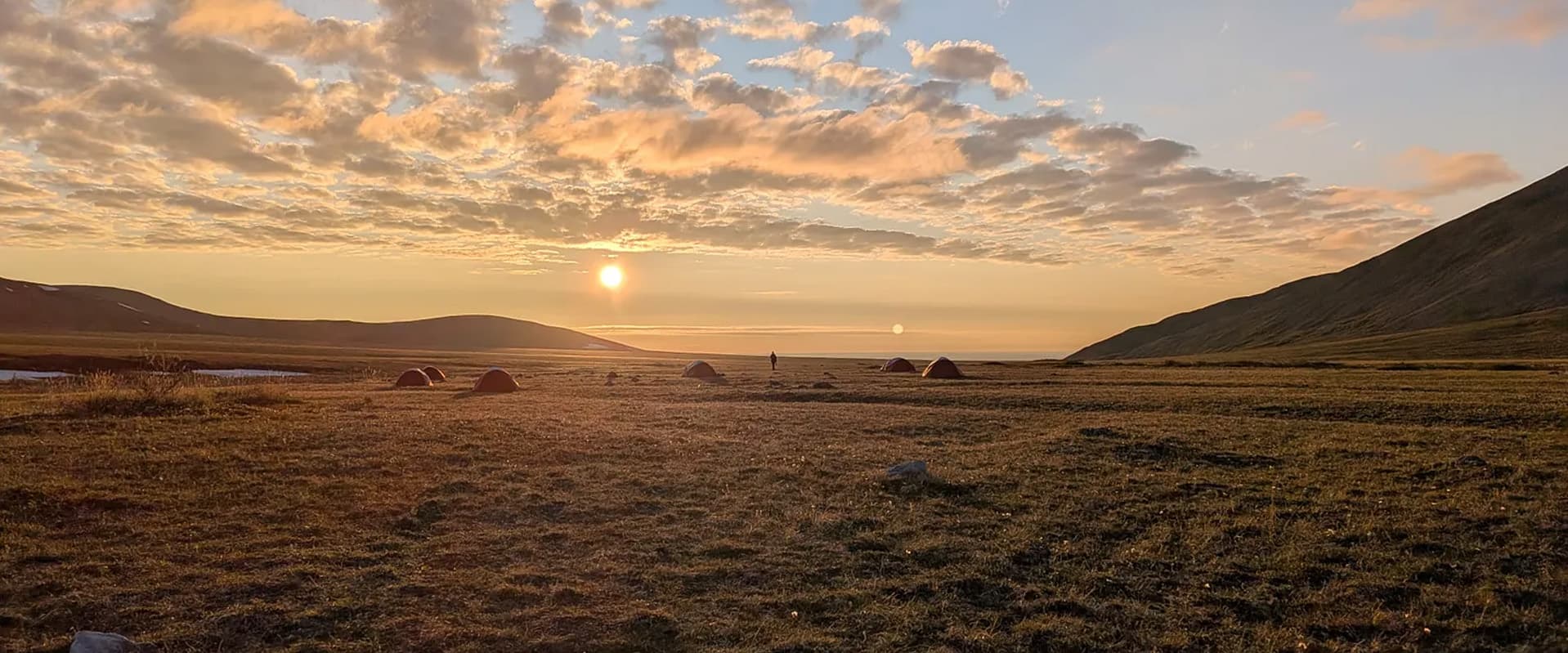
Photo by Jim Stump
Description
After spending five days camping above the Arctic Circle in Alaska’s Arctic National Wildlife Refuge, Jim Stump reflects on an experience that reshaped how he thinks about creation, wonder, and our place within it.
Guided by the wisdom of Annie Dillard and the poetry of Mary Oliver, Jim recounts the journey from simply being there, to paying close attention, to being astonished by a landscape that refuses to revolve around human convenience. Along the way, he shares stories of endless Arctic daylight, unexpected encounters with wildlife, deep conversations around camp, and the spiritual lessons found in one of the wildest places left on Earth.
This episode explores what Scripture, wilderness, and careful observation can teach us about humility, creation care, and the practice of seeing the world as gift from God rather than merely a resource.
- Originally aired on August 13, 2026
- WithJim Stump
Transcript
Stump:
Welcome to Language of God. I’m Jim Stump
I just got home from an incredible trip to the Arctic National Wildlife Refuge (or ANWR as the acronym is usually pronounced). Two women who know something about observing the natural world became my guides as I prepared for the trip and as I have since processed the experience. The first was Annie Dillard.
Before leaving, I reread her fantastic essay, “Expedition to the Pole”, thinking it to be relevant. And it was, and it led me back to her classic book Pilgrim at Tinker Creek, in which she pays extraordinarily close attention to one small corner of Virginia. In one part she tells about stumbling into a beautiful scene and marvelling at how such things are happening all time without anyone noticing. She remarked in that characteristic way of hers where it sounds offhand but is really profound: “Beauty and grace are performed whether or not we will or sense them. The least we can do is try to be there.”
The least we can do is try to be there.
Those were my marching orders for going to ANWR. There is a fair bit of “trying” involved, as it’s not the easiest place to get to. More on that shortly.
The second guide was Mary Oliver, whose poem “Instructions for Living a Life” consists of three lines: “Pay attention. Be astonished. Tell about it.”
This episode is mostly just me (I’ll bring a couple short clips from other people on the trip). I’ll tell you about my attempts to follow Dillard’s and Oliver’s instructions, through these four stages: I tried to be there. Then I paid attention. I was astonished. And now I am trying to tell you about it.
Trying to Be There
Stump:
There are parts of my job at BioLogos that can be challenging. The intersection of science and religion is a topic about which people occasionally have strong opinions, and there is a fair bit of work to managing that.
We’re also a nonprofit organization, which means we spend a good amount of time asking for money, from individuals or writing grant proposals to foundations. That’s not usually what someone says they want to do when they grow up… at least I didn’t.
But my job has also given me remarkable privileges. It has taken me places I never imagined I would go and introduced me to people I never imagined I would meet.
Sometimes an invitation arrives that is so extraordinary that you say yes before fully considering what you have agreed to. That is how I ended up camping for five days above the Arctic Circle in the Arctic National Wildlife Refuge.
Full disclosure: I was not the first choice. The invitation originally went to climate scientist and communicator extraordinaire, Katharine Hayhoe. Katharine’s schedule is booked about a year and a half in advance, because everyone wants her for their thing. BioLogos was already working with her on another project, and when she could not go on short notice to ANWR, she passed the invitation along to me.
My schedule is not booked a year and a half in advance. There are probably several reasons for that, that we don’t need to get into. And I am usually up for an adventure, so I said, “Yes, I would like to camp above the Arctic Circle for a week in June.”
The trip was organized by a non-profit educational organization that believes people relate differently to a place once they have encountered it first hand.
They bring leaders to threatened public lands, help them see what is there, introduce them to the people whose lives are bound up with those places, and then ask them to help tell the story.
They have often taken politicians on these trips, presumably on the theory that even politicians may occasionally benefit from looking up from briefing papers and seeing the actual world. This time, they wanted to take a small group of faith leaders. Perhaps people shaped by religious traditions could help tell a different story about public lands—not merely as resources waiting to be extracted, but as gifts to be received, as parts of creation to be protected, and places worthy of love.
That mission had new urgency under the current administration. Just before our trip, on June 5, the federal government held a lease sale for oil and gas development in the coastal plain of the Arctic Refuge. It was the first of four lease sales required under recent legislation.
The response from the oil industry was tepid. Five tracts received bids, totaling roughly seventy thousand acres. The sale brought in only a few million dollars, far less than earlier promises about how much revenue drilling in the Refuge would produce.
That limited interest was encouraging. Oil development in the Arctic is tremendously expensive, difficult, and risky. Many major companies have stayed away.
But the sale still did some damage. A lease opens the door to exploration, which could include seismic testing, with heavy tracked vehicles crossing delicate tundra to map the geology below. And exploration can eventually lead to roads, gravel pads, pipelines, drilling rigs, industrial camps, noise, and permanent transformation.
So the future of this place remains unsettled. So I went to see it as it is now. There is beauty and grace there, and the least I could do was try to be there. That wasn’t easy.
Our group gathered in Fairbanks and flew north in a small chartered plane. Then we transferred to an even smaller plane—a four-seater built in the 1950s and flown by a bush pilot named Dirk. I do not get to use the phrase “Dirk the bush pilot” very often in my work, so I am going to pause and enjoy the sound of it a bit. [sounds of plane flying and landing]
Dirk flew us in two groups to Sunset Pass in the Arctic Refuge, landing on the flattest strip of tundra he could find. Then, once his plane disappeared, the seven of us were in the middle of the 20 million acres of ANWR, with no other humans for miles, and no means of transportation except our feet.
There were no roads. No buildings. No phone service or internet. No electricity. No plumbing.
There was running water, if we use that phrase more literally. [sound of stream running] A clear stream fed by melting snow passed beside our camp. Some people filtered the water. I drank it straight, deciding it was probably purer than almost anything coming from a tap.
The Arctic National Wildlife Refuge is nearly twenty million acres in northeastern Alaska—about the size of South Carolina. It includes mountain ranges, coastal plain, rivers, tundra, and an astonishing web of life: caribou, bears, wolves, foxes, musk oxen, wolverines, fish, mosquitoes—many mosquitoes—and migratory birds arriving from every state and every continent.
The naturalist John Muir once walked from Kentucky to Florida and remarked about the experience, “the world, we are told, was made especially for man; a presumption not supported by all the facts.”
I would say that ANWR is Exhibit A of those facts. Nothing about the place suggested that it had been organized around me. It was not designed for my comfort, schedule, or transportation, or sleep patterns, or bathroom preferences. It was not designed at all, at least not by us.
Human beings have spent much of our history remaking the world for ourselves. We drain wetlands, straighten rivers, level ground, build roads, regulate temperatures, install lights, and arrange landscapes around human convenience.
One strand of Christian theology has sometimes justified this by appealing to the command in Genesis to fill the earth and subdue it. That can become permission to beat the world into submission so that creatures like us can live more comfortably.
But that is a very narrow reading of Scripture’s witness about our relationship to creation.
Genesis also portrays the human vocation as serving and protecting the garden. The Psalms imagine a creation filled with creatures who praise God in their own ways. Job confronts human arrogance by pointing to animals and landscapes that have no obvious usefulness to us. Again and again, Scripture places humans within creation, not above it as owners with unlimited rights.
Having now experienced ANWR, I am persuaded that serving and protecting that particular corner of creation means mostly letting it be.
Pay Attention
Stump:
But before I could reach conclusions about it, I had to pay attention.
I had gone into the Refuge intending to spend time reading and writing. I packed my iPad and keyboard, notebooks, camera, batteries, and all the equipment of a person who processes life by turning it almost immediately into sentences.
Once I arrived, writing felt wrong. Not bad. Not impossible. Just premature.
I did not want to turn the place too quickly into content. I didn’t want to arrange it into paragraphs while it was still happening. I wanted the land to be land before it became an illustration. I wanted the animals to be animals before they became symbols.
So I looked. I looked at mountains streaked with snow. I looked at rivers braiding through wide valleys. I looked at tundra that appeared from a distance to be a brown and green carpet, but became a miniature forest of flowers, mosses, lichens, grasses, pools, and insects when I knelt down close to it. I looked at the light. We were there during the summer solstice, far enough above the Arctic Circle that the sun never set during our five days in the Refuge.
One night, I decided to stay awake and witness this non-setting of the sun. Our camp sat in a long valley running north and south. The sun traveled along the mountains to the west, circled low over the end of the valley, and then began climbing along the mountains to the east. It did not rise and set. It circled.
I put my camera on a tripod and took a photograph every fifteen minutes. At two in the morning, the sun was still way above the horizon. By three-fifteen, it was clearly climbing again, without ever having gone down. If you like pictures, you can see some of mine now on my Substack account: jimstump.substack.com
The constant light felt like visual caffeine. We often did not eat supper until ten at night because the sky gave us no indication that the day should be ending. Then we would sit around camp talking until midnight or later.
I have never been a naturally gifted sleeper. Having sunshine pouring through my tent all night did not improve my performance. Yet I kept going. The Arctic light seemed to lend you more and more energy.
The week after returning home, I realized that Arctic energy was only mine on loan, and I crashed hard, paying it back with interest.
Paying attention also meant paying attention to the people beside me. There were seven us in camp:
Smink:
My name is Natalie Smink.
Stump:
Natalie organized the trip. She was the youngest member of the group and the person I trusted most to have considered the various ways things might go wrong in the Arctic wilderness.
Willcox:
I’m Courtenay Willcox
Stump:
Courtenay was a Presbyterian pastor from the Philadelphia area who had gone to seminary and entered ministry in her fifties. She carried wisdom, grace, and humor in almost ideal proportions.
Faria:
I’m Susie Faria
Stump:
Susie worked on climate and environmental policy for the Episcopal Church in Washington, D.C. She knew more about many of these issues before the age of thirty than I am likely to learn in the rest of my life.
Brown:
My name is Joan Brown. I’m a Franciscan Sister.
Stump:
Sister Joan was a seventy-three-year-old Franciscan nun, deeply at home in the wilderness and deeply at home with God. She became the mystical heart of our group.
Black:
I’m Reverend Andrew Black.
Stump:
Andrew was both a lawyer and a minister, with an impressive record of advocating for people and places pushed to the margins.
And then there was our guide, chef, protector, wilderness instructor, and general guardian angel, known to everyone as Country (I assume he has a legal name, but no one will know who you’re talking about if you use it instead of Country).
In the evenings, we told one another our life stories.
There was no formal plan. No laminated sheet titled “Three Vulnerable Questions for Building Trust Among Faith Leaders in the Arctic Wilderness.”
We simply asked one person to tell their story. Then another. Then another.
The stories usually began with facts: family, education, jobs, moves, marriages, losses. But facts opened up into deeper things, which I can’t help believing was the influence of this place on us. People spoke about what had wounded them, sustained them, called them, confused them, broken their hearts, and given them joy. The land bore witness to our stories, and being drawn into their lives, in that place, was one of the holiest parts of the experience.
Holy in the older sense: set apart, charged with significance, not completely under our control.
Sister Joan led prayers and songs. She helped us pay attention not only intellectually but spiritually—to the land, to one another, and to our own place within creation.
In a place without phones, meetings, errands, private rooms, or easy exits, there was the landscape, the weather, the people beside us, and the story being told.
That kind of attention creates intimacy quickly.
Be Astonished
Stump:
Mary Oliver’s second instruction is curious: Be astonished.
You cannot exactly order yourself to experience astonishment. You cannot wake up and say, “At 2:30 this afternoon, I will be overwhelmed by wonder.”
Astonishment is something that happens to us. So perhaps Oliver’s instruction is really a promise: if you pay attention properly, you will be astonished.
The book of Job offers a similar invitation: “Ask the beasts, and they will teach you.”
Job speaks those words while arguing with friends who think they understand the moral architecture of the universe. Good people flourish. Bad people suffer. Job is suffering; therefore Job must have done something wrong.
Job tells them to look beyond their tidy system. Ask the animals. Ask the birds. Speak to the earth. Let the fish teach you. The wider created order knows that reality is stranger and less manageable and less centered on human judgments than Job’s friends imagine.
When we arrived in ANWR, I expected to see large animals everywhere. There are no trees at sixty-nine degrees north latitude, so I assumed bears and caribou would be standing around on open hillsides for all to see, perhaps posing dramatically against the horizon for our convenience.
For several days, they were not.
We saw Arctic ground squirrels. We saw birds, including two peregrine falcon chicks perched at the edge of a nest in a cliff, looking like these tiny penguins who had made unfortunate housing choices somehow. There are amazing pictures of them.
These were wonderful. But I wanted the big mammals.
I even asked Sister Joan to put in a good word with Saint Francis and see whether he could send animals our way. She replied, “The animals are right where they need to be.”
This was spiritually mature… and not what I wanted to hear.
Country had issued each of us a can of bear spray, taught us to use it, and told us to carry it at all times. That tends to raise your expectations. If everyone has bear spray clipped to a belt, one assumes a bear will eventually enter the narrative.
I scanned every hillside when we hiked. I carried binoculars everywhere. I saw so many rocks I first mistook for bears, I thought maybe there really were no bears there and the people who had reported them previously were just mistaken. This should be called the land of the bear-shaped rocks.
By the end of the third day, we had seen no bears, no caribou, no large mammals.
That night—or whatever one calls it when it remains bright at one in the morning—I decided I would be content even if I never saw them. This moment of spiritual surrender may have been genuine. Perhaps fifty-one percent genuine; probably only 49%.
The next day, I decided to take a solo hike up one of the neighboring mountain passes. Country suggested a route that would take me about twenty-five hundred feet above our valley, where I could look across the coastal plain toward the Arctic Ocean.
The hike was difficult. Tundra is rarely level. It consists of tussocks—mounds of grass, moss, and lichen—with water and ankle-bending gaps between them. Not particularly designed for a middle-aged hiker. After about two hours, I reached a saddle between two peaks. Through my binoculars, I looked across the coastal plain toward the still-frozen Arctic Ocean. It looked empty.
I recorded a video there for BioLogos saying that although I had hoped to see large animals, I was learning to accept that Sister Joan was right. The animals were where they needed to be.
[Field audio: I keep looking for the big creatures, the caribou, the bear. I see lots of signs of them. I haven’t seen them in the flesh yet. I guess part of that is they don’t need us to see them. They do just fine. They exist up here. They glorify God in their own way.]
Then I sat down beside some big rocks to eat lunch. And I heard something.
Hearing something when you are alone in grizzly country produces a remarkably focused state of consciousness and I suddenly started to remember the bear-spray instructions, or I thought I did. How close do you let the bear get? Where do you aim? Don’t run, and don’t stare into its eyes, right? And do not yell like a frightened philosopher who has forgotten everything he was told about nature.
I slowly peeked around the rocks. Nothing. Must have been the wind.
But now I was fully alert and my eyes looked toward the hillside across the valley where something moved. Or perhaps it was another rock with shifting shadows. A tendency toward false positives was probably useful for our ancestors. It is safer to mistake a rock for a bear, than a bear for a rock. But best of all is recognizing that a bear is a bear.
I raised the binoculars. There was my bear. A grizzly wandering up the hillside beside a stream, rooting around in the tundra.
I sat and watched him for about thirty minutes through my binoculars. He’s not really my bear. Might be more accurate from his perspective to say I was his human. I was on his turf. And I was still a little nervous about it. I was alone in the wilderness with a grizzly bear. But the bear did not seem troubled by me. I am fairly certain he looked my way once and gave a slow nod of his large head, perhaps saying, “I see you, human.”
That may be me reading into the situation. But still: Thank you, bear.
Later, when I returned to the valley, Country waved me over. He had seen something moving strangely in the distance and we watched through our binoculars for several minutes. Then it emerged again, bounding and dancing kind of weird across the tundra. It was a wolverine.
Country had been guiding in that region for twenty years and had seen a wolverine only three or four times. Thank you, wolverine.
Then that night, around eleven o’clock, we were sitting at camp listening to one of our group tell her life story when Country slowly stood. “Caribou,” he said.
The rest of us responded with less composure. There we four caribou bucks running past camp on the far side of the stream. When they noticed us, they stopped. Then they crossed the stream and moved toward our camp. For about fifteen minutes, they grazed nearby, occasionally looking toward the strange bipedal creatures occupying their valley. It’s entirely plausible that we were the first humans they had ever seen. Thank you, caribou.
What did the beasts teach?
I am wary of answering too confidently here. But they taught me that they are not ours to summon. They did not appear because I wanted them to appear. They were where they were. For a brief time, our paths crossed.
They taught me something about being at home. The bear digging in the tundra, the wolverine bounding through the valley, and the caribou grazing beside our camp were not visiting. We were.
And perhaps they taught me something about limits. Animals of course take nourishment from their ecosystems. Caribou eat and bears dig, hunt, and scavenge. And wolverines do whatever fierce and mysterious things wolverines do. The natural world is not a sentimental paradise. Creatures die. Predators tear apart prey. And winter kills. Creation is beautiful, but it is not a petting zoo.
Yet ecosystems contain relationships shaped over immense stretches of time—there’s give and take, and death and renewal, and limits and feedback.
Human beings are part of nature too. But we have become a strange kind of animal within it. We can extract not only what grows back next season, but what took millions of years to form. We pull coal, oil, and gas from the earth and burn that ancient organic matter to fuel our modern lives. In the process, we release carbon far faster than the atmosphere and oceans can absorb it.
I do not say this from a position of innocence. I flew to Alaska. I wore synthetic clothing. I carried electronics and binoculars and bear spray created through a complicated extractive economy. I am not proposing a return to the Stone Age. But perhaps the beasts ask whether we know how to live within limits. Whether we know the difference between taking nourishment from our environment and consuming our home.
Tell About It
Stump:
Mary Oliver’s final instruction is: Tell about it.
That is the work I have been trying to do since I returned.
I cannot reproduce the experience for you. I can describe the sun circling the valley. I can play the sounds of the stream and the wind. I can show photographs of a grizzly that, because I took them by holding my phone against my binoculars, have roughly the evidentiary value of a smudge.
But I cannot make you experience what I experienced. I can only bear witness to what I saw.
And that raises the question: Why should anyone care about this place?
Almost none of us will ever see it.
During the trip, I asked my companions why they cared.
Courtenay said she could not not care.
Willcox:
The reason I care is not an argument that can sway anybody else. And I think that it’s because I can’t not. And I don’t know why, so I feel it must be from God to do this work. But that doesn’t convince anybody. And I have arguments and conversations with my husband who says you have to incentivise. And I don’t have—you talked about sacrifice, like feeling like you give something up. I don’t feel—I haven’t gotten to the point yet where I feel like I have sacrificed to care for creation. I mean I’ve given of my time and resources, but it hasn’t hurt me in any way. Like I haven’t felt like I’ve given something up. So I do this because I can do nothing else.
Stump:
Andrew began with John 3:16: “For God so loved the world.” The world—not only human souls, not only our own tribe, not only the parts of creation useful to us. If we do not love what God loves, Andrew asked, can we really call ourselves faithful followers of Christ?
Black:
One of the favorite sermons I ever preached was on John 3:16, the often quoted scripture of “for God so loved the World.” And I say “stop”. Stop right there. For God so Loved the world. Why don’t we? If we don’t love what God loves, can we really call ourselves faithful? If we don’t love what God loves, can we really call ourselves followers of Christ? And I think for me, that deeply drives me. That sense of, what does it mean to love God and what God Loves? And God so loves the world and the cosmos—the word that John uses in that text in the Greek is cosmos, the entire universe, all that is, all of reality God loves. And that love radiates through creation and is an eruption of God’s grace, as someone like Karl Barth would say. And I think for me, I never started out my life and my professional journey to seek or be a conservationist, but it became some of my calling and my path because creation is something I love and I’m passionate about. But it’s also something I love because I deeply sense, on a soul level, that God loves it and that’s part of being faithful.
Stump:
Sister Joan spoke about interdependence. We are created to love, she said, and everything is intertwined with everything else. Love means solidarity—with the Gwich’in people, with the caribou, and with the whole community of life.
Brown:
So if I am called to love, and that really is what being human is, and it takes a lot of discernment, choices, careful walking through each day, I need to love this place because everything is interdependent and connected to everything. Everything is intertwined with every element, everything. I mean the breath that I’m breathing as I’m sitting here in this Arctic place is breath that has touched ancestors, people, creatures, for millions, billions of years. The water that we’re drinking out of this river here, from glaciers, is water that some probably drop sometime touched Jesus. Everything is so intertwined. And so we, as humans beings, if we really want to live in hope, in this time of great challenge, of evolution, of suffering, I think it’s paramount that we come to understand ourselves more deeply as interconnected with our souls and our physical bodies with every.
Stump:
Susie said she had always loved animals and sometimes felt more comfortable with them than with people. When you love animals, she said, you want to protect the conditions that allow them to be themselves.
Faria:
I’ve always just preferred to be around animals. That has always brought me the most joy in my life. But in terms of why I care about this place, when you love animals and you want to protect what allows them to be themselves. And when we talk about advocacy, a lot of times in faith advocacy, we talk about speaking for the voiceless and that’s often referring to people whose voices have been repressed, but they still have voices, they’re still human, they still have ways to communicate. But animals just dont. And I really appreciate that. And that’s also driven me to work in a number of animal rehabilitation centers in my life. I worked with two different ones for rehabilitating sea turtles as well as one in Costa Rica with a number of different animals, many of which I had never even heard of. And I got to learn what they were and help in their journey back to rehabilitation. And I just find them so amazing, like the adaptations they’ve developed for their individual climates are so unique and so specific. And their internal clocks and their migratory patterns and there’s just so many interesting things that humans at some point in history, we all had but we’ve kind of left that behind. And so you see it in animals. And you can’t be and animal lover and not want to protect where they come from and where they thrive
Stump:
These were different answers: desire, Scripture, interdependence, solidarity, love of animals. That matters because we do not all begin from the same values. Some people do not recognize the Bible as an authority. Others care more about human welfare than animal welfare. Some prioritize climate. Others prioritize jobs, energy, or economic development.
But from almost any serious moral starting point, there are good reasons to leave ANWR wild.
If you care about animals, this is their home.If you care about climate, opening a new fossil-fuel frontier takes us in the wrong direction.
Even if you care about energy independence, ANWR is not a serious long-term solution. Even generous estimates are that there is roughly one year of current American oil consumption in ANWR, and developing the field could take a decade or more.
If you care about jobs and local communities, be cautious about exaggerated promises from politicians. Indigenous communities are not all of one mind, and their needs for employment, health care, infrastructure, and self-determination are real. But many of the most lucrative and highly skilled jobs would likely go to people brought in from elsewhere.
If you care about fiscal responsibility, ask why the public should risk an irreplaceable refuge for financial returns that have so far been tiny compared with what was promised.
Why do I care about ANWR? I came to think of this place in terms of character. Our character and what kind of character it could develop in us. What kind of people do we become when we refuse to leave anything alone? What kind of discipline might it be to collectively say “We don’t need to touch that place.”
In that sense, I have come to think of the Refuge as a kind of Sabbath in space. Sabbath typically sets aside time. For one day, we stop producing, acquiring, extracting, and behaving as though the world depends on our ceaseless activity.
A refuge sets aside space instead of time. We could build there, but we won’t. We could extract there, but we won’t. We could turn that place into money, but we won’t. Not there. Serving and protecting ANWR means letting it be. That restraint matters for what it protects. And it matters for what it makes of us.
What Can We Do?
Stump:
Well, telling about astonishment is not enough if the story ends only in admiration.
The future of the Refuge is still being decided. So what can we do? What can you do? We’ll put a bunch of links in the show notes. But let me walk through a few of these.
First, keep paying attention. We expect there to be proposals for seismic exploration in the Refuge. When opportunities for public comment open, add your voice.
Second, contact your senators and representative. Tell them you oppose oil and gas development in the Arctic Refuge and the Western Arctic.
Third, learn from and support the people already leading this work, especially Indigenous advocates such as the Gwich’in Steering Committee. ProtectTheArctic.org provides updates and concrete actions.
And help others see what is at stake. Share these stories. Talk about ANWR in your church, classroom, or community. Consider hosting a screening of the film The Arctic: Our Last Great Wilderness.
None of those actions fixes everything at once.
They are the slower work of commitment. But that is where I locate hope. Hope is not vague optimism that everything will turn out fine. Hope is a practice. Hope is what we do when we commit ourselves to the good we have seen.
Bearing witness to ANWR was a privilege. Most of you will never go there. In some ways, I hope most of you do not. The goal is not to turn it into another mass-tourism destination. The goal is to let it remain a refuge.
But I hope something of what I experienced can travel. I hope the bear keeps roaming those hills. I hope the wolverine keeps dancing through that valley. I hope the caribou keep crossing cold streams beneath the midnight sun. I hope the birds keep arriving from all continents to feast upon mosquitoes. And I hope we become the kind of people who can care about a place far away—not because it is useful to us, but because it is good.
[group singing]
Try to be there”, said Annie Dillard. Then Mary Oliver supplied the rest: Pay attention. Be astonished. Tell about it.
I went. I paid attention as best I could. I was astonished. And this has been my attempt to tell you about it.
Beauty and grace are still being performed there, whether or not we see them.
Now our task is to help make sure they remain. Thanks for listening.
Credits
Language of God is produced by BioLogos. BioLogos is supported by individual donors and listeners like you. If you’d like to help keep this conversation going on the podcast and elsewhere you can find ways to contribute at biologos.org. You’ll find lots of other great resources on science and faith there as well.
Language of God is produced and mixed by Colin Hoogerwerf. That’s me. Our theme song is by Breakmaster Cylinder. BioLogos offices are located in Grand Rapids, Michigan in the Grand River watershed. Thanks for listening.