How a South Carolina Church Put Creation Care Into Practice
Rod Scott never expected to lead on creation care. But as climate change threatened his community, God opened doors for his Greenville church to act.
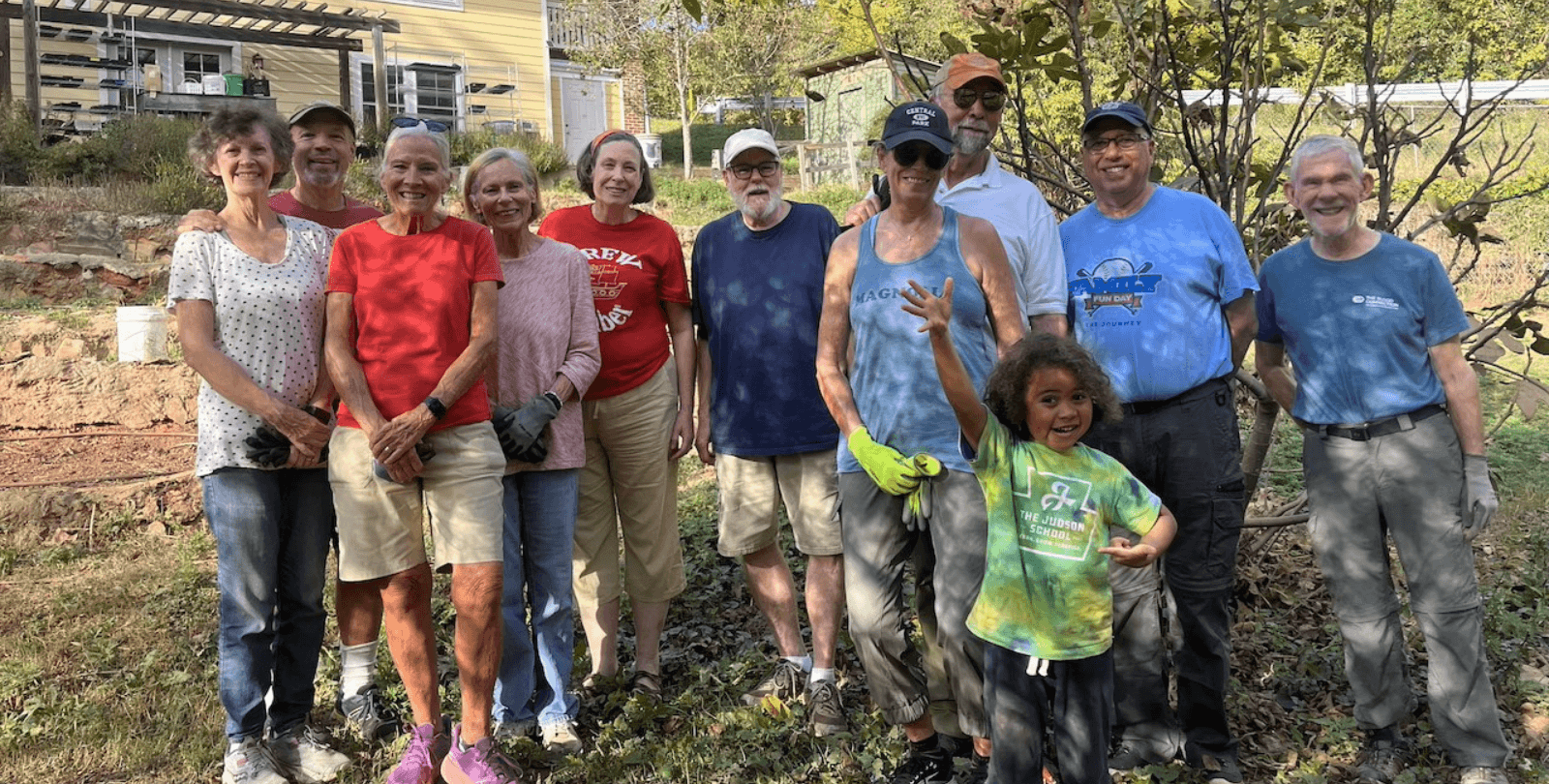
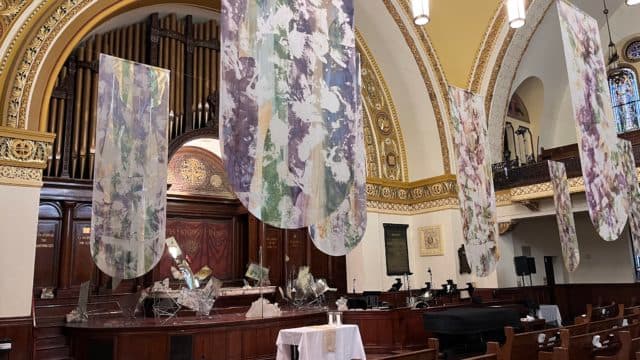
Photo provided by the author.
My heart sank when I looked out the window.
It was a Friday morning about two years ago. When I’d gone to bed the night before, all the trees on our property were standing tall. Now, three of them lay on the ground, their roots dangling in the air.
I had been expecting heavy winds and rain, but nothing prepared me for the sight of those three downed trees—the first of hundreds more I’d see all over Greenville, South Carolina, in the days to come.
It was the morning of September 27, 2024. The night before, Hurricane Helene had made landfall on the Florida coast.
Climate Crises in the Carolinas
The trials Helene caused me were memorable, but thankfully limited.
We were without power for eight days. The storm left us somewhat stranded, as we were restricted in where we could drive. In the aftermath, the three fallen trees meant hours of cleanup work.
But we were fortunate. Just 65 miles north, in the mountainous areas around Asheville, North Carolina, extreme flooding devastated communities. Hundreds of homes were destroyed. The storm so badly damaged Interstate 40, a primary highway connecting North Carolina to Tennessee, that it remained closed for five months.
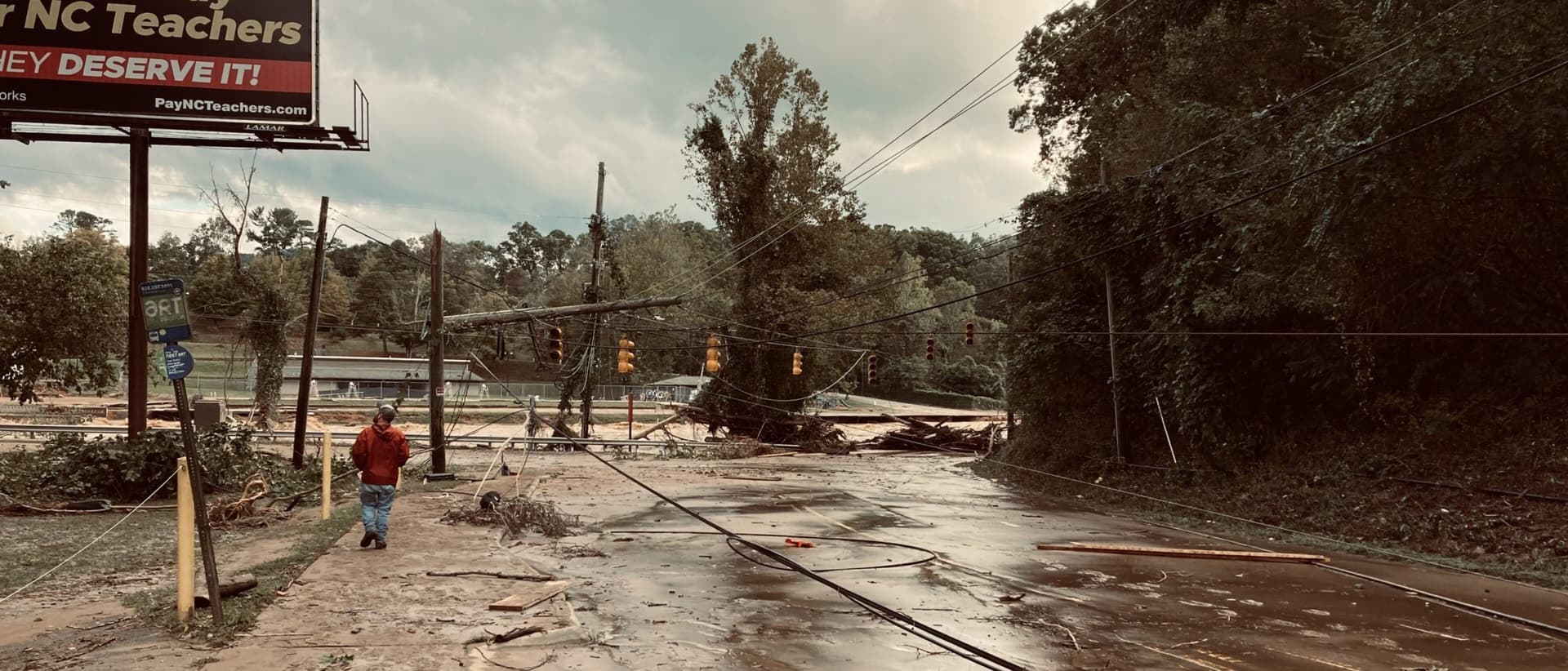
A photo from Asheville, North Carolina, where Hurricane Helene caused widespread devastation. Asheville is just 65 miles from our parish. Bill McMannis, CC BY 2.0 <https://creativecommons.org/licenses/by/2.0>, via Wikimedia Commons
It’s impossible to know how destructive Helene would have been in the absence of human-caused climate change. However, it is almost certain that this phenomenon amplified the storm’s devastating power.
And Helene isn’t the only example of weather becoming more extreme here in the Carolinas. Like most places, we’ve experienced an increase in extremely hot days in recent decades. Climate instability means that we are more prone to both heavy rains and extended dry periods than ever before.
With these lengthy droughts come fires that are more likely to spread and are harder to control. In March 2025, over 15,000 acres of forest in upstate South Carolina burned. The smoke from these fires, many of which blazed in and around three beautiful state parks, emitted a smoky haze that I could see from my neighborhood.
God is at Work: How My Church and I Became Involved in Creation Care
Before relocating to South Carolina, I taught biology at a Christian college for more than three decades. While I had always cared about the natural world, I had regarded genetics, and not creation care, as being my area of expertise. Frankly, I didn’t think it was an area where I would ever take a leading role.
That changed when God’s Spirit nudged me to think differently. I believe he did so by opening several doors that I felt compelled to walk through.
One door opened when I met the woman who coordinates adult education at my church, St. Peter’s Episcopal Church in Greenville. I told her about my background and offered to give a talk about faith and science. She said yes, and asked me if I could also give a talk about creation care. Though at first the idea filled me with a sense of inadequacy, God spoke to me through my passion for teaching. I ultimately agreed.
Becoming Communities of Creation
Becoming Communities of Creation is a one-stop guide for ministry and lay leaders looking to bring their community together in the act of caring for creation.
Around the same time, another door opened. And again, it did so because others saw something in me that I didn’t see in myself and, I think, because God was at work.
Some friends of mine oversaw the community garden at our church. They had been contacted by the Chairwoman of the diocesan committee on Environmental Stewardship and Justice, who was looking for a liaison to that committee for St. Peter’s. Because my friends were busy, they declined but suggested me for that role. I accepted.
All of this movement had me feeling excited about creation care. At the end of my creation care talk to the adult learning group, I asked if there were folks who’d be interested in founding a new ministry at St. Peter’s. That was the birth of our church’s creation care team!
Creation Care at St. Peter’s
By early 2023, the St. Peter’s creation care committee was up and running.
As I engaged with members of our community, I heard a consistent refrain. There was a hunger to care for creation, but until then, there had not been a structure to do so. I found that as God had been working in my heart, he had been working in the hearts of others.
This understanding gave our committee a purpose: to make caring for creation a practical, actionable aspect of church life. It has guided and sustained our work ever since.
With interest within the parish and the help of the diocesan committee, we’ve accomplished much in just the last three and a half years:
Practicing Sustainability
Recycling certain items, like batteries and eyeglasses, can seem complicated. We’ve made it easy for parishioners by setting up collection bins at church. We then take the collected items to a local battery vendor and a vision center for recycling.
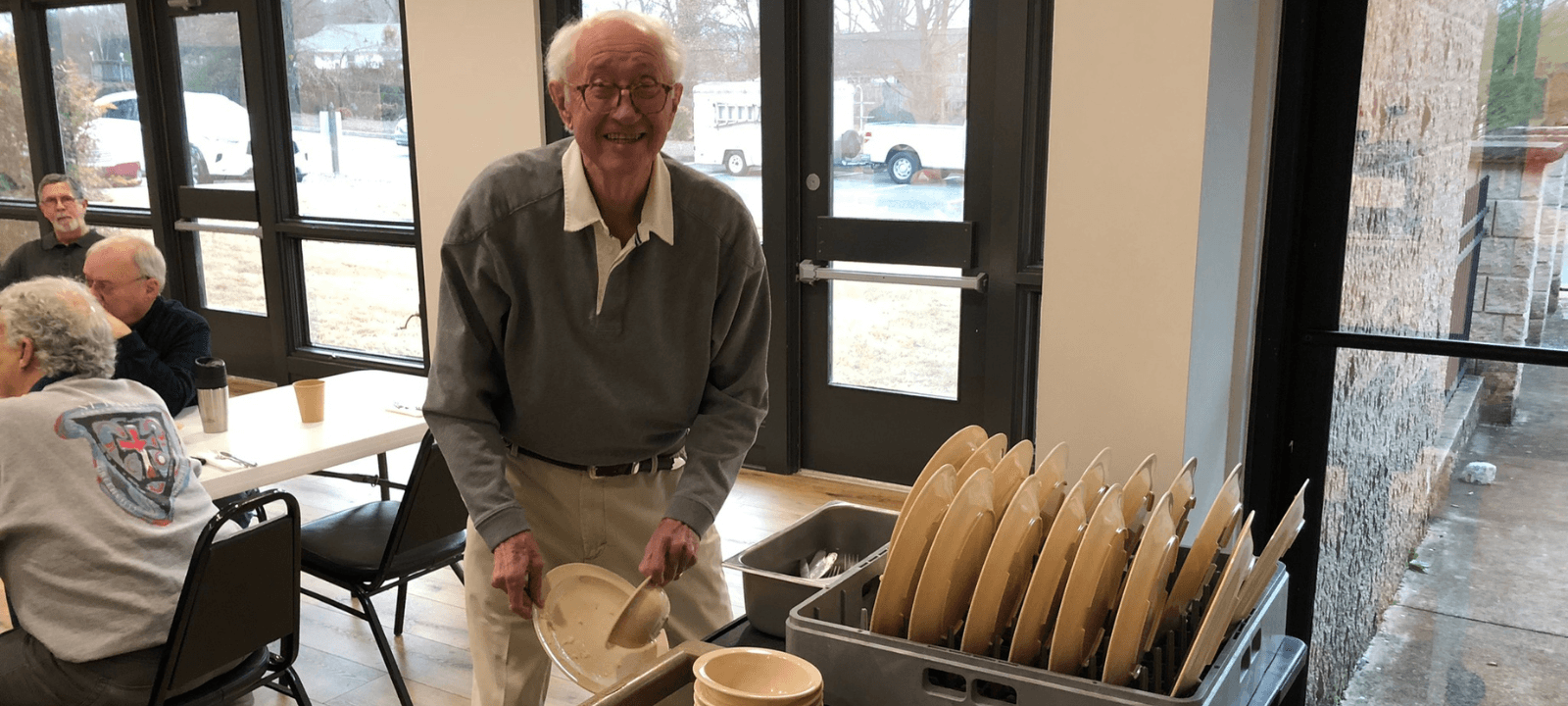
One of our sustainable practices is to use washable dishes, rather than single-use items. Here, one of our parish members wipes a washable plate clean. Photo provided by the author.
Additionally, since there is no public service for recycling glass in our area, the church now works with a company that picks up glass waste and turns it into sand.
We also strive, whenever possible, to avoid single-use cups and place settings at events that involve food. Instead, we use washable or compostable items.
Raising Awareness
To inspire more conversations about creation care, we now sponsor two annual events at St. Peter’s: Saint Francis Fest in October, and an Earth Day celebration in April.
We bring creation-focused activities to these events, such as a plant swap, a poster competition, and an upcycling competition.
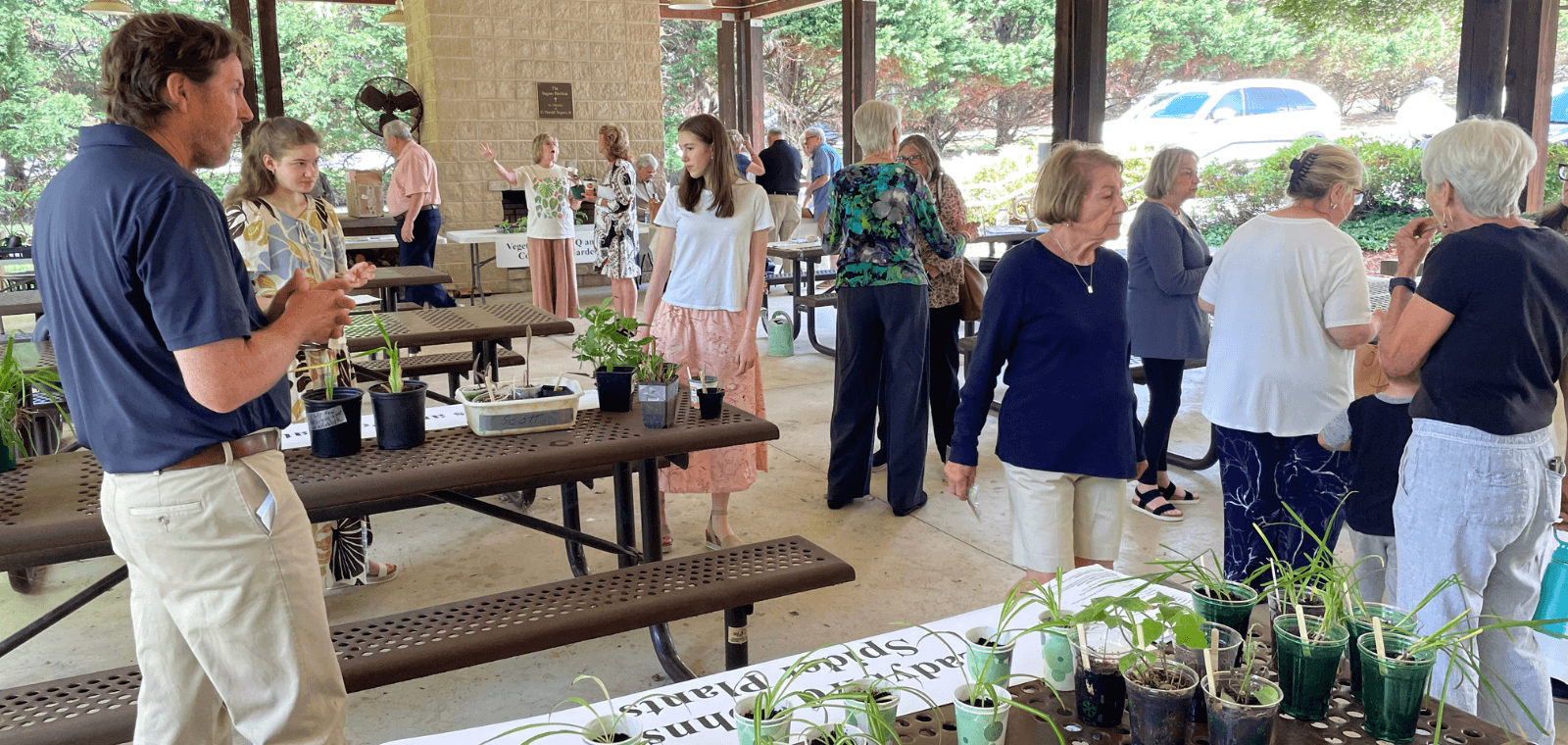
Our plant swaps have been a big hit! Photo provided by the author.
Of course, no church event is complete without food! One event included a meatless main dish competition, featuring all vegetarian recipes.
We regularly communicate with the parish through our community bulletin board, a monthly item in the church newsletter, and a dedicated page on the church website. We use these channels to share practical tips for living sustainably.
Spiritual Formation
We also strive to help our parish deepen its love of God through creation care.
Twice now, we have used excellent materials from an online small group curriculum called Love God, Love God’s World.
The Episcopal Church created this resource to help people recognize that caring for creation is one way to draw closer to God. Participants in these small groups have shared that the curriculum helped them connect to creation care issues on a spiritual level.
The Episcopal Church is also one of many denominations that actively promotes participation in what has come to be called “the Season of Creation,” which takes place between September 1 and October 4.
2026 marks the second year that St. Peter’s will modify its Sunday services during this period to more explicitly recognize the significance of God’s creation in our faith.
Creation Care Connections Beyond Our Church Walls
With so much progress being made at St. Peter’s, we felt that we could help other churches who weren’t sure how to start acting on creation care.
In early 2025, we helped lead two diocesan workshops—one in Greenville, and one in the capital city of Columbia—to encourage and equip other churches to take action. I also participate in a speakers bureau the diocesan committee formed to give presentations at other churches.

Worship with the Wild
Worship with the Wild equips lay leaders to bring their small groups into God’s world, where participants can praise the Creator and grow closer to one another.
From these efforts and others, five more churches are now working on creation care initiatives within our Episcopal diocese.
There is also additional collaborative work happening at the interfaith level in the Greenville area, with Episcopal, Baptist, and Presbyterian churches, as well as an Islamic group, currently involved.
God is at Work—Follow His Lead!
Across the Southeast and around the world, there’s a growing awareness in churches that creation care should be a vital part of our ministry. But knowing where to begin can be daunting.
My advice is this: Just start somewhere.
It might be as simple as creating a church bulletin board that features stories about creation care. It could mean having a conversation about creation care with your small group. Or perhaps you can find others and form a creation care team.
In any case, I believe that God is at work. If you follow his lead, great things will happen!
Author’s Note
If you feel inspired to bring creation care to your church, I’d love to help! If you’d like advice and/or leads on resources, feel free to contact me at rodney.scott@wheaton.edu.
About the author

Rodney Scott
Related resources
If you enjoyed this article, we recommend you check out the following resources: