The Firmament of Genesis 1 is Solid but That’s Not the Point

January 14, 2010
Category: BioLogos Features

The Firmament of Genesis 1 is Solid but That’s Not the Point

"Science and the Sacred" frequently features essays from The BioLogos Foundation's leaders and Senior Fellows. Today's entry was written by Pete Enns. Pete Enns is Senior Fellow of Biblical Studies for The BioLogos Foundation and author of several books and commentaries, including the popular Inspiration and Incarnation: Evangelicals and the Problem of the Old Testament, which looks at three questions raised by biblical scholars that seem to threaten traditional views of Scripture.

Genesis 1 and 2 tell the story of creation, and it says things that are at odds with what modern people know to be true of the world and universe around us.

One of those issue concerns the second day of creation (Genesis 1:6-8), where God made the “expanse” or the “firmament.” The Hebrew word for this is raqia (pronounced ra-KEE-ah). Biblical scholars understand the raqia to be a solid dome-like structure. It separates the water into two parts, so that there is water above the raqia and water below it (v. 7). The waters above are kept at bay so the world can become inhabitable. On the third day (vv. 9-10), the water below the raqia is “gathered to one place” to form the sea and allow the dry land to appear.

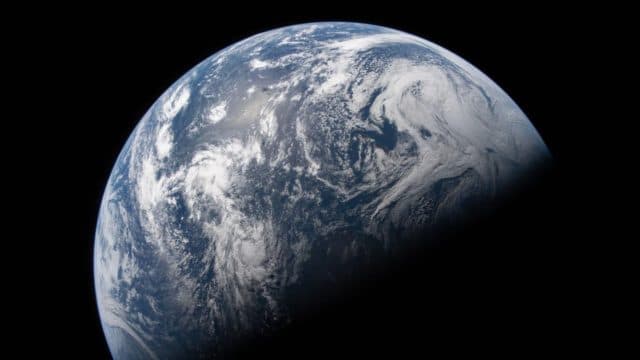
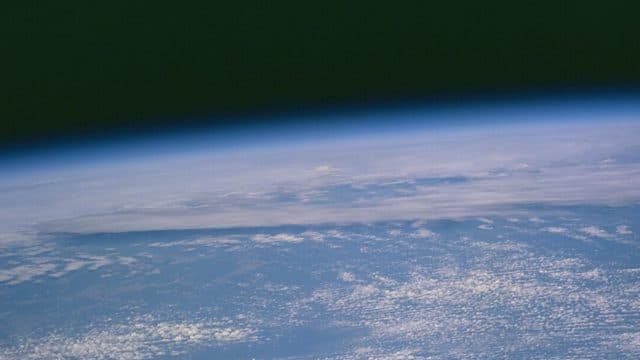
Ancient Israelites “saw” this barrier when they looked up. There were no telescopes, space exploration, or means of testing the atmosphere. They relied on what their senses told them. Even today, looking up at a clear sky in open country, the sky seems to “begin” at the horizons and reaches up far above. Ancient Israelites and others in that part of the world assumed the world was flat, and so it looked like the earth is covered by a dome, and the “blue sky” is the “water above” held back by the raqia. The translation “firmament” (i.e., firm) gets across this idea of a solid structure.

Biblical scholars agree on this understanding of raqia. For some Christians, however, this is troubling. How can the Bible, which is the inspired, revealed word of God, contain such an inaccurate piece of ancient nonsense? Hence, some invest a lot of time and energy to show that the raqia is not solid but more like the atmosphere. Often, the word “expanse” is the preferred translation because it does not necessarily imply something solid.

Arguing for a non-solid raqia in Genesis is extremely problematic, for two reasons. First, the biblical and extrabiblical data indicate that raqia means a solid structure of some sort. The second problem is a much larger theological issue, but is actually more foundational. Regardless of what one thinks of the raqia, why would anyone assume that the ancient cosmology in Genesis could be expected to be in harmony with modern science in the first place?

This second issue creates a conflict where they need not be one. The raqia “debate” is not the result of new evidence that has come to light. Our understanding of ancient perceptions of the cosmos has not been overturned by more information. The debate exists because of the assumption made by some Christians that the ancient biblical description of the world must be compatible on a scientific level with what we know today.

Genesis and modern science are neither enemies nor friends, but two different ways of describing the world according to the means available to the people living at these different times. To insist that the description of the sky in Genesis 1 must conform to contemporary scientific is a big theological problem. It is important to remember that God always speaks in ways that people can actually understand. In the ancient world, people held certain views about the world around them. Those views are also reflected in Genesis. If we keep this in mind, much of the conflict can subside.

Let me summarize some of the general arguments for why raqia is understood by contemporary biblical scholars as a solid structure1:

  1. The other cosmologies from the ancient world depict some solid structure in the sky. The most natural explanation of the raqia is that it also reflects this understanding. There is no indication that Genesis is a novel description of the sky;

  2. Virtually every description of raqia from antiquity to the Renaissance depicts it as solid. The non-solid interpretation of raqia is a novelty;

  3. According to the flood story in Gen 7:11 and 8:2, the waters above were held back only to be released through the “floodgates of the heavens” (literally, “lattice windows”);

  4. Other Old Testament passages are consistent with the raqia being solid (Ezekiel1:22; Job 37:18; Psalm 148:4);

  5. According to Gen 1:20, the birds fly in front of the raqia (in the air), not in the raqia;

  6. The noun raqia is derived form the verb that means to beat out or stamp out, as in hammering metal into thin plates (Exodus 39:3). This suggests that the noun form is likewise related to something solid;

  7. Speaking of the sky as being stretched out like a canopy/tent (Isaiah 40:22) or that it will roll up like a scroll (34:4) are clearly similes and do not support the view that raqia in Genesis 1 is non-solid.

The solid nature of the raqia is well established. It is not the result of an anti-Christian conspiracy to find errors in the Bible, but the “solid” result of scholars doing their job. This does not mean that there can be no discussion or debate. But, to introduce a novel interpretation of raqia would require new evidence or at least a reconsideration of the evidence we have that would be compelling to those who do not have a vested religious interest in maintaining one view or another.

There is another approach that attempts to reconcile Genesis and modern science. This approach distinguishes between what ancient authors described and what they actually thought. This is sometimes referred to as the “phenomenological” view. It acknowledges that the raqia in Genesis 1 is solid, but the Israelites were only describing what they saw without necessarily believing that what they perceived was in fact real?

Modern figures of speech are often called upon to support this argument. For example, when modern people say “the sun rose” we are merely describing what we perceive without any of us actually thinking that the sun rises. We know it doesn’t, but we talk as if it does. Likewise, as the argument goes, Israelites were merely describing what they saw in the sky and not what they actually thought about what was up there.

To make a distinction between what ancient texts say and what it is presumed people actually thought is hard to justify. The only reason to argue this way is because it is already concluded that the biblical description of the sky and modern scientific observations cannot be fundamentally at odds.

But this logic cannot be pressed very far, even within Genesis 1. For example, are we to say that the Israelites actually knew better than to think that the moon was a “lesser light to govern the night” (v. 16) corresponding to the light-giving sun, the “greater light to govern the day”? Did they look up and think, “Well it looks like the moon is a light-producing body that gives off less light than the sun, but something else probably accounts for its light. Let’s just call the moon a ‘lesser light’ without committing ourselves to making any pronouncement on reality.”

It is unreasonable to suggest that Genesis 1 knowingly describes only what Israelites perceived, while holding back any commitment that what they saw was in fact reality. The meaning of raqia is likewise a description not only of what the Israelites saw but also of what they actually believed to be true. They were in good company, for their understanding of what was “up there” was in harmony with what ancient peoples believed in general. God spoke to the ancient Israelites in a way they would readily understand.

The arguments for a non-solid raqia can only gain traction by swimming against the strong current of what we know of the ancient world. But the problem is not just the arguments themselves. Rather, it is the very fact that the arguments are made in the first place. Feeling the need to make the arguments at all asks Genesis to be involved in a discussion it is not designed for.

It is important to be clear on what we have a right to expect from Genesis. This is central to making progress in the conversation between science and faith. It is a false expectation of Genesis that contributes to some heated exchanges about things like the description of the cosmos in Genesis.

The debate over the nature of the raqia is not a central issue. It is a symptom of a deeper, more fundamental disagreement over what the Genesis is and what it means to read it well. This is level where the truly important discussion must take place.

1. Those interested in more details can begin by reading Paul H. Seely “The Firmament and the Water Above,” (a two-part article that appeared in the Westminster Theological Journal 53 [1991]: 227-40 and 54 [1992]: 31-46; John H. Walton, Genesis (NIVAC; Zondervan, 2001), 110-13. If you want to dive into the debate itself, a good place to start is this article on raqia by Answers in Genesis.

Filed Under:
science, religion, firmament, Genesis, interpretation, Scripture, Bible, cosmology, creation

Share |

Comments (42)
For the latest comments, subscribe to our Comment RSS feed. See a comment that violates our Commenting Guidelines? Use the "Report Inappropriate Comment" tool in the upper-right corner.


  1. Glen Davidson - #2624

    January 14th 2010

    Well if it looks like a solid dome, it must be.

    Or anyway, haven’t we heard something like that somewhere?

    Glen Davidson
    http://tinyurl.com/mxaa3p

  2. Charlie - #2625

    January 14th 2010

    I think the main problem many Christians have with the Bible conflicting with science is that if they are to interpret parts of the Bible differently at the individual level, there is no way to determine if that interpretation is correct.  It is difficult to have an organized religion with multiple, personal religions.  Also, how does one exclude God as a symbol for something like the big bang instead of being a higher being, while still seeing other aspects of the Bible as symbolic?  If the Bible is taken on personal interpretation, it is impossible for Christians to know or learn what aspects of the Bible are actually fact (I’m guessing all Christians agree that Jesus existed) from something the Biblical writers were uneducated about (raqia) from something divine (believing God is a higher being).

  3. MF - #2629

    January 14th 2010

    Dr. Enns,

    Thank you for your post. I agree with your larger point about not reading modern views back into the Bible.

    How does this approach address the rest of the primeval history (Gen 1-11)? Was there really a worldwide (or even localized but massive) flood with an Ark? Was the Tower of Babel really the genesis of the major divisions of languages? Were Adam and Eve, Cain, Abel, Seth, Lamech, and Noah historical people with accurately recorded histories? Did people live to be 700 years old?

    I can’t get away from a historical Adam because Jesus and Paul and the rest of the NT seem to obviously believe in the historical veracity of the primeval history.

  4. Janet - #2631

    January 14th 2010

    Dr. Enns,

    I have many of the same questions as MF.  I don’t have a problem with understanding that Genesis was written from the worldview of its author(s), that they really believed the “raqia” was a hard surface, that the numerical ages given are figurative, etc.  But what do we do with the geneologies?  Why trace Abraham’s ancestors back to Adam if there was no historical Adam?  At what point in the geneologies do historical people appear?

    Thank you very much for your post.

  5. p duggan - #2634

    January 14th 2010

    Dr Enns, you talk about the birds “in front of” but not the sun and moon “in” the raquia.

    So (1) embedded in the metal like a jewel? Or (2) in a volume of space (like we think today).

    And when the sun is eclipsed by the moon, what did Israel think was happening, if they thought (1)? And if they thought (2), then how was always conceived as ‘solid’?

  6. Pete Enns - #2647

    January 14th 2010

    Thanks for your comments, all.

    p duggan: You are probably aware that the points you raise come up fairly quickly in this discussion. I wish I could ask some ancient Hebrews how they hold some of things together, but what we would consider logical inconsistencies do not call into question the Israelite participation in a commonly held cosmology. Inconsistencies are not just in Gen 1, but between chaps. 1-3, in fact throughout 1-11.

    MF and Janet: These are precisely the kids of questions that need to be asked and are the reason why organizations like BioLogos exist. How do we synthesize all sorts of issues concerning Genesis 1-11 that have come to light in the modern period with traditional Christian theology? It is indeed a problem, and we are committed to working through them with others who see the need for dialogue. Other posts will periodically work address the issues you raise and others.

  7. Jonathan Gauntlett - #2651

    January 14th 2010

    MF and Janet,

    These are questions I have also asked and the only in depth treatment of these question that I have found yet was in Dr O. Lamoureux’s book “Evolutionary Creation: A Christian Approach to Evolution” (http://www.amazon.com/Evolutionary-Creation-Christian-Approach-Evolution/dp/1556355815).  Perhaps you might be interested in reading a copy?

    Regarding Babel, I have heard from Dr Graeme Finlay (although I do not know if he is the originator of the idea) the position that the story of Babel is not historical but is rather a polemic against the surrounding pagan religions such as the Babylonians.  They built Ziggurat temple complexes which may have been the inspiration for the “tower” of Babel reaching to heaven.  The story of the tower of Babel is thus regarded as a mockery or a comment on the folly of the pagan towers in attempting to contest the rightful position of the one true God.

  8. Scott Jorgenson - #2655

    January 15th 2010

    p duggan, to say that the heavenly bodies are “in” the raquia is not necessarily to say they are fixed and immobile.  “A chariot is in the field” yet free to move around in it.  “A mole is in the earth” yet free to move about within it.  I don’t think the view presented by Peter Enns here is compromised or refuted by that one datum, when so many independent lines of evidence converge in its favor.

    Dr. Enns, I’m wondering if there is any Jewish rabbinical commentary on the nature of the raqia, or physical cosmology in general?  For example in the Talmud?  Although such commentary would date considerably later than ANE times, it would be interesting to know whether it cohered with the cosmology you sketched here.

    I really appreciate your reference to Paul Seely’s papers on the raqia.  I highly recommend them; they were some of the first that really got me thinking about this.  People can read them online here: http://www.thedivinecouncil.com/seelypt1.pdf and http://www.thedivinecouncil.com/seelypt2.pdf.  (I hope those are not copyright violations and have no idea who operates that Web site.)

  9. Scott Jorgenson - #2657

    January 15th 2010

    Janet, geneologies which trace from historical people back to traditional legendary figures are not unprecedented.  To this day, the Imperial Throne in Japan is traced back to the at-least-semi mythical Emperor Jimmu and eventually his great-great-grandmother (if I’ve counted correctly), the sun-goddess Amaterasu.  From Amaterasu, through Jimmu and all the way down to the very historical, very concrete Hirohito (Emperor of Japan during World War II and into the 1980’s) and Akihito (Emperor today), there are names in the geneology each step of the way.  Nobody knows exactly where the transition from legendary to historical occurs, and it is much more likely that a curve or gradient of historicity exists.  See http://en.wikipedia.org/wiki/List_of_Japanese_monarchs for the geneology.

    The point is that at least some traditional cultures do not find such geneologies to be an absurdity; they serve their own literary and cultural purpose.  And if we say that the God of the Bible would not be involved in inspiring such a thing, since he is concerned at all times about being literally accurate in all things, we beg the very question Peter Enns is raising here and import a modern view foreign to the original context.

  10. Tim Elston - #2659

    January 15th 2010

    I noticed the raqia problem back in 2001 when I was reading through Genesis in Arabic, Syriac, and Greek translations with a couple of buddies of mine.  It seemed likely to me that the “windows of the heavens” from the Flood narrative reflected the same firmament conception.  I had already decided by then that the first creation narrative must have been written as poetry, due to its structure.  But I could not get past the problem I began to see throughout scripture with humans presuming to speak for God in statements of ignorance, often even taking the form of bigotry.  A lot of scripture started to make sense when seen as the product of the human imagination, fraught as it is with prejudice, bigotry, ignorance, murder, nationalism, denial, and delusion.  A lifetime of biblical study finally came together to solve a lot of interpretive problems.  It is human.  And so, in my view, is the attempt to salvage it as divine.

  11. Pete Enns - #2672

    January 15th 2010

    Scott, I’ll try to look into the rabbinic issue more when I am near a library in the next couple fo weeks. I know Seely made a comment in one of his raqia articles about the essentially unanimity throughout antiquity extending to the Renaissance period that readers of Genesis assumed a solid raqia. Still, how rabbinic tradition handled it is always interesting.

    Tim, I really do appreciate your comment here. The issues you list are ones that I wish would be treated more deliberately among some Christians than is normally the case. Looking at it from a bird’s eye view, the general problem I and others are trying to counter is the idea of “human vs. divine.”  Could I recommend two books to you? My Inspiration an Incarnation and Kent Sparks’s God’s Word in Human Words.

    Jonathan, yes, Denis Lamoureux’s approach is excellent. He gets the science and the hermeneutics. A rare and invaluable combination.

  12. garver - #2678

    January 15th 2010

    I seem to recall that the Bereshit Rabba sees the firmament as a solid dome and notes the differing opinions of the rabbis regarding its thickness.

    For a medieval Christian discussion, interacting with church Fathers and a variety of differing natural philosophies, Aquinas’ comments are fun: http://www.newadvent.org/summa/1068.htm Aquinas, however, along with many medieval commentators, seems non-committal on the solidity of the firmament.

  13. Jordan - #2679

    January 15th 2010

    @Pete Enns:

    DISCLAIMER: I’m a scientist, not a theologian or biblical scholar so I may totally slaughter this.

    A question I have about your incarnational model is that if we use the analogy of Christ where we traditionally hold something like “fully divine, fully human, yet without sin”, what would the “without sin” part mean with respect to the Bible?

    A second question is that while I can see your incarnational model as relieving some intellectual “stress” from Genesis 1-11 for instance, I’m not sure what we’re supposed to do with the rest. For instance, we might be perfectly happy to say that Ephesians 5:22: “Wives, submit to your own husbands, as to the Lord.” reflects the cultural world view that Paul was living in and does not apply to our current culture, but then on the flip side do we do the same three verses down when he says: “Husbands, love your wives, as Christ loved the church and gave himself up for her”? Is it only when the Bible doesn’t fit our present cultural vision that we plead “look, it was human, that’s not meant to be taken truthfully”?

  14. garver - #2680

    January 15th 2010

    I’m inclined to a phenomenological view, at least to the degree God structured the world so things really do look like a solid dome and this is a real feature of his cosmic temple. Further, pre-modern peoples were more attuned to “reading” the cosmos as symbolically imbued. We moderns are impoverished by our inability to see this way (or at the least, by our differing—perhaps destructive—symbolic economy, where money and celebrities retain god-like enchantments).

    Now, ancient people (and OT) were wrong insofar as they took “raqia” literally, just as medieval people were wrong to think “melancholy” folks suffer an excess of black bile.  Yet, in the same way our continued talk of “melancholy” picks out a real feature of human experience, so also “raqia” picks out a real feature of natural phenomena.

    I expect if you asked an Israelite, “If you had a ladder long enough, could you climb up and rap your knuckles on the firmament?” she’d say, “Of course.”  But I also expect if you said, “Where I come from we can fly there and it turns out the firmament has fuzzy boundaries and is permeable,” assuming she believed you, she’d say, “Oh, really? Well, then it’s nothing at all like what I expected.”

  15. garver - #2681

    January 15th 2010

    ...But I doubt she’d give up talking about a firmament any more than we’ve given up talking about melancholy, even though we’ve rejected the humors. They’re still a useful and powerful way of thinking and speaking, even insofar as they evoke scientifically wrong-headed images.

    Thus, the “phenomenological view,” as I see it, has less to do with what the Israelites (and other pre-modern peoples) understood themselves to be saying when they used this language, and more to do with whether or not they’d give up talking this way, even if they had the modern, scientific evidence in front of them.

    Just because our culture has fixated on scientific modes of speech over symbolically-fraught phenomenological ones doesn’t mean that’s how all cultures would (or should) respond to the sorts of evidence we have available.  Retaining this mythic and poetic language, grounded in primal experience of our world, seems to me one way the scriptures determine the grammar of faith.

  16. Charlie - #2684

    January 15th 2010

    Dr .Enns,

    If personal interpretation is needed for the Bible (taking the Bible in a non-literal sense), how is it possible for Christians to know or learn what aspects of the Bible are actually fact (Jesus’ existence) from something the Biblical writers were uneducated about (raqia) from something divine (believing God is a higher being and created the universe)?

    Note my examples in parentheses are what I am assuming Biologos thinks are valid examples.

  17. Pete Enns - #2686

    January 15th 2010

    Garver,

    I think I largely agree. I would add, though, that the symbolic value of the ancient worldview is laden with theological significance in the OT vis-a-vis the ANE in general. I’m sure you agree that the Israelite understanding of the cosmos is much more interesting that how it related to physical reality and whether it’s OK fro God to talk like that in an ancient context. The real payoff is seeing how much theological umph the Israelites get out of it (e.g., the role the raqia plays in the flood story as a creation reversal, the revisiting of the ‘cosmic battle’ motif in Exodus and numerous psalms). Don’t get me started in all that. i’ll have to create my own website do discuss it grin

  18. Pete Enns - #2687

    January 15th 2010

    Jordan,

    Good questions. The analogy means that, as Christ is without sin, the BIble is “without error” although I think the word “inerrancy” is too burdened with misconceptions and political overtones to be of any use. The rubber hits the road when you talk specifics. Do, for example, the “mythic” themes of Gen 1-11 correspond to Jesus’ humanity (olive skin, spoke Aramaic) or to what would be “sin” in Jesus life? Many assume that, since any interaction between Gen and ancient myth is “error” and so corresponds to “sin” in the analogy. I disagree strongly. I think that the ancient feel of Genesis is analogous to Jesus’ humanity: it is precisely what you would expect of origins texts in the ancient world. The incarnational analogy is just a way of trying to express that theologically. On your second point, well, that is the stuff serious biblical study is made of. Welcome to the journey.

  19. Pete Enns - #2688

    January 15th 2010

    Charlie,

    I think I understand what you are getting at, but you seem to assume that a literal reading of the Bible is the default mode. What is to be taken as literal, less literal, more literal, is a matter of making some decisions about the genre of literature you are dealing with. Sure, it is all the Bible, but within the Bible you have different types of literature at work, and “literal interpetation” does not cover them all. For example, Gen 1-11 is of a VERY different genre then are the Gospels or the NT letters. Your question is still a very good one. “Genre” does not make the questions go away, but it is a very important starting point. Arriving at deeper understanding is what all of this is about. To put it another way, you are asking a very good, 30-second question that requires a much longer, involved answer.

  20. Nancy Janisch - #2691

    January 15th 2010

    Thanks for this article. I have tried, as a modern person, to look at the sky and see the raqia. I have tried in the day and at night. I simply can’t see it. My worldview is too profoundly shaped by modern science to view the heavens as they did in ancient times. What this means for me is that I need to be thoughtful and careful when I read the Bible. I need to make an effort to understand, as best I can, the perspective of the first hearers of the text. I cannot assume they viewed the world in the same way that I do. We simply must bring our interpretive abilities (individual and communal) to the text. To ignore the differences between “then and now” is to risk profoundly misinterpreting the text. On the other hand, to dismiss the Biblical text because they were mistaken about the nature of the sky, is to miss the forest for the trees. Ancient folks used their best understanding, their best knowledge to talk about God, just as we do today.

  21. Nancy Janisch - #2694

    January 15th 2010

    One other comment concerning an earlier comment that people of the NT believed in a historical Adam and what that should mean for us. I would be surprised if Paul didn’t believe in a historical Adam. To my knowledge there was not a credible alternative in his day.  Paul and his readers had no evidence to the contrary. Sometimes we forget how recent our scientific knowledge is. 
    As to Jesus’ knowledge of the historicity of Adam, scholars debate what the historical Jesus knew vs what Jesus as preexistant second person of the Trinity knows. But regardless of that, Jesus was talking to people who only had the knowledge that was generally available in those days.  And so spoke to people in language they could understand. Personally the fact that a historical Adam is mentioned in the NT doesn’t pose a particular problem for me. The reasoning that “works” for the OT, “works” for the NT. Now, I may not be thinking complexly enough about this topic and I would appreciate others comments to improve my thinking.

  22. Jordan - #2705

    January 15th 2010

    It seems to me that there is a bigger question here. To me the argument over whether “raqia” is solid or not is a bit tangential.

    Pete makes the case that we must understand how the people writing and originally reading scripture would interpret it. I don’t think very many Evangelicals would disagree with that. I wouldn’t imagine most have an issue with the idea that the Bible has a cultural and historical context. So then what’s the issue? I think maybe it’s that most Evangelicals would say that because this is God’s Word, the Bible has meaning in addition to that which the original readers might have seen. In other words, we don’t expect that the ancient writers and readers understood modern science or culture, but God *does*, so does He also include in some sense modern meaning in the Bible. Prophecy seems to be an example of this kind of thinking. Quite often (I don’t know about always) prophecy has both an “immediate” fulfillment and a longer-term ultimate fulfillment.

  23. beaglelady - #2736

    January 15th 2010

    <blockquote>I mean, the resurrection of Jesus was also “back in the day” when people understood things differently.<./blockquote>

    No way.  They didn’t know astronomy, but they sure knew when someone was dead.

  24. beaglelady - #2737

    January 15th 2010

    Oops let me try again with correct html:

    I mean, the resurrection of Jesus was also “back in the day” when people understood things differently.

    No way.  They didn’t know beans about astronomy, but they sure knew when someone was dead.

  25. Charlie - #2770

    January 16th 2010

    Hi Dr. Enns,

    Responding to your post #2688

    I do not assume the Bible is to be read literally, actually I am a scientist that sees the bible more as a mixture of history, symbolism, and lessons.  That being said, I feel the evil in this world that comes from religion is based on personal interpretation.  Because it is impossible to break up the Bible into the categories of fact, something the Biblical writers were uneducated about, and something divine, religion diversifies and can become either good or evil.  So I think assuring an accurate interpretation of the Bible is impossible and is different from assuring a good interpretation of the Bible (supporting love and harmony with everyone, regardless of who they are).  Do you agree or do you think an accurate interpretation of the Bible could be done?  Thanks.

  26. Dan Allen - #2788

    January 16th 2010

    I appreciated this article quite a bit.  This has been an important issue for me because I have been “disfellowshipped” at my church for stating this argument in favor of a solid firmament as opposed to it being atmosphere.  This appears to have been too much for the church to handle.  I’m going to circulate this article around to the leaders at my church in the hopes that perhaps they will take another look and study this idea some more.  Thanks again for the post.

    - Dan

  27. beaglelady - #2853

    January 17th 2010

    Dan Allen,

    Of course the firmament was thought to be solid. How else could it rest on pillars and hold back enough water to drown the whole planet?  I hope you found a better church!

  28. Pete Enns - #2860

    January 17th 2010

    Charlie,

    HUGE question and an excellent one (and pardons for misunderstanding you). I can’t possibly give a complete answer to this, even in 10,000 posts, but let me say that many are recognizing that plurality in interpretation—both throughout church history and throughout the world today—is not only an obvious fact, but “the way God wanted it” (if you’ll allow to speak for God). Scripture in that sense is not so much the source of information from which we can arrive at final “accurate” answers to everything we happen to ask it, but it is a means by which we can commune with God on own own life’s journey’s. That means our own understanding of what the Bible is doing will develop, mature, and also be tied to our own contexts. I would rather say that there are interpretations of Scripture that are more or less persuasive.  Anyway, you’ve opened up a can of worms and I managed somehow to step in it (to mix metaphors).

  29. Charlie - #2960

    January 19th 2010

    Hi Dr. Enns,

    You stated “Scripture in that sense is not so much the source of information from which we can arrive at final “accurate” answers to everything we happen to ask it, but it is a means by which we can commune with God on (our) own life’s journey’s.”

    Is it my understanding then that you hold the belief that the Bible cannot provide one with accurate answers (due to the reason I stated in my previous post)?  Biologos’ mission states that faith can lead to truth about creation, something I disagree with simply due to faith being a personal belief unaffiliated with evidence.  Do you think faith can lead to truth?  What are your definitions of faith and truth?  Thanks for your responses.

  30. Knockgoats - #3016

    January 20th 2010

    Of course the firmament is solid! That’s why they had to fake the Moon landings in the Mojave desert!

  31. Martin Rizley - #3103

    January 21st 2010

    Dr. Enns,
    Two points:  First, I don’t know see how you can object to raqia being translated “expanse,” when that is the translation given in most Hebrew dictionaries.  The verb from which it is derived, raqa, means to spread out, beat out, or hammer out as one would a malleable metal.  So a raqia is any substance that has been thus “spread out.”  In itself, the word does not say anything definite about the relative permeability or impermeability of the substance that has been thus spread out.  Second, it seems that when you say the Hebrews held to the same ideas about the nature of the raqia that earlier, or contemporary, or later cultures held, that is simply an assumption.  But reality is often not nearly as tidy, or neat, or predictable as we assume—just witness the recent election in Massachussettes!  History, logic, demographics would have led the investigative scholar to predict that one would find a Democrat sitting in Teddy Kennedy’s seat at the present time; but in this case, predictions based on logic, history, and demographics would prove to be wrong!  I fail to see the logic in imputing to the prophets the same ideas as other cultures about God’s raqia.

  32. Martin Rizley - #3192

    January 22nd 2010

    Dr. Enns,
    One further point:  how do you reconcile your opening statement with 2 Peter 1:20-21?  If no prophecy of Scripture represents the prophet’s own interpretation of reality, but holy men of God spoke as they were “carried along” by the Spirit, it follows that their teaching, rightly interpreted, is inerrant, since God cannot err.  But you begin by saying, “Genesis 1 and 2. . .says things that are at odds with what modern people know to be true of the world and universe around us.”  At face value, that appears to be a flat denial of biblical inerrancy.  That’s why I object to your saying that Genesis 1 teaches that the firmament is a solid dome; for then, Genesis 1 would be in error.  But it does not say what you affirm that it says.  It says simply that God made a thin, spread out layer of something to separate the waters above from the waters below—which is a true statement, insofar as it goes, since it allow for the layer to be permeable (i. e., the atmosphere, which does indeed separate the upper and lower waters.  There is no need to write “error” over Genesis 1, as you do; nor may we write error over Genesis 1, if we accept Peter’s view of the Scriptures.

  33. James B. Jordan - #5204

    February 23rd 2010

    Pete,

    Like Joel, I’m not opposed to language of appearance, but I very much do question some aspects of the model you’re using. During the day, the sky does appear to be a dome, or curtain (Is. 40:22), but at night it has depth. The ancients all knew that the sun was farther away than the moon. They knew that the moving stars (planets to us) were at various distances. It was the fixed stars that were on a firm dome in pre-modern cosmology.

    This is imaged in the Holy Place, which is between two curtains, and is the tent-form of the firmament (associated with Day 4; the curtain with Day 2). The lampstand’s seven lamps are the seven moving stars moving from the earth up to the fixed stars: moon, Venus, Mercury, sun, Mars, Jupiter, Saturn. (continued below)

  34. James B. Jordan - #5205

    February 23rd 2010

    I do not see that the Biblical materials require a pre-modern cosmology for interpretation. We today say that “the sun rises,” not that “the horizon dropped to reveal the sun.” The question is whether there is anything in the Biblical text that is simply in error when compared with what we know about the present construction of the universe.

    I grant that raqia by itself implies a hard flat surface. But the term must be taken in Biblical context, and since the representations of it in the tabernacle include both a hard shell (the bowl of the laver), soft smoke-permeable curtains (the veils), and an actual room (the holy place), it seems to me that we must allow that information to speak into the Biblical meaning of the term.

    Back to you.

  35. Dr. Rodney Sadler - #6130

    March 8th 2010

    Thank you Dr. Enns for the article.  It was an interesting read.  I enjoy teaching on Genesis and wrestling with the notion of the raqia and the fact that the biblical cosmology is quite different from our own. That said, I think the larger point of the story is that Genesis 1 wrestles not with our questions, but with questions that were particular to the original audience.  They were concerned about the nature of the universe, the nature of God, the inter-relation between their cosmology and their customs (i.e. 7 day week and Sabbath), and the nature of humanity.  If we appreciate what their questions were, we will find that Genesis 1 answers those questions quite well, providing a wonderful contrast to other origin stories from that region of North East Africa.  Further, taken on its own terms, it can speak again to us an offer us answers not to the questions we think are primary, but questions that really stir in our soul. Understood own its own terms, this story from an ancient world can speak to us anew without bearing the weight of questions it never intended nor cared to answer. Thanks for the thought provoking article.
    God’s Grace and Peace,
    Dr. Rodney Sadler

  36. Rich - #10750

    April 22nd 2010

    Martin Rizley (#3192):

    Granted that the expanse could be something permeable, but you still have a problem.  You want the expanse to be the atmosphere.  What are “the upper waters” above earth’s atmosphere?  The atmosphere contains water, but there isn’t water above it (even if by atmosphere you mean only the troposphere)—not in any appreciable volume.  Any stray water molecules above the troposphere would not be rain water, and the Flood story makes clear that we are talking about rain water.  So you rescue the literal text from one error, but not from the other.  There are no upper waters. 

    Further, if the atmosphere is permeable, why do the windows of heaven have to be opened for the Flood to take place?  The clear suggestion of the Flood story is that normally the water can’t get through, unless the windows are opened.  This sounds like gates in a solid barrier.  That doesn’t sound like the atmosphere, does it?  So the language of the Flood story itself counts against your interpretation.  Ironically, your attempt to rescue the literal sense of the Bible goes against the literal sense of the Bible.

  37. Bryan Hodge - #11720

    April 29th 2010

    If I can just jump in a bit late to the conversation to suggest that the raqi’a in Gen 1 is neither the result of a phenomenological perspective nor an attempt of the author to communicate a scientific cosmology (not even one that existed in his day). It seems clear that the raqi’a is the ceiling of the temple, per Ezekiel and other ancient Near Eastern concepts of temple ceilings that hold back the rains (i.e., waters of chaos) as a symbol of their ordering presence within the community. The author is conveying the creation in terms of temple imagery (something suggested many times now, only recently by Walton), therefore, not his view of the universe. I don’t think we can conclude, therefore, what ancient Israelites believed about the universe from these texts alone. In fact, the ancients seem to have more of a precise science, although nothing equaling what we have today, when they calculate and measure celestial phenomena. Just thought I would throw that one in there, since it’s in a chapter I just finished writing. Good discussion.

  38. Dan Baright - #17586

    June 16th 2010

    Obviously, the history, symbols, lessons, hypotheses, theories, and even poetry and mythology of the ancient peoples as recorded in the Bible has brought great coherence over time.  But in regards to science, it occurs to me that the phenomenological approach and a literal recording of observations to the best of ones ability also has a lot going for it.  For example, if a biblical account infers that the sun rises in the east, then we know the report is of a planet Earth that is consistent with our own no matter what hypotheses, theories, or speculations there are regards such observation.  What matters is the data.  On the other hand, if some future revision of the Bible states that a temple was built during the time indicated in I Kings 7:23 and that the builders used a value of pi equal 3.1415923536 ..., then the reader of such a translation might rightly infer that the translator’s love of mathematics exceeded his love of accurate history.  And you know what has been written about “love.”  (I John 4:8)                          ——cont

  39. Dan Baright - #17587

    June 16th 2010

    It would be interesting to know what researchers even 500 years in the future might think of our current hypotheses and speculations in regards to whatever data we and they might have.  Thus the epistemology of Evolution (speciation by means of common descent) is of interest, particularly regards its lack of scientific rigor.  For example, many natural history writers have expressed the thought that Evolution is as absolutely true as heliocentricism is absolutely true.  But the real world data informs that (1) Evolution is absolutely false and (2) heliocentricism is a relative truth depending on ones place of observation within a particular inertial frame of reference.  In my view, major errors as these have occurred in theoretical biology due, at least in part, to the acceptance of a very weak definition of “fact.”  In science, a theory isn’t a “fact” even when the theory is well confirmed and assumed to be true.  Also, a more rigorous definition of “scientific fact” captures the notions of observation and observables.
                                                                                                ——cont

  40. Dan Baright - #17588

    June 16th 2010

    Further regards heliocentricism vs. geocentricism, there is some thought, and I agree, that relativity theory is now well beyond the phenomenological and actually represents reality.  Seeing is indeed believing.  Thus the Ptolemaic geocentric kinematics based on observations that the sun rises in the east, goes up and around, sets in the west, etc.—- this understanding of motion based on the precise data collected indirectly (for safety reasons) by oneself and ones fellow researchers around the world could be entirely scientific and used to make predictions, i.e., statements of FUTURE events.  One might also make some fine calendars.

    Alternatively, and even more interestingly, ones frame of reference for motion (kinematics) AND force (dynamics) could be the Earth’s moon, Mars, a space station, Earthbound train, elevator, or even the fuel guzzling school buses children otherwise waste all too much time on.  Furthermore, if technologists and experimental scientists would at long last invent a ‘videovectometer,’ such a device might be quite educationally useful. Hans Reichenbach in his ‘From Copernicus to Einstein’ (Dover; 1942, 1970) is good on this subject.                                ——-  cont

  41. Dan Baright - #17590

    June 16th 2010

    A note to Janet #2631: Gerald L. Schroeder’s book, ‘The Science of God’ might be of interest. Schroeder is an M.I.T. trained theologian who divides time into pre-Adam time based on the cosmic background radiation and post-Adam time based on our current 24-hr. day.

                                                                                      db ——-  end

  42. Christopher Svanefalk - #25218

    August 10th 2010

    I appreciate Martin Rizley’s commitment to a literal reading of Scripture. He is to me proof that one can indeed hold such a persuasion and yet be a truly intelligent thinker.

    As for the question raised in this article, it is a difficult one. Another paper on the same topic, for the interested, is “Lessons From the Heavens - On Scripture, Science, and Innerancy”, by Dr. Lamoureux:

    http://www.asa3.org/asa/PSCF/2008/PSCF3-08Lamoureux.pdf
    (this paper is more of a work against concordism)

    I echo Rizleys concern about 2 Peter 1:20-21. However, what are we really to make of this passage? To what is Peter referring? The corpus of the OT as a whole, or just the works of the prophets “proper” (i.e. Isaiah, Jeremiah, Nahum etc)? I find it plausible that Scripture, definetly, counts Moses among the prophets, and the passage may as such indeed be generally applicable.

    Remember that there are interpretations that reject the notions of a solid Raqia as discussed here and otherwise. There is an article I cannot remember, but it should be available somewhere on the CMI homepage. If you search for “Seely” there, you should find it, in the form of a reply to Seely.

    • Add Your Comment

    • Science & the Sacred welcomes both critical and supportive voices in our comments section. However, please be sure to read our Ground Rules for Commenting before posting. We reserve the right to remove any comments we deem inappropriate.

    • You have 1250 characters remaining.